Why Roofers Should Book Autumn Inspections While Fixing Spring Leaks
 by Peter Bednarek, Founder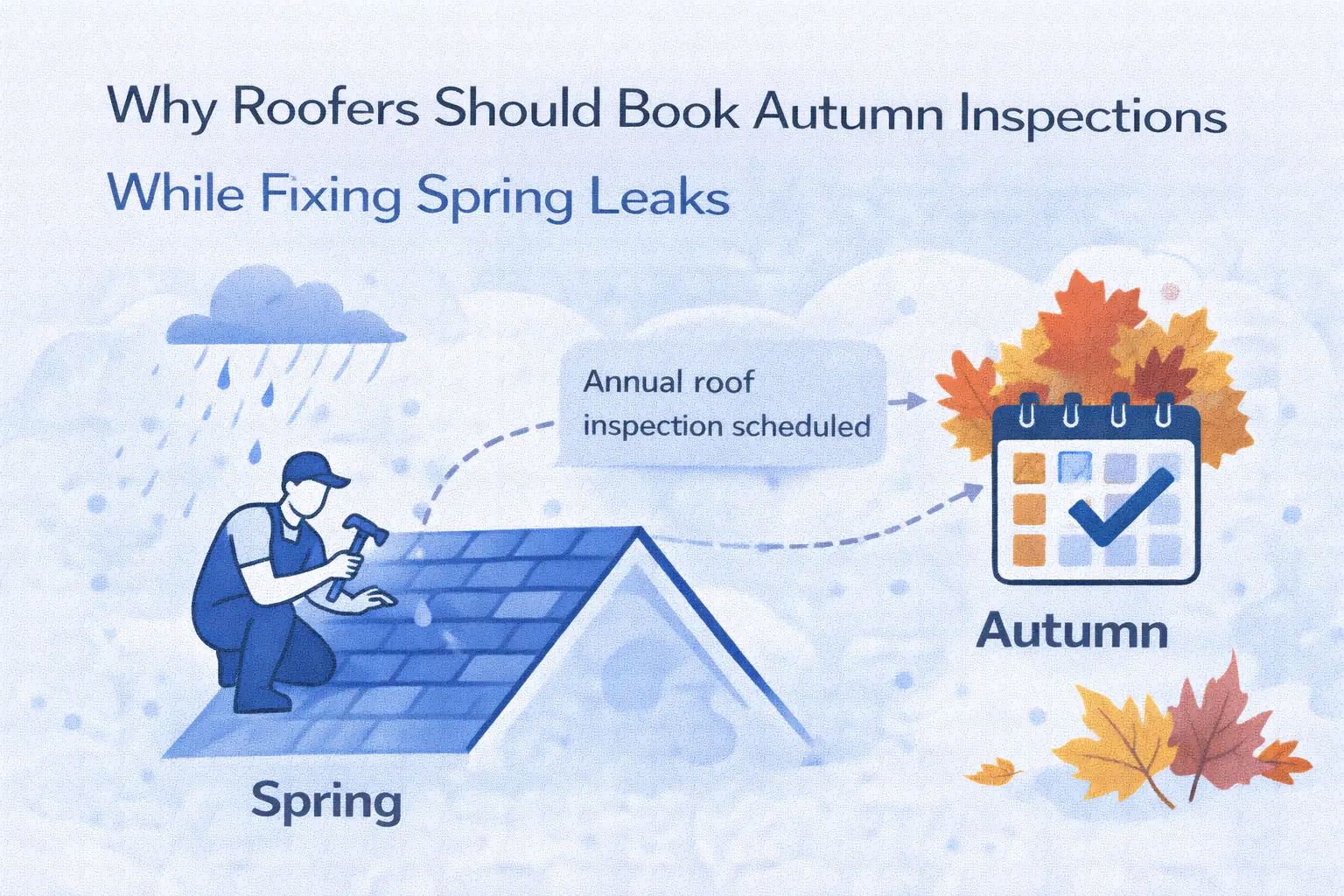
Every spring, roofers are overwhelmed with emergency calls from homeowners dealing with leaks, damp patches, and storm damage. Most of this work could have been prevented with a simple autumn inspection. Here is how automated SMS reminders can turn one-off emergency repairs into a predictable, year-round roofing business.
Right now, as you read this, roofing companies across the UK are fielding call after call from homeowners in a panic. Water dripping through the bedroom ceiling. Damp patches spreading across a newly decorated living room. Mould creeping into corners that were perfectly dry just months ago.
It happens every single spring. The pattern is so predictable it might as well be written into the calendar alongside bank holidays and the clocks going forward.
And yet, most of this damage could have been caught and fixed months earlier, before winter turned a hairline crack into a full-blown leak.
The spring rush nobody wants
British weather is famously unkind to roofs. Between October and March, the average UK home endures months of driving rain, freeze-thaw cycles that loosen tiles, high winds that lift flashing, and the occasional snowfall that adds weight to already ageing structures. By the time spring arrives, the damage has been done.
For homeowners, this means stress, disruption, and unexpected bills. A minor leak repair might cost £150 to £500, but if water has been seeping in undetected for weeks, the costs escalate quickly. Rotten timbers, soaked insulation, damaged plasterwork and mould remediation can push the total well beyond £1,000. Emergency call-out fees add another £100 to £300 on top.
For roofers, the spring rush creates a different kind of problem. The phone does not stop ringing, but the work is reactive, stressful, and hard to schedule. Customers want the job done yesterday. You are juggling urgent call-outs with existing commitments. Quoting accurately is difficult when every job is an emergency and the scope of damage is unclear until you get up on the roof. And because customers only called when something went wrong, there is no loyalty. They simply rang whoever could come soonest.
This is not a sustainable way to run a roofing business.
The customer you already have
Here is the thing that most roofers overlook: you are already standing on the roof of your next scheduled job.
Every time you repair a leak, replace tiles, re-bed ridge caps, or clear gutters after a harsh winter, you are working for a homeowner who now trusts you. They have seen your work. They know you showed up when they needed help. That trust is worth far more than any Google ad or leaflet drop.
The problem is that once the repair is done and the invoice is paid, both you and the customer move on. Six months later, when autumn arrives and their roof could benefit from a pre-winter inspection, neither of you thinks about it. The customer forgets because roofs are invisible until they fail. You forget because you have been busy with other jobs all summer.
Then winter comes. The same tiles that were fine in June start letting water through by January. And in March, another panicked phone call, maybe to you, maybe to whoever answers first.
The missed opportunity here is not just the inspection fee. It is the entire relationship. A homeowner who gets a routine inspection every autumn becomes a customer for years. They refer you to neighbours. They call you first when something goes wrong because you are already their roofer, not a name they found in a desperate late-night search.
Why the UK climate makes this essential
Other countries might get away with less frequent roof checks. The UK is not one of them.
The combination of persistent rainfall (the UK averages roughly 172 rainy days per year), coastal winds, frequent temperature swings around the freezing point, and the predominance of tiled and slated roofs creates conditions that are uniquely harsh on roofing materials. Clay and concrete tiles expand and contract with temperature changes. Mortar joints deteriorate. Lead flashing fatigues and splits. Moss and algae trap moisture against surfaces, accelerating decay.
The National Federation of Roofing Contractors recommends at least two roof inspections per year. Spring catches winter damage. Autumn prepares the roof for what is coming. For older roofs or flat roofs, quarterly checks are advisable.
This is not cautious advice. It is a practical necessity in a climate where the weather is essentially trying to get inside your house for half the year.
For roofers, this natural cycle is an enormous business opportunity. Every customer whose roof you repair in spring is a candidate for an autumn inspection. Every autumn inspection is an opportunity to catch small issues, sell preventative repairs, and lock in the relationship for another cycle.
The gap between knowing and doing
Most roofers know all of this intuitively. The value of repeat customers is obvious. The logic of preventative maintenance is clear. The problem is not knowledge. It is execution.
You finish a repair in April. You think, "I should check back on this one in September." But September comes and you are busy with other work. You have no system for tracking which customers are due. You would have to dig through old invoices, find phone numbers, and send individual messages. It is not that you do not want to follow up. It is that the effort required to do it manually, across dozens or hundreds of customers, makes it practically impossible alongside running your actual business.
This is where automated SMS reminders change the equation entirely.
Set it up once, let it run
The concept is simple. When you finish a job, you add the customer to a reminder system with their name, phone number, and the date of service. You set the reminder interval, say six months for a routine inspection, and then you get on with your life.
Six months later, the customer receives a text message. Something like:
Hi David, it has been 6 months since we repaired your roof on Elm Street. With autumn storms on the way, now is the ideal time for a quick inspection to catch any issues before winter. Book a slot at [link] or reply to this message. Cheers, Martin - Apex Roofing
You did not have to remember. You did not have to look anything up. You did not have to spend an evening going through paperwork. The message went out automatically, and David, who had completely forgotten about his roof, books an inspection because the timing feels right and the message came from someone he already trusts.
This is what Remindlo's AI-powered system is designed to do. You set up your reminder once, connect it to your customer list, and the system handles the rest. Every customer gets a personalised message at the right time, automatically, without you lifting a finger after the initial setup.
The maths of predictable customers
Let us put some rough numbers on this.
Say you complete 10 emergency roof repairs between February and May. Each of those customers pays for the immediate fix but has no reason to call you again until something else goes wrong, which might be next year, or might be never.
Now imagine you add all 10 to an automated reminder system. Six months later, they each receive a text about an autumn inspection. Even if only 3 or 4 book in, that is 3 or 4 planned jobs at a time of year when emergency work slows down. You can schedule them efficiently, one after another in the same area. No emergency pricing, just steady, predictable income.
But the real value goes further. During those inspections, you spot a cracked tile here, deteriorating flashing there, gutters that need clearing. Small jobs, easy to quote, easy to complete. The homeowner says yes because you are already there, the cost is modest, and they understand it prevents a bigger problem later.
Over two or three years, those 10 one-off emergency customers become 3 or 4 regulars who each generate two or three visits per year. Your business becomes less dependent on bad weather and more dependent on good relationships.
Crafting the right message
The reminder itself matters. A generic "your service is due" text will not have the same impact as a message that connects with what the customer actually cares about.
For roofing customers, the motivators are clear: protecting their home, avoiding expensive damage, and not having to deal with the stress of an emergency repair. Your message should tap into these without being alarmist.
If you are not sure what to write, Remindlo's SMS generator can help you draft messages that feel personal and hit the right tone. A few principles worth keeping in mind: use the customer's first name, mention the specific service (inspection, gutter clearing, tile check), reference the season or upcoming weather, and always include a clear way to book.
Here are two templates that work well:
Hi [Name], autumn is the ideal time for a roof check before winter weather sets in. We last worked on your property in [month]. Shall we book a quick inspection? Call us on [number] or book at [link]. [Your Business Name]
Hi [Name], it has been [X] months since we repaired your roof. The NFRC recommends a check every 6 months to catch small issues early. Reply YES to book your inspection. [Your Business Name]
Getting started
The beauty of this approach is that it costs almost nothing to set up and runs itself once it is in place.
Start with your next repair job. When you hand over the invoice, tell the customer you offer a follow-up inspection service. Most will appreciate it. Add them to your Remindlo account, set the reminder for six months, and move on to your next job.
Within a few months, you will have a growing list of customers who receive timely reminders and book inspections without you having to chase them. Within a year, your autumn and early spring schedules will start filling up with planned work, giving you a buffer against the unpredictable nature of emergency repairs.
The roofers who thrive are not necessarily the ones who do the best emergency work. They are the ones who turn every emergency into a long-term customer relationship. Automated reminders are how you bridge that gap.
FAQ
How often should a roof be inspected in the UK?
Industry bodies such as the National Federation of Roofing Contractors recommend at least two inspections per year, ideally in spring and autumn. Spring inspections catch damage caused by winter weather, while autumn inspections prepare the roof for the months ahead. Older roofs or flat roofs may benefit from more frequent checks.
When is the best time to schedule a roof inspection?
The best windows are April to May (spring, post-winter assessment) and September to October (autumn, pre-winter preparation). These periods offer mild working conditions and enough lead time to complete any necessary repairs before extreme weather arrives.
How much does an emergency roof repair cost in the UK?
Emergency roof repairs typically cost between £250 and £2,000 depending on severity and timing. Call-out fees alone can add £100 to £300 on top of standard repair costs. Planned repairs are significantly cheaper, with minor fixes ranging from £150 to £500 when caught early.
Can automated SMS reminders help roofing businesses?
Yes. Automated SMS reminders allow roofers to schedule follow-up inspections at the point of service and then forget about them. The system sends a text when the inspection is due, bringing customers back without any manual effort from the roofer.
What should a roof inspection reminder message include?
An effective reminder should include the customer's name, the type of service due, your business name, and a clear way to book. For example: "Hi Sarah, it has been 6 months since we last inspected your roof. Autumn storms are coming. Book your inspection now: [link] - ABC Roofing"
More seasonal trade guides: bicycle service shops and gardeners and landscapers. If you also take on garden or grounds maintenance alongside roofing work, see SMS reminders for gardeners and landscapers.