Product Replacement Reminders: How Retail Shops Turn One-Time Buyers Into Repeat Customers
Contents
- What are product replacement reminders?
- The maths: what a forgotten replacement cycle costs
- Retail categories with predictable replacement cycles
- How to set this up without a booking system
- Reminder templates that work in retail
- When to send: timing by category
- Consent and the UK rules for retail SMS
- Common mistakes
- Frequently asked questions
- From reactive to proactive retail
- Getting started
Quick answer
Product replacement reminders are short SMS messages sent when an item a customer already bought is due to be replaced - a car battery at three years, a water filter at six weeks, a flea treatment at three months. You record the purchase date and the replacement cycle once, and reminder software sends the message at the right moment so the customer comes back to you instead of buying wherever is nearest when the item finally fails.
Most retail shops do not lose customers because of bad service. They lose them because the customer forgets, and by the time the item breaks or runs out, someone else is closer.
Across the UK, people buy products that must be replaced on a predictable schedule: car batteries, water filters, vacuum consumables, pet treatments, printer cartridges. Almost nobody tracks the date. That leaves shops in a reactive model - waiting, hoping the customer will come back, usually only after something has already gone wrong.
This guide covers the practical side of flipping that: which retail categories have cycles worth tracking, how to capture the data at the till when you have no booking system, what the messages should say, when to send them, and what UK consent rules actually require.
What are product replacement reminders?
A product replacement reminder is an automated message tied to one customer and one item they already own. It is not a promotional blast to your whole list. Three things make it different from marketing texts:
It is timed to the product, not the calendar. The message goes out because that specific battery is 40 months old, not because it is the first Monday of the month.
It is useful before it is commercial. The customer is being told something they would want to know anyway, which is why response rates for reminders sit far above those for generic offers.
It repeats on its own. Once the cycle is recorded, the next reminder is already scheduled. You are not rebuilding a list every quarter.
In practice this is the same mechanism garages use for MOT dates and vets use for vaccinations, applied to physical products. Remindlo covers both patterns: periodic reminders for a fixed due date you record once, and recurring reminders for items on a repeating cycle, where the next due date rolls forward automatically after each one passes.
The maths: what a forgotten replacement cycle costs
The case for reminders is easier to see with numbers than with arguments. Take a shop selling car batteries - the figures below are an illustration, so swap in your own:
Figure | Example |
|---|---|
Batteries sold per year | 600 |
Average sale value | £95 |
Replacement cycle | 3 to 5 years |
Customers who return to you unprompted | 20% |
Customers who return after a reminder | 35% |
Extra sales per year | 90 x £95 = £8,550 |
Messages needed | About 100 a month |
A 15 percentage point swing is not aggressive - it is the difference between the customer thinking of you first and thinking of whoever is open when the car will not start. The reason the arithmetic works in retail is that the cost of a reminder is fixed and small, while the value of the sale it protects is not.
The same shape applies to consumables, only faster: a filter customer buying four cartridges a year instead of two is worth double, on a product they intended to buy anyway.
Retail categories with predictable replacement cycles
Not every product is worth tracking. The test is simple: can you predict the replacement date to within a month or two at the point of sale? If yes, it belongs in a reminder campaign. These are the categories where UK shops usually find the most sitting there unused.
1. Car batteries and automotive consumables
Car batteries typically last three to five years, but most drivers only think about them on the first cold morning the car will not start. A reminder at month 36 turns your shop into the business that prevented the problem, rather than one that happened to be open after it.
It has been 3 years since your battery was fitted. Cold weather is when they give up - pop in for a free check.
Other automotive items with reliable cycles: wiper blades, bulbs, cabin and engine filters, brake pads, engine oil. If you also fit what you sell, the reminder can carry a booking prompt, which brings workshop scheduling into the same message.
2. Tyres and seasonal changeovers
Tyres wear on mileage rather than dates, but the seasonal pattern is dependable enough to work with: a check before winter, a check before a summer holiday, and a nudge roughly three years after a full set was fitted. Shops that pair the reminder with a fitting slot convert far better than those that only say "come in sometime". Tyre shops get an extra benefit here - once a fitting is booked, an appointment reminder the day before stops the slot going to waste.
See our full guide about sending SMS Reminders for Tyre Shops.
3. Home water and air filters
The UK is full of filter jugs, air purifiers, dehumidifiers and cooker hoods, all with published replacement intervals:
Water filter cartridges: every 4 to 8 weeks
Air purifier filters: every 6 to 12 months
Cooker hood filters: every 3 to 6 months
Boiler and HVAC filters: yearly
These are the highest-frequency items on the list, which makes them the best starting point: you will see whether reminders work within two months rather than two years.
4. Smoke alarm and CO alarm batteries
A safety essential that almost nobody diarises. Most households need a battery change every 6 to 12 months, and the usual prompt is a 3am chirp. A shop that sends the reminder first is doing something genuinely useful, and the message is easy to write because the customer already agrees with it.
5. Vacuum cleaner consumables
Vacuums are household essentials that quietly degrade: HEPA filters every 6 to 12 months, belts every 6 months, dust bags continuously, roller brushes periodically. Most customers do not realise their machine is not broken - it just needs a filter. The shop that says so first keeps both the consumable sale and the customer.
6. Pet products
Pet owners want to be consistent and simply forget. Flea and worming treatments run every 1 to 3 months, food monthly, dental chews and grooming supplies on a similar rhythm.
It is time for Max's flea treatment - we have your usual in stock.
Using the pet's name is the difference between a reminder and an advert. The same logic drives vaccination reminders in veterinary practices, which is why pet retail is usually the fastest category to show results.
7. Garden machinery and seasonal supplies
Garden maintenance follows the calendar closely: lawnmower blades each season, strimmer lines, chainsaw chains, pressure washer accessories, fertilisers and soil improvers. A message in early spring lands while the customer is already thinking about the garden, and it is one of the few retail reminders where a whole segment can share a send date.
8. Printer cartridges and office supplies
Offices and home users replace cartridges, toners and paper on a usage cycle you can estimate from their last order. For trade customers this is less a reminder than a light account-management touch, and it is often what turns an occasional buyer into a standing order.
How to set this up without a booking system
This is where most retail shops stall. Garages and salons have a diary; a counter does not. But a reminder system only needs three fields, and all three can be captured at the till in about fifteen seconds.
Step 1: capture the mobile number and permission at the point of sale
You need the number and a clear yes. Say what the messages are for, not "would you like to join our mailing list":
Would you like a text when this is due for replacement? Just the reminder, nothing else.
That framing does two things: it gets a much higher opt-in rate than a generic marketing ask, and it sets an expectation you can keep. Record the answer on the sale. If you are already handing over a receipt, add the number to the same record.
Step 2: record what they bought and when it is due
You need the item and its next due date - not a full product database. "Battery, fitted 14/03/2026, due 03/2029" is enough. Most shops add these as they go, then import a backlog from a spreadsheet of past sales in one go. If your sales data already lives in a spreadsheet, you can send reminders straight from it rather than retyping anything.
Step 3: set the cycle once so it repeats itself
This is the part that decides whether the system survives contact with a busy shop. If every reminder has to be scheduled by hand, it will be abandoned within a month.
In Remindlo, you mark a contact as recurrent and give the interval - 6 weeks for a filter, 3 months for a flea treatment, 3 years for a battery. When a due date passes, the next one is calculated automatically and the following reminder is already scheduled. You do the work once per customer, not once per cycle. That is what recurring reminder software is for; one-off dates that do not repeat, like a warranty expiry, fit the periodic reminder pattern instead.
Step 4: add the touches either side of the sale
The replacement reminder is the revenue driver, but two smaller messages make it work better:
A short thank-you message a day or two after the purchase, confirming what to expect and when. It also proves the number is correct while the customer still remembers giving it.
A review request at the same moment, when the experience is fresh. Local shops live on local reviews, and the ask converts far better by text than by email.
And for the customers already sitting in an old spreadsheet who have not been back in two years, a reactivation campaign is usually the fastest first win: they know you, they bought once, and nobody has spoken to them since.
Reminder templates that work in retail
Retail reminders fail for predictable reasons: they are too long, too vague, or too obviously a marketing message. A reminder that works usually does four things - names the item, names the timing, gives one clear action, and signs off with the shop name so the customer knows who is texting.
Car battery, 3 years after fitting:
Hi John, your car battery was fitted 3 years ago in March. Cold mornings are when they fail - free check any day this week. Kirkstall Motor Factors
Water filter, 6-week cycle:
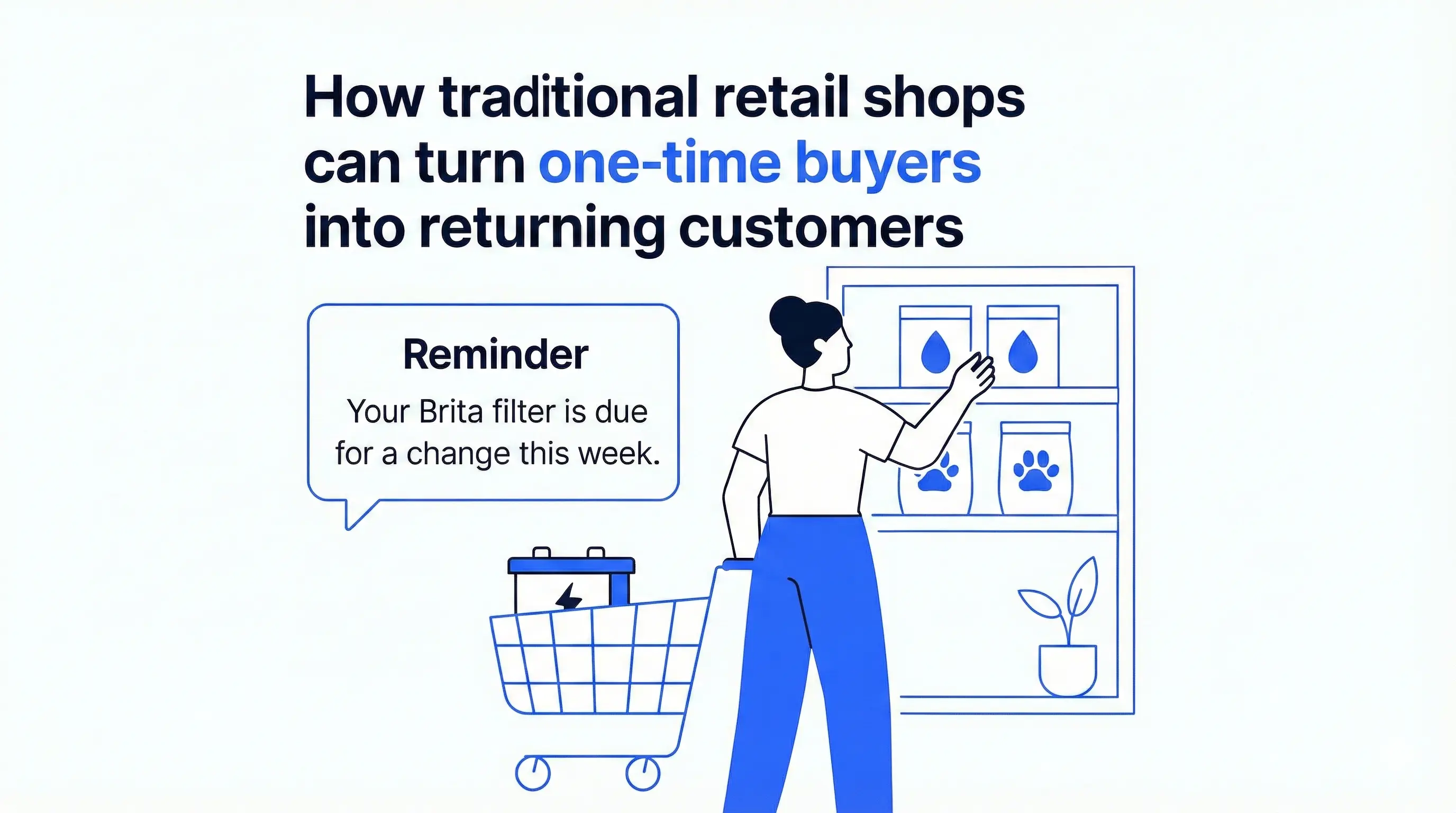
Hi Anna, your water filter is due for a change this week. We have your size in stock. Bramley Home Store
Flea treatment, 3-month cycle:
Hi Sam, Max is due his flea treatment this week. Pop in and we will have it ready. Headingley Pet Supplies
Smoke alarm batteries, annual:
Hi Claire, it has been a year since your smoke alarm batteries. Worth changing before the clocks go back. Otley Hardware
Seasonal, garden:
Hi Tom, mowing season is nearly here - a fresh blade makes a real difference. We sharpen and sell. Wharfedale Garden Machinery
Two practical notes. Keep an eye on length: a plain-text message runs to 160 characters before it is charged as two, and a single emoji or curly quote drops that limit to 70. And write the message as if the customer has forgotten who you are, because after three years they probably have. If you want a starting point for your own products, the free SMS template generator will draft variants you can edit.
When to send: timing by category
Send too early and the customer files it away and forgets. Send too late and they have already bought elsewhere. As a rule, send when the customer could act this week but is not yet under pressure.
Product | Cycle | Send the reminder |
|---|---|---|
Car battery | 3 to 5 years | At 3 years, ideally in October or November |
Water filter | 4 to 8 weeks | 2 to 3 days before due |
Flea or worming treatment | 1 to 3 months | 2 days before due |
Vacuum filter | 6 to 12 months | 1 to 2 weeks before due |
Smoke alarm battery | 6 to 12 months | On the anniversary, tied to the clock change |
Lawnmower blade | Seasonal | Early spring, before the first cut |
Printer cartridge | Usage-based | At 80% of the customer's typical interval |
Two more timing rules that matter as much as the schedule:
Respect the hours. Nothing before 8am or after 9pm. Remindlo holds messages inside quiet hours automatically, but if you are sending by hand, watch the clock.
One reminder, not three. For a consumable, a single well-timed message is enough. Chasing a customer who did not respond is how a useful reminder turns into spam, and it is the fastest route to an opt-out.
Consent and the UK rules for retail SMS
Texting customers about products is regulated in the UK by PECR alongside UK GDPR, and retail sits in a slightly more forgiving position than cold marketing. The practical version:
Soft opt-in applies to your own customers. If someone bought from you, you gave them a chance to opt out when you collected the number, and you are messaging about similar products, you can contact them without separate written consent. A reminder that the filter they bought needs replacing is the textbook case.
Ask properly anyway. Explicit consent at the till is stronger, easier to evidence, and produces a cleaner list. Note when and how you asked.
Every message needs a way out. This is where retail lists most often go wrong. Give a route that genuinely works - the shop's phone number in the message, an email address, or a word at the counter - and act on opt-outs the same day.
Do not assume "reply STOP" works. UK messages sent from a business name rather than a phone number are one-way: the reply has nowhere to go. If your reminders carry a sender name, tell customers how to actually reach you. Remindlo's messaging policy spells out both cases.
Keep the reminder a reminder. The further a message drifts from the product the customer already owns, the closer it gets to marketing that needs full consent.
For the detail, including what to record and how long to keep it, see SMS compliance and UK GDPR.
Common mistakes
Starting with everything. Pick one product category with a short cycle, run it for two months, then expand. Filters and pet treatments beat batteries as a first test purely because you learn faster.
Sending to the whole list at once. A blast on the first of the month is a promotion, not a reminder, and it will be read as one.
Leaving out the shop name. An unsigned text from an unknown number three years after a purchase reads as a scam.
Not recording the date at the till. The whole system depends on this one habit, so make it part of the sale, not an admin task for later.
Ignoring the customers who never came back. Old buyers are the cheapest audience you will ever have; start there rather than with new ones.
Frequently asked questions
Do replacement reminders work without a booking system?
Yes. Reminders need a name, a mobile number and a due date - not a diary. Most retail shops capture those three at the till and add them to a contact list, either directly or by importing a spreadsheet of past sales.
How do I know when a customer's product needs replacing?
Use the manufacturer's stated interval and the purchase date. Filters, treatments and consumables publish clear cycles; for batteries and tyres, use the low end of the range so the reminder lands before the failure rather than after it.
Is it legal to text customers about a replacement in the UK?
Generally yes, under the PECR soft opt-in, provided the person bought from you, was offered a way to opt out when you took the number, and the message relates to a similar product. Every message must still carry a working opt-out route.
How many reminders should I send per customer per year?
As many as the product genuinely needs and no more. A filter customer might get six a year and be grateful; a battery customer gets one every three years. Adding messages that are not tied to a real replacement date is what drives opt-outs.
What if the customer already replaced the item somewhere else?
Then the reminder cost you a few pence and told you something useful. Keep the tone light so a mistimed message is easy to ignore, and update the due date when a customer tells you they bought elsewhere.
How much does this cost to run?
Far less than the sales it protects. A shop tracking a few hundred customers usually sends between 50 and 150 messages a month. Remindlo's free plan includes 10 SMS a month, which is enough to test the flow on real customers before paying for anything.
Can I run this from a spreadsheet?
You can start there, and many shops do. It stops scaling when you have to work out by hand who is due each week - that is the point at which setting the cycle once and letting it repeat pays for itself.
From reactive to proactive retail
Traditional retail waits for the customer to start the next purchase. Customers usually come back only when something breaks, runs out, becomes unusable, or they finally remember - and in each of those moments, convenience beats loyalty.
Replacement reminders move the moment earlier, to a point where the customer is not under pressure and you are the one who raised it. The shop stops chasing and starts being the business that remembered. The revenue follows, because a customer who is reminded on time rarely has a reason to go elsewhere.
Retail is not alone in this. The same pattern runs through every business with a natural service interval, from trades turning one-off jobs into annual bookings to garages tracking MOT dates, and online shops working from order history. The product life cycle behind predictable revenue is the same one; retail simply has more of them.
Getting started
Pick your shortest cycle. Capture numbers at the till for a fortnight. Send the first batch of reminders and count what comes back.
👉 Start free with Remindlo - 10 SMS a month, no card needed
👉 Draft your first message with the SMS generator
👉 See how other businesses use reminders to build repeat custom