How Often Should a Boiler Be Serviced? UK Guide (2026)
Contents
- Why every 12 months?
- Is it a legal requirement?
- What happens during a boiler service?
- What does it cost in 2026?
- What happens if you skip a year (or several)?
- When is the best time of year to book?
- New boilers vs old boilers: does servicing frequency change?
- Combi vs system vs regular: does the boiler type matter?
- How to find a Gas Safe engineer
- How to remember your annual service
- Frequently asked questions
- The bottom line
Quick answer
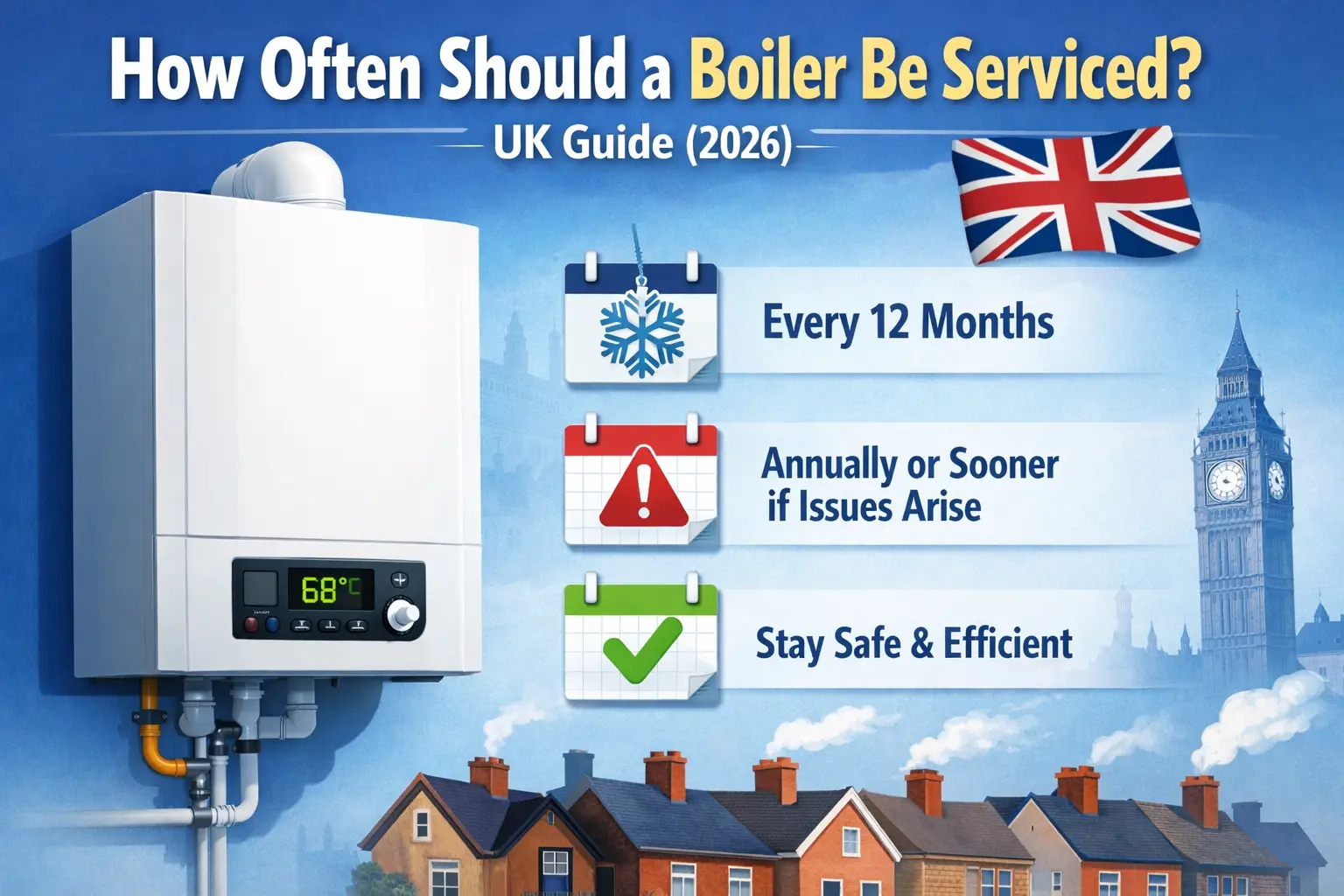
The short answer is every 12 months. Every gas and oil boiler in the UK should be serviced once a year by a Gas Safe registered engineer, regardless of its age, brand, or whether it seems to be working fine.
That's the industry recommendation, backed by every major manufacturer, every home insurance provider, and the Gas Safe Register itself. But knowing you should service your boiler annually and understanding why it matters, what actually happens during a service, and what the consequences are of skipping it, are different things.
This guide covers everything a UK homeowner needs to know about boiler servicing frequency in 2026, including the costs, the legal requirements, the warranty implications, and what to do if you've missed a service or two.
Why every 12 months?
A boiler burns gas to heat water. Over the course of a year, the components that manage this process - the burner, the heat exchanger, the seals, the flue - all experience wear. Deposits build up, seals degrade slightly, and small changes in gas pressure or combustion efficiency occur gradually enough that you won't notice them in day-to-day use.
An annual service catches these changes before they become problems. An engineer checks that the boiler is burning gas efficiently and completely, that the flue is expelling combustion gases safely, that the pressure and flow rates are within the correct range, and that no components are showing signs of wear that could lead to a breakdown.
The 12-month interval isn't arbitrary. It's based on the rate at which these components typically degrade under normal use, combined with the carbon monoxide safety risk that comes with incomplete combustion. A boiler that's working perfectly in October can develop a small combustion issue by the following October that's not yet causing visible problems but is producing elevated levels of carbon monoxide - an odourless, colourless gas that kills around 60 people in the UK each year and hospitalises many more.
Annual servicing is the primary safeguard against this.
Is it a legal requirement?
For homeowners occupying their own property, boiler servicing is not legally required. There's no law that says you must service your boiler. However, failing to do so can have significant practical consequences, which we'll cover below.
For landlords, the situation is different. Under the Gas Safety (Installation and Use) Regulations 1998, landlords must arrange an annual gas safety check for every gas appliance in their rental properties, carried out by a Gas Safe registered engineer. This includes boilers. The engineer issues a Gas Safety Certificate (CP12), which must be provided to tenants within 28 days of the check or before they move in. Failure to comply can result in unlimited fines, up to six months' imprisonment, or both.
A gas safety check and a full boiler service are not identical (a safety check is primarily a safety inspection, while a service includes cleaning and maintenance), but many engineers offer both together. If you're a landlord, you need the gas safety check as a legal minimum. Adding a full service at the same time is strongly recommended and usually costs only a small amount extra.
What happens during a boiler service?
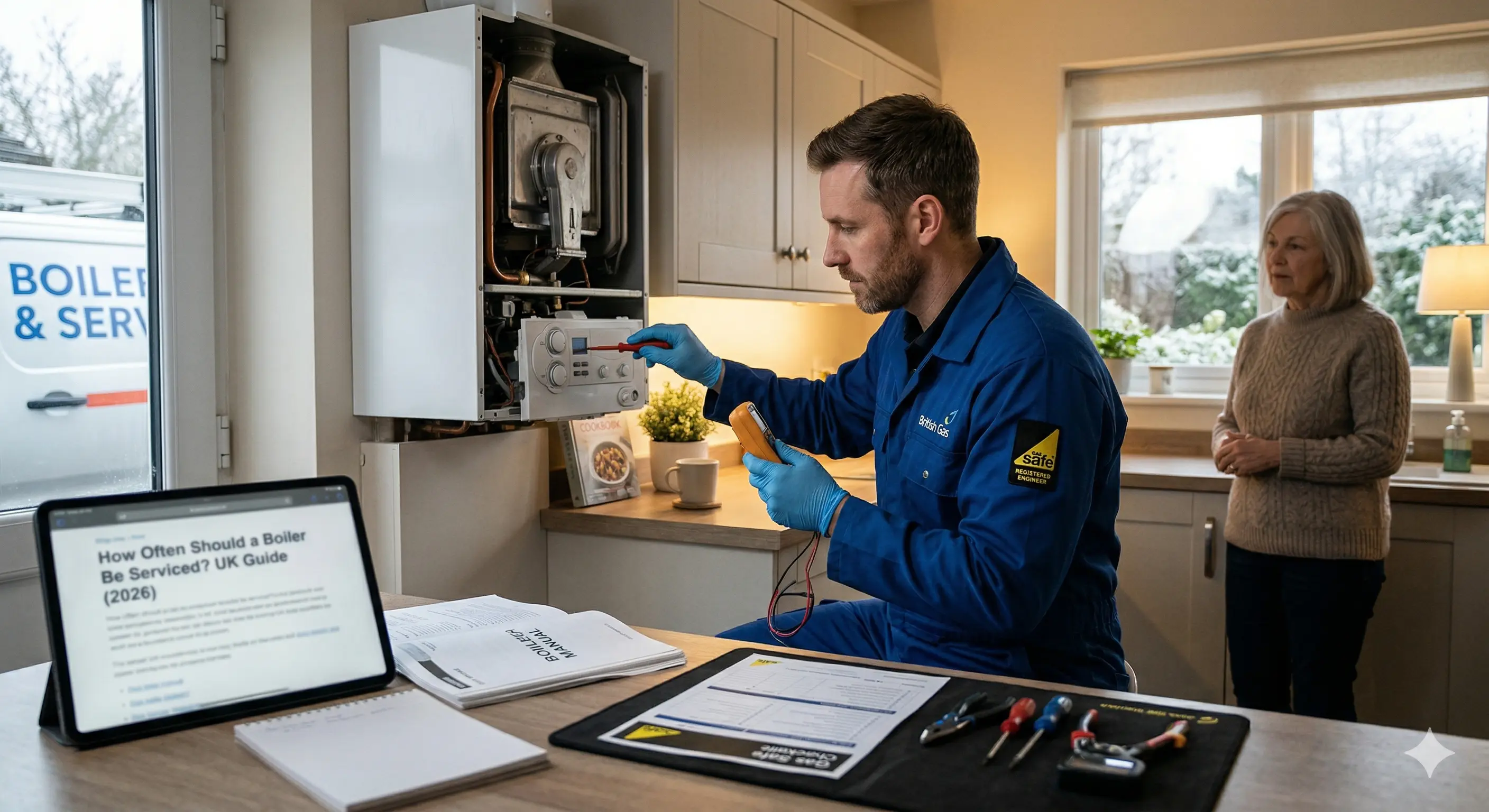
A standard boiler service takes 30-60 minutes and involves a series of checks, tests, and cleaning tasks. Here's what a Gas Safe engineer typically does.
Visual inspection. The engineer examines the boiler externally for any signs of damage, corrosion, or leaks. They check that the boiler is correctly installed, accessible, and ventilated, and that the pipework and connections are in good condition.
Removing the casing and inspecting internal components. The engineer opens the boiler to inspect the heat exchanger, burner, main injector, spark electrode, and other internal parts. They look for signs of wear, corrosion, or carbon deposits that could affect performance or safety.
Flue check. The engineer tests the flue using a flue gas analyser to measure the levels of carbon monoxide, carbon dioxide, and oxygen in the exhaust gases. This is the critical safety check - it confirms that the boiler is burning gas completely and that no dangerous gases are being released into the home. They also check that the flue is correctly fitted and unobstructed.
Gas pressure and flow rate tests. Using calibrated equipment, the engineer measures the gas pressure at the boiler and compares it to the manufacturer's specifications. Incorrect pressure can reduce efficiency, cause incomplete combustion, or damage components over time.
Safety device tests. The engineer tests the boiler's safety devices, including the pressure relief valve, overheat thermostat, and flame supervision device. These are the systems that shut the boiler down if something goes wrong.
Cleaning. The engineer cleans key components as needed, particularly the burner and the main injector. This removes any debris or deposits that could affect combustion.
Final checks and report. The engineer fires up the boiler, checks for correct operation, verifies the flue readings are within safe limits, and issues a service report or certificate. If any issues were found, they'll explain what needs attention and provide a quote for repairs.
See our full guide on how the process looks and What You Should Actually Pay (and Why) for the Boiler Service.
What does it cost in 2026?
The cost of a boiler service in the UK varies by location, engineer type, and boiler type, but the typical range in 2026 is £80-120 for a one-off gas boiler service.
The average sits around £87-100 for a gas boiler service by a local independent engineer. National providers (like British Gas or HomeServe) typically charge more, around £110-120 or higher. Oil boiler services tend to cost slightly more, averaging £90-125, because they require a different set of specialist checks. Electric boilers are at the lower end, around £75-110, because they don't involve gas safety checks.
Location matters. Services in London and the South East typically cost £10-20 more than the national average. Rural areas may also be higher due to travel time.
If you combine a boiler service with a gas safety check (relevant for landlords), the combined cost is typically £100-150 - cheaper than booking them separately.
For the price of a single boiler service, you get peace of mind that your heating is safe and efficient for the next 12 months, your warranty remains valid, and your insurance won't have grounds to reject a claim if something goes wrong.
What happens if you skip a year (or several)?
A fifth of UK households - around 5.5 million homes - don't get their boiler serviced annually. The most common reason is cost, with 31% of people who skip saying they can't justify the expense. Here's what they're risking.
Warranty invalidation. This is the most immediate financial consequence. Almost every boiler manufacturer in the UK - Worcester Bosch, Vaillant, Ideal, Baxi - requires proof of annual servicing to maintain the warranty. Warranties on modern boilers last 5-12 years, and many now extend to 10+ years. Missing even one annual service can void the warranty entirely, meaning a fault that would have been repaired for free under warranty now costs you £200-500+ for parts and labour, or £2,500-5,500 for a full replacement if the issue is severe.
A £100 annual service protects a warranty worth thousands of pounds. The maths is straightforward.
Increased breakdown risk. Boilers that are regularly serviced are significantly less likely to break down, particularly during winter when they're running hardest and when you need them most. A service catches worn components, low pressure, and minor faults before they escalate into failures. An unserviced boiler is more likely to fail on the coldest day of the year, when every engineer in your area is already fully booked with emergency call-outs.
Higher energy bills. An inefficient boiler uses more gas to produce the same amount of heat. According to energy efficiency research, an unserviced boiler can increase energy costs by up to 30%. For a household spending £800-1,200 per year on gas (typical for UK homes in 2026), that's £240-360 per year in wasted energy - significantly more than the cost of the service itself.
Carbon monoxide risk. This is the most serious consequence. An unserviced boiler can develop incomplete combustion, producing carbon monoxide - a gas you can't see, smell, or taste. CO poisoning causes headaches, dizziness, nausea, and confusion in mild cases, and death in severe cases. An annual service includes a flue gas analysis that specifically checks for this. If you have a working CO alarm (which you should), it provides an additional layer of protection, but it's a backup, not a replacement for proper servicing.
Insurance complications. Most home insurance policies include a clause requiring regular maintenance of heating systems. If your boiler causes damage (for example, a leak that damages flooring or a fire caused by a faulty component), your insurer may reject the claim if you can't demonstrate that the boiler was properly maintained. Annual service records are the standard proof of maintenance.
When is the best time of year to book?
Summer. Specifically, June, July, or August.
During these months, heating engineers are less busy (because nobody's boiler is breaking down in July), appointment availability is better (you can pick a day and time that suits you, rather than taking whatever's available), and prices may be slightly lower (some engineers offer summer service discounts to fill their quieter months).
Most importantly, if the service reveals a problem, you have months to get it fixed before you need the heating. Discovering a faulty heat exchanger in July is an inconvenience. Discovering it in November is an emergency.
The worst time to book is October-December. This is peak season for heating engineers. Wait times are longer, prices are higher, and if your boiler needs a repair, you may be without heating while waiting for parts or a follow-up appointment.
If your boiler was last serviced in winter and you want to switch to a summer schedule, it's perfectly fine to service it again after 9-10 months to shift the timing. You can't over-service a boiler.
New boilers vs old boilers: does servicing frequency change?
No. A brand-new boiler needs servicing after its first 12 months, and every 12 months thereafter. In fact, the first service is arguably the most important, because it confirms that the installation was done correctly and that the boiler is performing as expected.
For older boilers (10+ years), annual servicing becomes even more important, not less. Components are more worn, efficiency degrades further each year, and the risk of failure increases. Some engineers recommend that boilers over 15 years old should be checked every 6-12 months, particularly if they've shown signs of reduced performance.
If your boiler is approaching 15-20 years old and requiring increasingly frequent repairs, your engineer may recommend replacement rather than continued servicing. Modern condensing boilers are significantly more efficient than older models, and the energy savings can offset the installation cost over a few years.
Combi vs system vs regular: does the boiler type matter?
All three types - combi, system, and regular (conventional) boilers - should be serviced annually. The service process is broadly similar for all types, though there are minor differences.
Combi boilers are the most common type in UK homes. The service covers both the heating and hot water functions, since a combi does both in a single unit.
System boilers work with a hot water cylinder. The service covers the boiler itself. The cylinder should also be checked periodically, but this isn't part of a standard boiler service.
Regular (conventional) boilers work with both a hot water cylinder and a feed-and-expansion tank in the loft. Again, the annual service covers the boiler. The wider system components (tank, cylinder, pump, motorised valves) should be checked but are not always included in a basic service.
If you have a system or regular boiler and want a comprehensive check of the entire heating system - not just the boiler - ask your engineer about a full system health check. This is more thorough (and more expensive) than a standard service, but worth doing every few years, especially if you're experiencing uneven heating, noisy radiators, or other system-level issues.
How to find a Gas Safe engineer
Every engineer who works on gas appliances in the UK must be registered on the Gas Safe Register. This is a legal requirement, not a recommendation. Using an unregistered engineer is illegal and dangerous.
To find a registered engineer, use the Gas Safe Register's postcode search at GasSafeRegister.co.uk. Enter your postcode and you'll see a list of registered engineers in your area. You can also verify a specific engineer by entering their Gas Safe ID number (which should be on their ID card). Check their qualifications cover your boiler type - not all engineers are qualified for all appliance types.
Beyond Gas Safe registration, look for engineers who have manufacturer accreditations (Worcester Bosch Accredited Installer, Vaillant Advance Installer, etc.), positive Google reviews with specific mentions of servicing work, clear pricing with no hidden call-out fees, and availability for emergency follow-up if the service reveals an issue.
How to remember your annual service
The most common reason people miss their annual boiler service isn't cost - it's forgetting. You had it done last March, life happened, and suddenly it's been 18 months.
There are several ways to stay on top of it. Set a calendar reminder 11 months after your last service, giving you time to book before the anniversary. Some engineers and heating companies offer annual service plans (typically £8-15 per month) that include a scheduled visit, so you don't need to remember to book. If your engineer uses an automated reminder system, they'll text or email you when your service is due - ask whether they offer this. See our full CP12 gas certificate for a landlord guide.
From the engineer's perspective, automated service reminders are one of the most effective ways to ensure customers come back each year. If you're a heating engineer reading this, setting up an automated reminder system means your customers get a text when their service is due, and you get a full diary without chasing bookings manually. For a guide on how to set this up, see our article on automating boiler service reminders for HVAC businesses.
Frequently asked questions
Can I service my own boiler?
No. Gas work in the UK must be carried out by a Gas Safe registered engineer. It's illegal to work on gas appliances without registration, and it's extremely dangerous. Even if you're technically capable, you cannot issue a valid service certificate or gas safety record.
My boiler seems fine. Do I still need a service?
Yes. Many boiler issues, particularly carbon monoxide leaks and early-stage component wear, are invisible to the homeowner. The boiler can appear to work perfectly while operating unsafely or inefficiently. A service uses specialist equipment (flue gas analyser, pressure gauges) that detects problems you can't see, hear, or smell.
What if I've missed several years of servicing?
Book a service as soon as possible. The engineer will carry out the standard checks and let you know if any issues have developed. There's no penalty for having missed previous services (unless you're a landlord, in which case you may be in breach of the Gas Safety regulations). Your warranty may already be void if annual servicing was a condition, but it's worth checking with the manufacturer - some offer reinstatement if you resume regular servicing.
Do I need a service if I have a new boiler?
Yes. Most manufacturers require the first service within 12 months of installation to validate the warranty. The first service also confirms the installation was done correctly.
Is a boiler service the same as a gas safety check?
Not exactly. A gas safety check (CP12) is a legally required annual inspection for landlords that focuses on whether gas appliances are safe to use. A boiler service is more comprehensive and includes cleaning, maintenance, and performance optimisation as well as safety checks. Many engineers offer both together for a combined price. If you're a landlord, you need the gas safety check as a minimum. Adding a full service is strongly recommended.
How long does a service take?
Typically 30-60 minutes for a standard gas boiler. Oil boilers may take slightly longer. If the engineer finds an issue that needs investigation, it may extend beyond an hour, but they'll discuss this with you before doing additional work.
Do electric boilers need servicing?
Electric boilers don't burn fuel, so there's no carbon monoxide risk, and they don't require a Gas Safe engineer. However, they still benefit from annual servicing to check electrical connections, heating elements, and safety devices. An annual check helps maintain efficiency and catch problems early.
The bottom line
Service your boiler every 12 months. Book in summer if you can. Use a Gas Safe registered engineer. Keep the service records.
The cost is £80-120. The cost of not doing it - voided warranties, higher energy bills, breakdown risk, and the small but real danger of carbon monoxide - is far higher.
If you're a homeowner, set a reminder now for 11 months from your last service. If you're a landlord, make sure your gas safety checks and boiler services are scheduled and documented for every property. And if you're a heating engineer looking to make sure your customers actually come back each year, automated service reminders are the simplest way to keep your diary full without chasing bookings. Be sure to review our full comparison of Boiler Service Reminder Systems for UK Heating Engineers.
For more on how automated reminders help heating businesses, see our guides on HVAC customer retention strategies and reminding customers about their annual boiler service.