HVAC Customer Retention Strategies That Work in 2026
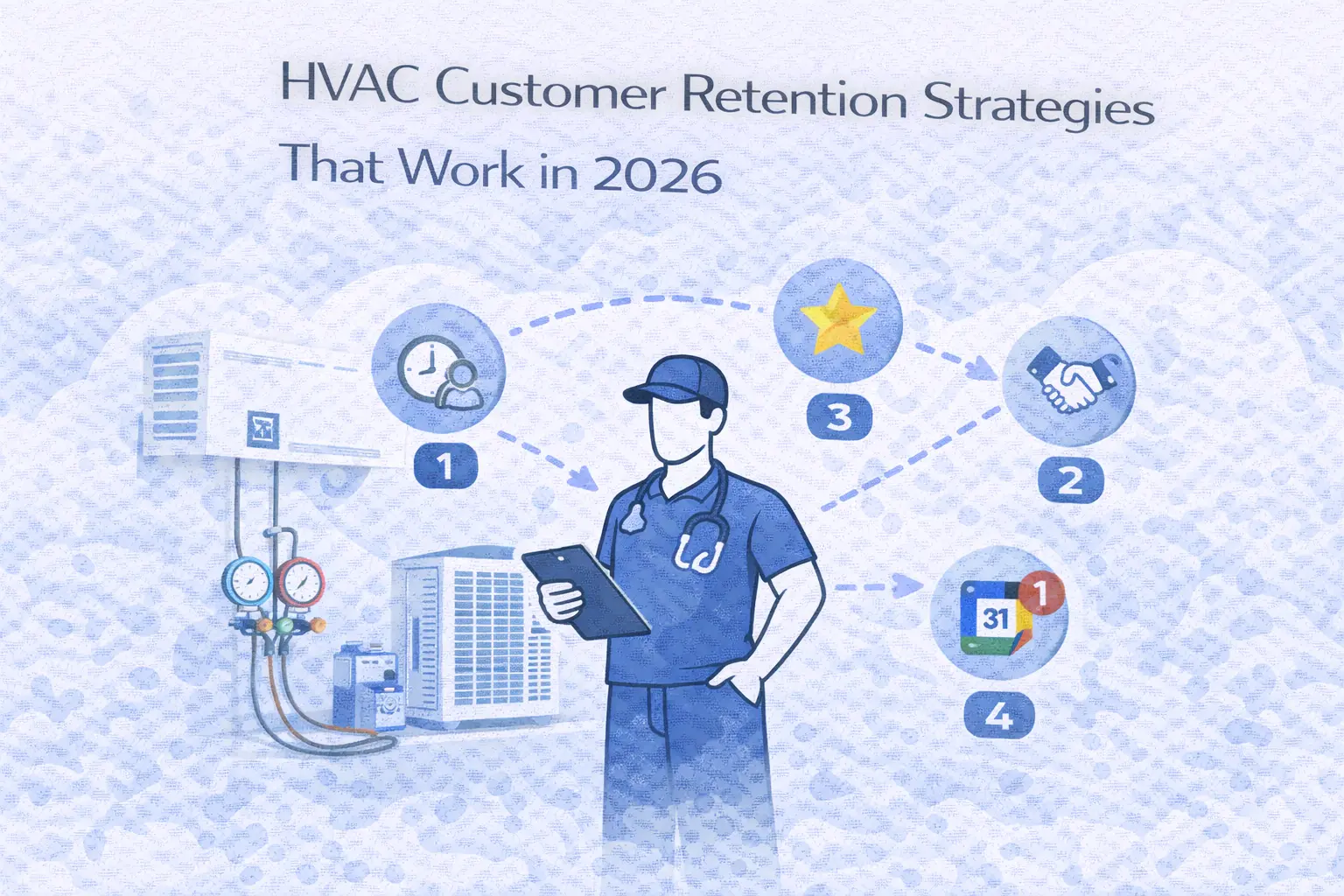
Most heating engineers are good at finding new customers. Between Checkatrade listings, Google Ads, word of mouth, and the steady stream of emergency call-outs during winter, the work comes in. The problem is that it stops coming in from the same people.
Contents
- Why retention matters more in 2026 than ever before
- The lifetime value of a heating customer
- 1. Automated annual service reminders
- 2. Annual service plans and maintenance agreements
- 3. Post-job follow-up messages
- 4. Seasonal check-in campaigns
- 5. Referral programmes
- 6. Google reviews and reputation management
- 7. Upselling and cross-selling to existing customers
- 8. Year-end summary and service report
- Putting it together: a practical retention system
- The retention advantage in a changing market
- Start building your retention system today
A homeowner calls you to fix a leaking radiator in January. You do a great job, leave your card, and never hear from them again. When their boiler needs servicing the following autumn, they search Google, see a different engineer, and book with them. Not because you did anything wrong, but because you weren't the one who reminded them.
This is the retention problem in HVAC, and it's expensive. Acquiring a new customer costs five to seven times more than retaining an existing one. For the average UK heating engineer spending £200-350 to acquire a new customer through advertising, that means a retained customer who comes back year after year is worth significantly more than a new lead, even before you factor in referrals.
This guide covers eight strategies that UK heating and plumbing businesses are using in 2026 to keep customers coming back, build predictable recurring revenue, and reduce their dependence on expensive lead generation.
Why retention matters more in 2026 than ever before
The economics of the UK heating industry are shifting in ways that make customer retention not just nice to have, but essential for survival.
First, lead costs are rising. Google Ads CPCs for heating-related keywords have increased steadily, with competitive terms like "boiler repair near me" now costing £8-15 per click. Checkatrade membership fees and lead costs have also risen. Every year, acquiring new customers gets more expensive.
Second, the heat pump transition is creating a two-speed market. The government's Boiler Upgrade Scheme now offers £7,500 grants for air source heat pump installations, with a £295 million budget for 2025/26. Over 100,000 applications have been submitted since the scheme launched. Engineers who retain existing customers are in the best position to convert them to heat pumps when the time comes, rather than losing that high-value installation job to a competitor who got to them first.
Third, customer expectations have changed. In an era where every subscription service sends automated reminders and every restaurant texts a booking confirmation, homeowners expect the same from their heating engineer. The engineer who sends a service reminder in September feels professional and organised. The one who relies on the customer to remember feels outdated.
Finally, the gas boiler ban in new builds is tightening the market. With fewer new gas installations to chase, the existing customer base becomes the most reliable source of revenue. Engineers who've built strong relationships with their customers will weather the transition better than those who rely on one-off jobs.
The lifetime value of a heating customer
Before diving into strategies, it helps to understand what a retained customer is actually worth.
The average UK boiler service costs £87-120 in 2026. A boiler typically lasts 10-15 years. Over that period, a retained customer who books an annual service generates £870-1,800 in service revenue alone.
But that's just the baseline. A retained customer also generates revenue from repairs when something goes wrong (average repair cost £150-300), a boiler replacement when the existing one reaches end of life (£2,500-5,500 for supply and installation), radiator upgrades and system modifications, Gas Safety Certificate renewals if they're a landlord (£60-90 annually), and increasingly, heat pump installations (£8,000-15,000 after grant).
Add it all up, and the lifetime value of a loyal heating customer can reach £5,000-20,000 over a 10-15 year relationship. Compare that to the £200-350 it costs to acquire them, and the maths is clear: keeping customers is dramatically more profitable than finding new ones.
Calculate your potential profit
See how much you can earn by recovering lost customers
Your data
What that could be worth
5-year projection
Assumes every recovered customer then returns each year
No credit card required • Full access • 10 SMS per month
Both percentages here are assumptions you set, not measurements. What we have actually measured, and the published research on reminders: our sources.
The critical question is how. Heating engineers are busy people. Most are sole traders or run small teams. Retention strategies that require hours of admin each week aren't practical. The best approaches are ones you set up once and that run largely on autopilot.
1. Automated annual service reminders
This is the single highest-impact retention strategy for any heating business. Annual boiler services, Gas Safety Certificate renewals, and filter replacements all follow predictable cycles. The customer knows they need the work done, but they forget, or they put it off until it's too late, and by then they've already searched for another engineer.
An automated SMS reminder four to six weeks before the service is due solves this almost entirely. The customer receives a text, thinks "oh right, the boiler service," and calls to book. The reminder creates the action. Without it, nothing happens.
Gas Engineer Software, which sells reminder software to gas engineers, reports that around 33% of its automated service reminders convert into booked jobs. That is a vendor's figure for its own product rather than independent research, so treat it as a hypothesis to test on your own list: for an engineer with 200 annual service customers it would mean 66 bookings a year. What has been measured independently is at our evidence page.
The most effective approach uses a stacked sequence: an initial reminder four to six weeks before the due date (gives the customer time to schedule), a follow-up two weeks before (a nudge for those who haven't acted), and optionally a final reminder in the week the service is due.
SMS is the primary channel. With a 98% open rate compared to email's 20-30%, text messages reach customers in a way that emails simply don't. Many engineers combine both: an email with detailed information six weeks out, followed by SMS reminders closer to the date.
For a step-by-step guide on setting up automated reminders, see our guide to automating boiler service reminders for HVAC businesses. If you use Google Calendar for scheduling, see how to connect your calendar to send SMS reminders automatically. Still using a paper calendar - that can be all digitalized with just a few pictures.
2. Annual service plans and maintenance agreements
Service plans transform one-off customers into subscribers. Imagine converting your ad-hoc business into something that emulates a Netflix subscription (with all its commercial benefits for you, the business owner). Instead of hoping a customer remembers to book their annual service, you sell them an ongoing maintenance agreement that includes scheduled visits, priority booking, and discounted repairs.
A well-structured heating service plan for UK homeowners typically includes one annual boiler service visit, priority response for breakdowns (often within 24-48 hours), a discount on parts and labour for repairs (typically 10-15%), and no call-out charge for plan members.
Pricing varies, but most UK heating engineers charge £8-15 per month or £80-150 per year for a basic maintenance plan. Some offer tiered plans: a basic option covering the annual service only, and a premium option including breakdown cover.
The retention impact is significant. Industry data suggests that HVAC businesses retain 80-90% of maintenance agreement customers year-on-year, compared to just 40-60% of general service customers. That's roughly double the retention rate.
Service plans also smooth your cash flow. Instead of feast-or-famine seasonal income (busy September-November, quiet March-May), monthly payments from plan members provide a predictable baseline. For an engineer with 100 customers on a £10/month plan, that's £1,000 per month in guaranteed revenue before you do any additional work.
The practical challenge is administration. Tracking who's on a plan, when their visit is due, and managing payments manually is time-consuming. Most engineers who successfully run service plans use some form of software to handle the scheduling and reminders, even if the payment collection is done separately through a standing order. Still, to start, you only need a basic template of how the plan could work and the "courage" to ask a customer if they'd be interested in such a plan. You'll be surprised how many will be. And the worst can happen - you'll hear "no, not right now".
3. Post-job follow-up messages
The period immediately after completing a job is the best time to cement the customer relationship. The work is fresh in their mind, they're (hopefully) satisfied with the result, and they're most receptive to hearing from you.
A simple follow-up SMS 24-48 hours after the job does three things. It shows you care about the quality of your work, which distinguishes you from engineers who disappear after cashing the cheque. It gives the customer an easy way to raise any issues while they're still small, rather than leaving a bad review weeks later. And it creates a touchpoint that keeps your name in their phone.
A good post-job message looks something like this:
Hi {first_name}, thanks for choosing {business_name} for your boiler service yesterday. If you have any questions or notice anything unusual, give us a call on [phone]. We'll remind you when your next service is due. Have a great week!
The last sentence is important. It tells the customer they don't need to remember when the next service is due, because you'll handle it. That's a promise of ongoing service, not just a transaction.
4. Seasonal check-in campaigns
Heating and cooling work is inherently seasonal. Boiler services peak in September-November (before winter), AC servicing peaks in March-May (before summer), and emergency repairs spike in January-February.
Smart engineers use these natural rhythms to stay in touch with customers year-round, not just when a service is due. A seasonal check-in campaign might include a spring message about AC prep or thermostat settings (March-April), a summer message about water efficiency or system flushing (June-July), an early autumn message about booking boiler services before the rush (August-September), and a winter message about energy-saving tips or pipe insulation (December-January).
These aren't sales messages. They're helpful, relevant communications that position you as a trusted advisor rather than someone who only calls when they want money. Over time, they build the kind of familiarity that makes customers think of you first when they need heating work done.
The key is keeping them short and genuinely useful. A two-sentence text about bleeding radiators before turning the heating on costs almost nothing to send but keeps your name in the customer's phone and positions you as the expert.
5. Referral programmes
Word of mouth is already the most common way homeowners find heating engineers. A referral programme formalises this by giving existing customers an incentive to recommend you.
The simplest approach works best: offer a credit or discount for every successful referral. For example, "Refer a friend who books a boiler service, and you both get £10 off your next job." This is straightforward, easy to explain, and gives both parties a reason to participate.
More complex reward structures (points systems, tiered rewards, prize draws) tend to underperform for trades businesses because they're harder to explain and track. A flat, simple offer that customers can describe in one sentence to their neighbour is more effective than a sophisticated programme nobody understands.
Track referrals manually if you have to (just ask new customers how they heard about you), but even a simple note in your customer records helps you see which customers are your best advocates and which referral channels produce the most work.
6. Google reviews and reputation management
In 2026, your Google Business Profile is often the first thing a potential customer sees, even before your website. And for existing customers, seeing strong reviews reinforces their decision to keep using you rather than switching to a competitor.
The connection between reviews and retention isn't obvious, but it's real. A customer who sees you consistently receiving five-star reviews from other homeowners feels validated in their choice. They're less likely to shop around because the social proof tells them they already have a good engineer.
Ask for reviews after every completed job. The best time to ask is in your post-job follow-up message: "If you were happy with our work, a quick Google review would really help. [link]". Most customers who are satisfied will leave a review if asked directly. Very few will do it unprompted.
Respond to every review, positive or negative. A thoughtful response to a positive review takes thirty seconds and shows future readers that you're engaged. A professional response to a negative review shows you take concerns seriously. Both contribute to the image of a business that cares about its customers.
7. Upselling and cross-selling to existing customers
Your existing customers already trust you. They've let you into their home, they've seen your work, and they're satisfied enough to have kept your number. This makes them far more receptive to additional services than a cold prospect.
The most natural cross-sell opportunities for heating engineers include annual boiler service customers who haven't had a Gas Safety Certificate check (if they're landlords), boiler service customers who might benefit from a powerflush or system treatment, customers with ageing boilers who should be thinking about replacement before an emergency failure, homeowners who could benefit from smart thermostat installation, and increasingly, customers who might be interested in heat pump installations under the Boiler Upgrade Scheme.
The heat pump opportunity is particularly significant. The BUS grant of £7,500 makes heat pump installations financially accessible for many homeowners, with over 100,000 applications submitted since the scheme launched. Engineers who've maintained a relationship with their customers are naturally positioned to be the first person those customers call when they're ready to explore heat pumps.
Cross-selling works best when it's genuinely helpful rather than pushy. During a boiler service, if you notice the system is 12 years old and showing signs of wear, mentioning that replacement might be worth considering in the next couple of years is helpful advice. The customer may not act immediately, but when the boiler does fail, they'll call you, not Google.
8. Year-end summary and service report
At the end of each year (or on the anniversary of the customer's first job), send a brief summary of the work you've done for them. This works especially well for landlords managing multiple properties, but homeowners appreciate it too.
A simple email or message covering what work was done over the past year, what's coming up in the next twelve months, and any recommendations based on the condition of their system serves multiple purposes. It demonstrates professionalism and record-keeping, it reminds the customer of the value you provide, it creates a natural moment to discuss future work, and for landlords, it provides documentation they may need for compliance.
This doesn't need to be a polished PDF report. A clear, well-structured email with the relevant details is sufficient. The act of sending it is what matters, not the production quality.
Putting it together: a practical retention system
Each of these strategies works independently, but they're most effective when combined into a simple system. Here's what a practical retention setup looks like for a UK heating engineer in 2026.
Automated layer (set up once, runs on autopilot): annual service reminders via SMS (4 weeks and 1 week before due date), post-job follow-up messages (24-48 hours after each completed job), and seasonal check-in messages (4 per year, timed to natural demand cycles). More on sending service reminders for the HVAC industry.
Manual layer (takes 10-15 minutes per week): asking for Google reviews after completed jobs, noting referral sources when new customers call, and mentioning relevant cross-sell opportunities during service visits.
Periodic layer (quarterly or annually): reviewing which customers haven't booked in over 12 months, sending year-end service summaries to landlord clients, and updating service plan pricing and offerings.
The automated layer is the foundation. It handles the highest-impact retention activities (service reminders) without ongoing effort. See more on the topic of how you can Automate Boiler Service Reminders for your HVAC Business.
The retention advantage in a changing market
The UK heating industry is in the middle of the biggest transition in decades. Gas boilers are being phased out of new builds. Heat pump installations are accelerating, with 35,387 installations in the first nine months of 2025 alone, up 11% year-on-year. The Boiler Upgrade Scheme budget has grown to £295 million.
In this environment, the engineers who thrive will be those with a loyal customer base. Not because gas work is disappearing (23 million UK homes still have gas boilers), but because the transition from gas to heat pumps will happen customer by customer, over years, and the engineer who's been servicing a customer's boiler for the past decade is the natural choice to install their heat pump.
Retention isn't just about the next boiler service. It's about being the trusted engineer when the customer decides to make the switch.
Start building your retention system today
You don't need to implement all eight strategies at once. Start with the one that has the highest impact for the least effort: automated service reminders.
Set up automated SMS reminders with Remindlo for free — 10 SMS per month, no credit card required. Import your customer list, set their service due dates, and let the reminders run on autopilot.
Related reading:
For more on reducing missed appointments, see our complete guide on how to remind customers about annual boiler service
For a comparison of reminder systems built for HVAC businesses, see our guide to the 5 best boiler service reminder systems
You can also read what the homeowner's perspective is in this guide: How Often Should a Boiler Be Serviced
How Mobile Service Businesses Bring Customers Back Year After Year