Why Your Customer List Is Your Most Valuable Business Asset Right Now
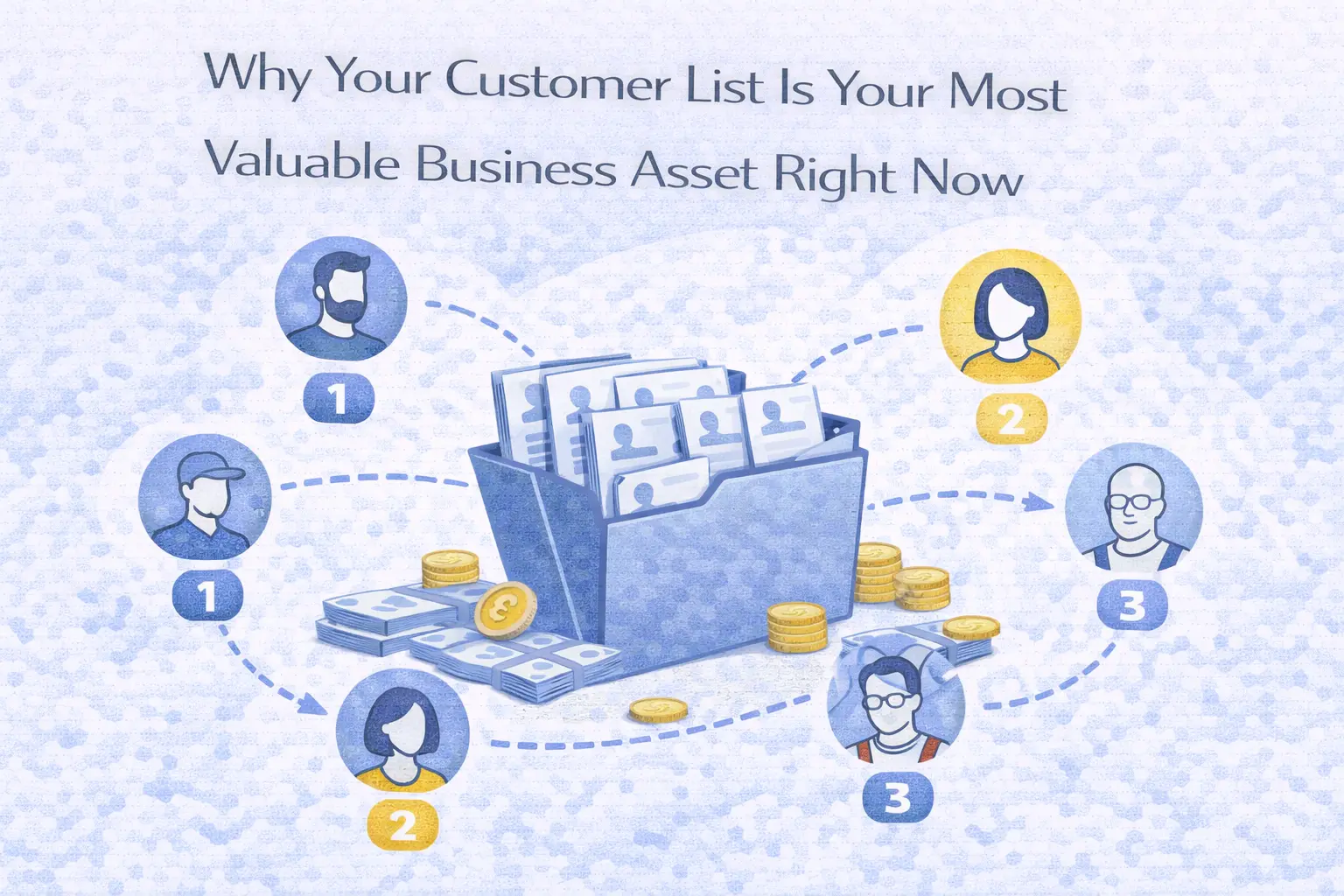
Rising costs, fewer walk-ins, and tougher competition. Small service businesses across the UK face real pressure in 2026. The businesses that will come through strongest are the ones that own their customer relationships, not rent them from Google.
Contents
If you run a small service business in the UK, you already know 2026 feels different. Fuel is more expensive. Your energy bills have gone up. National Insurance costs more. And the customers who used to find you on Google might be getting their answers from AI instead of clicking through to your website.
None of this is in your control.
But there is something you do control: whether past customers come back to you, or quietly disappear to a competitor.
This article looks at what is changing for small service businesses right now, why the businesses that own their customer data will handle it best, and what you can do today to make sure your business is one of them.
What is actually happening
Three things are hitting UK service businesses at once, and they are connected.
Costs are rising faster than expected. The conflict in the Middle East has pushed oil above $100 a barrel, up from around $70 at the start of the year. That means higher fuel costs for your van, more expensive deliveries, and rising energy bills. On top of that, employer National Insurance increased to 15% in April 2025, the National Living Wage is going up again in April 2026, and business rates are climbing. For a small firm with a handful of employees, the Federation of Small Businesses estimates the combined annual employment cost increase runs into tens of thousands of pounds.
Consumer spending is tightening. When household budgets get squeezed, people delay non-urgent services. The boiler service gets pushed back. The MOT gets left until the last week. The dog grooming appointment goes from every six weeks to every ten. UK GDP showed zero growth in January 2026, unemployment has risen, and the Bank of England is expected to hold interest rates at 3.75% rather than cut them, because inflation is picking up again. Consumers have less spare cash, and they are more careful about where they spend it.
Google is changing how people find local businesses. This is the one most business owners have not noticed yet, but it matters. Google's AI Overviews now appear on nearly half of all search results. When someone searches "best boiler engineer near me", they increasingly get an AI-generated summary at the top of the page, not a list of websites to click. Research from BirdEye shows that Google Business Profile impressions are down 54% year on year. The clicks that remain are still valuable, but there are fewer of them. And with features like Ask Maps rolling out in Google Maps, the way people discover local services is shifting from browsing to asking.
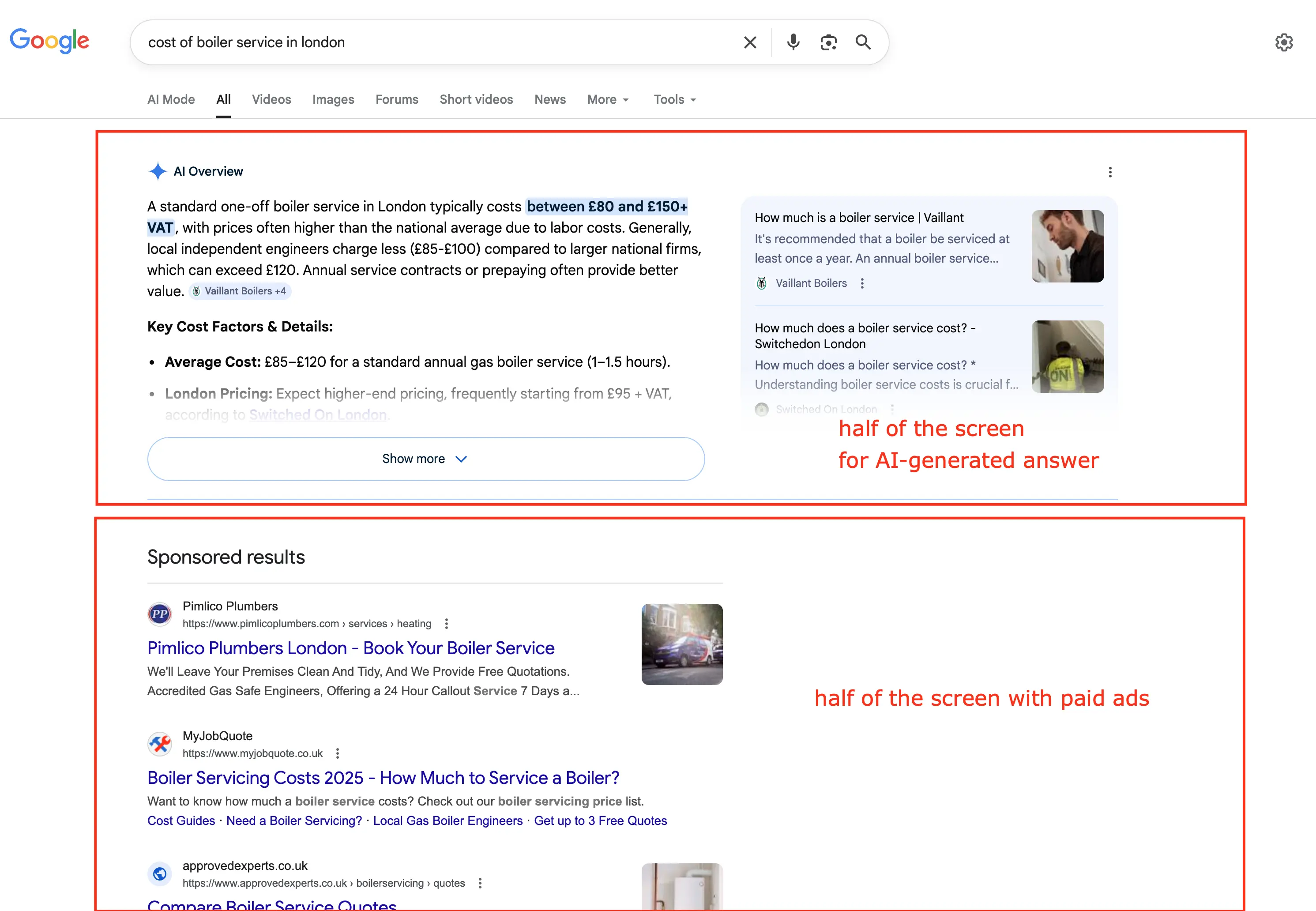
We ran a small experiment on a popular, "longer-tail" phrase that used to generate leads for the business. See how much of the screen is taken up by the AI overview, while the rest is filled with ads. Space for organic results on the first visible screen - zero, space for showing Google Maps results - zero.
And in May 2026, Google went a step further. At its I/O conference, the company announced that Search agents will soon be able to call local businesses directly on a customer's behalf, starting with categories like home repair, beauty, and pet care. The customer no longer browses, no longer chooses, no longer even dials. They describe what they need, and an AI agent reaches out to whichever business it picks. For service businesses that rely on being the one people find and ring, this is the next shift in the same direction: less control over the first point of contact, more dependence on whichever business the algorithm surfaces first.
For small service businesses, this creates a compounding problem. Costs go up. Customers pull back. And the channels you relied on to find new customers are becoming less predictable.
We also collected a real story from a service business owner who lost almost all his Google traffic after running his website for 12 years. See what exactly happened.
Why this hits small service businesses hardest
A plumber, an MOT garage, a mobile dog groomer, a heating engineer: these businesses typically have two to five employees, thin margins, and no dedicated marketing budget. They sit below what you might call the "CRM threshold." They do not need Salesforce or HubSpot. They need a reliable way to stay in touch with the customers they already have.
The challenge is that most small service businesses operate on a reactive model. You do good work, the customer is happy, they leave, and you hope they remember you next time. But they do not always remember. Life gets busy. When they eventually need the service again, they Google it. And now they might not even find your website. They might get an AI summary that recommends someone else entirely.
Meanwhile, your costs have gone up but your prices have not. According to a Simply Business survey, 82% of small business owners reported rising operating costs over the past year, yet only 12% increased their prices. That margin pressure only gets worse when customer volume drops.
The businesses that will struggle most are the ones that depend entirely on new customer acquisition through search, directories, or word of mouth. The businesses that will cope best are the ones that have a reliable system for getting existing customers to come back.
What the strongest businesses do differently
The most resilient small service businesses share one thing: they do not leave repeat business to chance. They have a structured list of past customers, and they reach out when it is time for the next service.
This is not a complicated CRM. It is a simple database with a name, a phone number, what service was done, and when it was done. No technical knowledge is needed to build such a business asset. From that, you can work out when each customer is likely due again.
A heating engineer who serviced a boiler in October can send a text the following September. An MOT garage that tested a car in March can SMS reminder to the owner in February. A mobile dog groomer who sees a client every eight weeks can prompt them when it is time to book.
This is customer reactivation, not appointment confirmation. The difference matters. An appointment reminder confirms something already booked. A reactivation message generates a new booking from a customer who might otherwise have forgotten about you or drifted to someone else.
The maths are straightforward. If you served 200 customers last year and 30% of them rebook because of a well-timed reminder, that is 60 repeat bookings you would not have had. At an average job value of even GBP 80, that is GBP 4,800 in recovered revenue, from customers who already know and trust you. No advertising cost. No competing on Google. Just a message at the right time.
Calculate your potential profit
See how much you can earn by recovering lost customers
Your data
What that could be worth
5-year projection
Assumes every recovered customer then returns each year
No credit card required • Full access • 10 SMS per month
Both percentages here are assumptions you set, not measurements. What we have actually measured, and the published research on reminders: our sources.
And the effect compounds. In year two, you are reminding this year's customers and last year's. Your base of reliable repeat customers grows every year, making you less dependent on the unpredictable flow of new enquiries.
Why owning your customer data matters more than ever
There is a deeper point here that goes beyond the immediate economic pressure.
When you depend on Google to send you customers, you are renting access to your own market. Google decides who sees your listing, how prominently it appears, and whether an AI summary names you or your competitor. You have limited influence and zero control.
When you have your own customer list, you own the relationship. You can contact your customers directly, on your terms, whenever you need to. No algorithm change can take that away from you.
This is becoming more important as AI reshapes local search. Google Business Profile impressions are falling. AI Overviews are answering questions that used to drive clicks. New features like Ask Maps in Google Maps let users have a conversation about local businesses, and the AI decides which ones to mention. If your business is not the one it references, you are invisible.
Every new move Google makes in 2026, from AI Overviews to Ask Maps to agents that call businesses for you, pushes control over the first point of contact further away from small businesses and closer to the algorithm. A customer who already has your number in their phone, who got a helpful reminder from you last month, is the one part of your marketing that none of this touches.
But a customer who already has your number in their phone, who got a helpful reminder from you last month, who rebooked because you made it easy: that customer is not going through Google at all. They are coming straight to you. That direct relationship is worth more than any search ranking, and it is completely within your control.
What a good customer reactivation system looks like
You do not need expensive software. You need four things:
A structured customer list. Not a pile of invoices or a notebook with phone numbers. A proper list where each customer has a name, phone number, service history, and a date when they are next due. This is the foundation. Without it, everything else is guesswork.
Timely reminders. A message that arrives when the customer is likely thinking about the service, or just before. The timing depends on your trade. For annual services like boiler checks or MOTs, one month before the due date works well. For more frequent services like grooming or window cleaning, a week or two is enough. The key is consistency. Every customer, every cycle, on time.
A personal touch. The message should feel like it comes from a person, not a system. "Hi Sarah, your boiler service is coming up next month. Would you like to book in? - Dave" works far better than a generic "YOUR SERVICE IS DUE. CLICK HERE TO BOOK." People respond to people, especially from a business they already trust.
Recovery messages for lapsed customers. Some customers will miss their reminder or put it off. A follow-up two to four weeks later catches the ones who meant to reply but forgot. And for customers who have been inactive for a year or more, a simple "We have not seen you in a while, just checking in" message can bring back people you had written off.
Practical steps you can take this week
You do not have to change everything overnight. Start with what you can do immediately.
Step 1: Gather your customer data. Go through your invoices, booking records, and phone contacts. Build a list of every customer you have served in the past two years. You need their name, phone number, what you did, and when. If you take bookings in a calendar, most of that list already exists - here is how to pull your customer list out of your calendar without typing it up by hand.
Step 2: Identify who is due for a service soon. Look for customers whose annual or periodic service is coming up in the next one to three months. These are your quick wins, people who are ready to rebook if you just remind them.
Step 3: Send a few messages manually. You do not need automation to start. Text five customers today with a personal reminder. See how they respond. Most businesses are surprised by how many people reply with "Yes, please book me in."
Step 4: Set up a system so it happens automatically. Manual reminders work, but they do not scale. When you have 100, 200, 500 past customers, you need a system that sends the right message to the right person at the right time, without you having to remember every one.
This is exactly what SMS reminder systems like Remindlo are built for. You upload your customer list, set up reminder campaigns based on service cycles, and the system sends personalised SMS messages automatically. Your customers hear from you at the right moment. You get repeat bookings without chasing anyone. And every new customer you serve goes into the system, growing your base of reliable, returning clients year after year.
The bottom line
You cannot control oil prices, interest rates, tax increases, or what Google does with AI. But you can control whether your past customers come back to you.
The businesses that will thrive in a tighter economy are not the ones spending more on ads or hoping for better search rankings. They are the ones with a structured customer database, a system for reaching out at the right time, and a direct line to the people who already know and trust their work.
Your customer list is the one asset that gets more valuable the more you use it. Start building it now.
FAQ
Does this only apply to businesses with annual service cycles?
No. Any business where customers need a service more than once benefits from reactivation reminders. That includes six-weekly grooming, quarterly window cleaning, biannual dental check-ups for pets, and seasonal services like garden maintenance or gutter clearing. If a customer needs you again at some point, a reminder at the right time brings them back.
Is texting customers legal under UK rules?
Yes. Under UK GDPR and PECR, you can send service reminders to existing customers using legitimate interest as your legal basis. This applies to reminders about services they have previously used. It is not the same as marketing cold contacts. You should give customers an easy way to opt out, and you should only message people you have a genuine service relationship with.
How is customer reactivation different from appointment reminders?
An appointment reminder confirms a booking that already exists. For example: "Your MOT is booked for Tuesday at 10am." A customer reactivation message generates a new booking. For example: "Hi Tom, your boiler was last serviced in October. It is coming up to that time again. Would you like to book?" Reactivation is about bringing customers back, not confirming plans they have already made.
What if I only have a small number of past customers?
Start with what you have. Even 30 or 40 past customers are worth reaching out to. As you complete more jobs and collect more contact details, your list grows. The businesses that start early build the strongest base over time.
Can I use Google Calendar for this?
Google Calendar can work as a basic reminder system for very small numbers. But it does not send messages to your customers automatically. You still have to remember to check the calendar and send each message yourself. For businesses with more than a handful of customers, a dedicated tool saves time and ensures nothing gets missed. What's even better here is a SMS reminder system that works on top of Google Calendar. No extra work needed, no workflow change.
Related reading:
Reactivate customers who already know you
Updated May 2026 to reflect Google's I/O announcements on Search agents and agentic calling.