Gas Safety Certificate Requirements for Landlords UK
 by Peter Bednarek, Founder
Contents
- What is a gas safety certificate?
- What does the law actually require?
- Is there a grace period for a gas safety certificate?
- What does the gas safety check involve?
- How much does it cost?
- What happens if you don't comply?
- Who can carry out a gas safety check?
- Properties with no gas supply
- HMOs and shared properties
- Scotland: additional requirements
- How to stay compliant without thinking about it [FREE TEMPLATE]
- Frequently asked questions
- Video Walkthrough
Quick answer
If you rent out a property in England, Scotland, or Wales that has any gas appliance, you are legally required to hold a valid gas safety certificate. No exceptions, no grace period, no exemptions for properties where the tenants "don't use the gas."
The law is the Gas Safety (Installation and Use) Regulations 1998, and it has applied to every landlord with gas appliances in a rental property for over 25 years. What has changed in 2026 is the consequence of non-compliance, because the Renters' Rights Act 2025 has fundamentally altered how landlords regain possession of their properties, and gas safety compliance is now directly tied to that process.
This guide covers everything UK landlords need to know about gas safety certificates in 2026: what the law requires, what the certificate covers, how much it costs, what happens if you don't comply, and the specific changes that make compliance more important this year than any year before it.
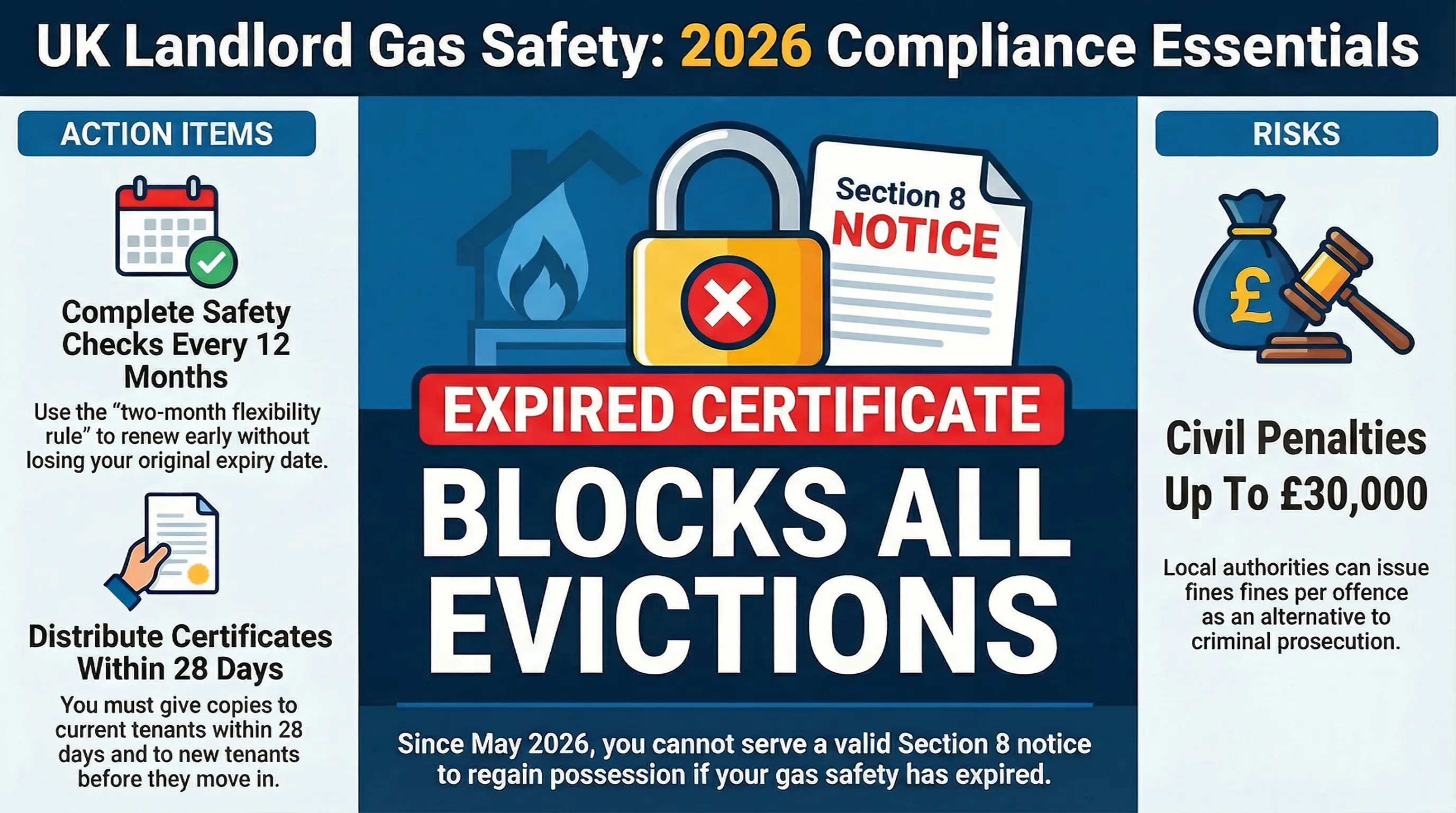
You can start from a summary infographic we prepared, then dive into the article for more details and a video walkthrough at the very end.
What is a gas safety certificate?
A gas safety certificate, formally called a Landlord Gas Safety Record and commonly referred to as a CP12, is the document a Gas Safe registered engineer issues after completing an annual gas safety check on a rental property. It records that all gas appliances, fittings, and flues in the property have been inspected and are safe to use.
The term CP12 comes from the old CORGI (Council for Registered Gas Installers) reporting form. CORGI was replaced by the Gas Safe Register in 2009, but the name CP12 has stuck in everyday use. The official term is now "Landlord Gas Safety Record," but your engineer, your letting agent, and your tenants will all call it a CP12.
The certificate covers every gas appliance provided by the landlord for tenant use. This includes gas boilers, gas cookers, gas fires, gas water heaters, and any other gas-burning appliance installed in the property. It also covers the associated pipework and flues.
Appliances owned by the tenant (for example, a freestanding gas cooker they brought with them) are not the landlord's responsibility for gas safety certification purposes. However, the pipework supplying gas to those appliances is, because the landlord owns the fixed installation.
What does the law actually require?
The Gas Safety (Installation and Use) Regulations 1998, specifically Regulation 36, sets out four core obligations for landlords.
Annual gas safety check. You must arrange for a Gas Safe registered engineer to carry out a safety check on each gas appliance and flue in the property every 12 months. Not every 13 months, not "roughly once a year," but within 12 months of the previous check. If the certificate expires, you are immediately in breach of the law. There is no grace period, though the regulations do allow you to book the check up to two months early without losing your renewal date.
Record keeping. You must keep a record of each safety check for at least two years. The record must include the date of the check, the address of the property, a description of each appliance or flue checked, any defects identified, and any remedial action taken. In practice, the Gas Safe registered engineer fills out the CP12 form and gives you a copy.
Tenant notification. You must provide a copy of the gas safety record to each existing tenant within 28 days of the check being completed. For new tenants, you must provide the record before they move in. This is not optional, and "it's available on request" does not meet the legal requirement. The tenant must receive a copy.
Maintenance. You must ensure that all gas appliances, fittings, and flues provided for the tenant's use are maintained in a safe condition. This is separate from the annual check. If a tenant reports a gas smell or a faulty appliance, you have a duty to arrange repair promptly, regardless of when the last annual check was.
Is there a grace period for a gas safety certificate?
There is no grace period after a gas safety certificate expires. The day after the expiry date you are in breach, and the Renters' Rights Act consequences set out below apply immediately. What does exist is a two-month window before expiry, and it is the only timing flexibility the regulations offer.
A common source of confusion is the timing of the annual check. Since 2018, an amendment to the regulations allows landlords to arrange the annual gas safety check up to two months before the existing certificate expires, without losing the original expiry date.
Here's what this means in practice. If your current CP12 expires on 1 September 2026, you can book the gas safety check any time from 1 July 2026 onwards. If the engineer carries out the check on 15 July, your new certificate still shows the next expiry date as 1 September 2027, not 15 July 2027. You don't lose any time.
This flexibility was introduced specifically to address the problem landlords had with scheduling. Previously, booking the check a few weeks early meant the expiry date crept forward each year, eventually shifting the annual check into an inconvenient time of year. The two-month window solves this.
If you arrange the check more than two months before the expiry date, the new 12-month period starts from the date of the check, not from the previous expiry date. So book within the two-month window if you want to preserve your dates.
What does the gas safety check involve?
The check itself typically takes 30 to 60 minutes, depending on the number of gas appliances in the property. Here's what the engineer inspects.
Visual inspection of appliances. The engineer examines each gas appliance for signs of damage, corrosion, or incorrect installation. They check that the appliance is adequately ventilated and accessible.
Gas tightness test. Using a manometer, the engineer tests the gas pipework for leaks. This involves pressurising the system and checking that the pressure holds. Any drop in pressure indicates a leak that must be found and repaired.
Flue inspection. For each appliance with a flue (most boilers and some gas fires), the engineer checks that the flue is clear, correctly routed, properly sealed, and discharging combustion gases safely to the outside. A blocked or incorrectly installed flue is one of the most dangerous gas safety issues because it can cause carbon monoxide to build up inside the property.
Combustion analysis. The engineer uses a flue gas analyser to measure the levels of oxygen, carbon monoxide, and carbon dioxide in the flue gases. This verifies that the appliance is burning gas efficiently and completely. Abnormal readings indicate a combustion problem that may need servicing or repair.
Safety device checks. The engineer tests the appliance's built-in safety devices, including flame failure devices, overheat cut-outs, and pressure relief valves. These are the mechanisms that shut the appliance down if something goes wrong.
Operating pressure check. The engineer verifies that the gas supply pressure and the appliance operating pressure are within the manufacturer's specified range.
After completing the checks, the engineer records the results on the CP12 form. If all appliances pass, the certificate is issued. If an appliance is found to be unsafe, the engineer will classify it as either "At Risk" (AR) or "Immediately Dangerous" (ID). An Immediately Dangerous appliance must be disconnected on the spot. An At Risk appliance can remain connected but must be repaired before the next check. In either case, the engineer notes the defect on the CP12 and the landlord has a duty to arrange repair.
How much does it cost?
The cost of a gas safety check varies by region and the number of appliances, but typical prices in 2026 are:
Single appliance (e.g. boiler only): £60-80. This is the most common scenario for flats and smaller rental properties with a combi boiler and no other gas appliances.
Two to three appliances: £70-100. Properties with a boiler plus a gas cooker or gas fire. Each additional appliance adds £10-20 to the check.
Combined gas safety check and boiler service: £90-150. Many engineers offer a package deal. A gas safety check is an inspection for safety. A boiler service is a more thorough maintenance procedure that includes cleaning components, adjusting settings, and replacing worn parts. For landlords, combining the two makes practical and financial sense because the engineer is already on site, and a well-maintained boiler is less likely to fail during a tenancy.
London and South East: Add £10-30 to the above figures. Higher labour costs and travel times push prices up in these areas.
The cost of the certificate itself is included in the engineer's fee. You don't pay separately for the CP12 form.
To put the cost in context: a gas safety check at £70-80 once a year is one of the cheapest compliance obligations a landlord faces. An EICR (electrical safety check) costs £150-300 every five years. An EPC costs £60-120 every ten years. The gas safety check costs less and you need it more often, which is precisely why it's the one most likely to slip through the cracks if you don't have a system for tracking it.
See also what a standalone vs bundled service actually costs in 2026.
What happens if you don't comply?
The penalties for gas safety non-compliance operate on multiple levels, and they've become more severe in practice since the Renters' Rights Act 2025 took effect.
Criminal prosecution
The Health and Safety Executive (HSE) can prosecute landlords who fail to maintain gas safety. The standard penalty is an unlimited fine in the Magistrates' Court. Historically, fines of £2,000-6,000 have been common, but the courts can and do impose higher penalties for serious or repeat offences. In the most serious cases, a landlord can face up to six months' imprisonment. Each individual offence (each property, each expired certificate) can be penalised separately.
Local authority civil penalties
Since 2019, local councils have had the power to issue civil penalty notices of up to £30,000 per offence for housing-related breaches, including gas safety failures. This is an alternative to prosecution, not an addition to it - the council chooses one route or the other. In practice, civil penalties have become the more common enforcement route because they don't require court proceedings. The council investigates, issues the penalty, and the landlord pays or appeals.
Insurance implications
Most landlord insurance policies include a condition that the property must comply with gas safety regulations. If a gas incident occurs (a fire, a carbon monoxide leak, damage to the property or injury to the tenant) and you don't hold a valid CP12, your insurer can refuse the claim. This applies even if the incident was unrelated to the gas appliance. The absence of a valid certificate gives the insurer grounds to argue that you were in breach of your policy conditions.
Tenancy deposit disputes
When a tenancy ends and there's a dispute over the deposit, the adjudicator will check whether the landlord met their legal obligations during the tenancy. A missing or expired gas safety certificate undermines the landlord's position and can result in the deposit being awarded to the tenant, even if the deduction was for legitimate damage.
The Renters' Rights Act 2025: the biggest change for landlords
This is the change that matters most in 2026.
The Renters' Rights Act 2025 abolishes Section 21 "no-fault" evictions from 1 May 2026. From that date, Section 8 of the Housing Act 1988 becomes the only route for landlords to regain possession of a property.
Section 8 requires the landlord to demonstrate specific grounds for possession (rent arrears, antisocial behavior, intention to sell, intention to move in, and so on). But here's the critical link to gas safety: the Act requires landlords to meet all prescribed compliance requirements before a Section 8 notice can be validly served.
Gas safety certification is one of those prescribed requirements. In practical terms, this means that if your gas safety certificate has expired, you cannot serve a valid Section 8 notice. You cannot begin the possession process. You are locked into the tenancy until you get back into compliance.
Previously, under the old Section 21 regime, a landlord with an expired CP12 couldn't serve a Section 21 notice, but Section 21 was a "no-fault" route that many landlords didn't use anyway. The change under the Renters' Rights Act is that there is now no alternative route. Section 8 is the only option, and gas safety compliance is a prerequisite for using it.
For landlords who have historically been relaxed about gas safety timing ("I'll get to it next week," "the engineer cancelled and I haven't rebooked"), the stakes have materially increased. An expired CP12 doesn't just expose you to a fine. It removes your ability to manage your tenancy.
Who can carry out a gas safety check?
Only a Gas Safe registered engineer can legally carry out a landlord gas safety check and issue a CP12. Using an unregistered engineer is itself a criminal offence for the landlord, and the resulting certificate has no legal validity.
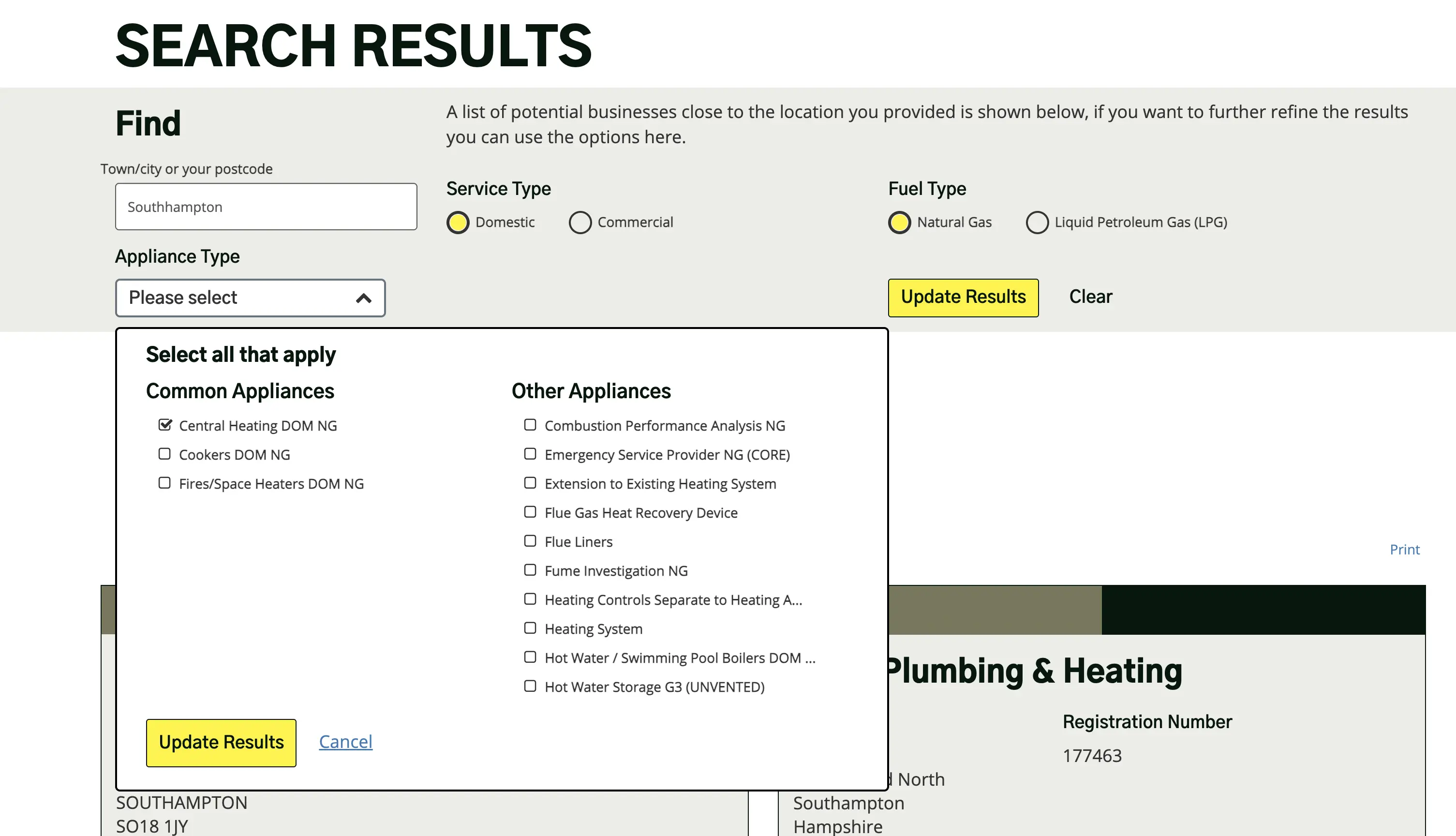
You can verify an engineer's registration at gassaferegister.co.uk by entering their registration number or name. Every Gas Safe engineer also carries an ID card with their photo, registration number, and the categories of gas work they're qualified to do. Ask to see it before the engineer starts work.
Not all Gas Safe engineers are qualified for all types of work. The registration card lists specific appliance categories (for example, central heating boilers, gas fires, cookers, and commercial catering). Make sure your engineer is qualified for the types of appliances in your property. Here's an example of how you can search for a qualified gas engineer in your area.
Properties with no gas supply
If the property has no gas supply and no gas appliances whatsoever - for example, an all-electric flat - you don't need a gas safety certificate. There's no gas to check.
However, if the property has a gas supply but the appliances have been removed, the situation is more nuanced. The gas supply pipework may still need to be checked. If there's a gas meter but no appliances, the safest approach is to have the gas supply properly capped off by a Gas Safe engineer and documented. If you later rent the property and a tenant connects a gas appliance to the existing supply, you're back in scope.
If you're unsure whether your property needs a gas safety check, the simple rule is: if gas enters the property in any form, get the check done. The cost is modest, and the legal protection is worth it.
HMOs and shared properties
For Houses in Multiple Occupation (HMOs), the gas safety obligations are the same but apply to all common areas as well as individual rooms. Every gas appliance in every part of the property must be checked, including boilers in communal cupboards, gas cookers in shared kitchens, and gas fires in communal living rooms.
HMO landlords should be particularly careful because local authorities tend to inspect HMOs more frequently, and civil penalties for HMO non-compliance tend to be at the higher end of the range due to the greater number of tenants at risk.
Scotland: additional requirements
Scottish landlords face the same Gas Safety (Installation and Use) Regulations 1998 as England and Wales, but with additional obligations under the Repairing Standard. Since March 2024, all Scottish rental properties must have satisfactory gas installations that meet the Tolerable Standard, and landlords must comply with the enhanced Repairing Standard which includes specific requirements around carbon monoxide alarms and gas safety documentation.
The Scottish Private Residential Tenancy (introduced in 2017) already abolished no-fault evictions in Scotland, so the Renters' Rights Act changes are specific to England. However, the principle is the same: gas safety compliance is tied to the landlord's ability to manage the tenancy.
How to stay compliant without thinking about it [FREE TEMPLATE]
The biggest risk with gas safety compliance isn't that landlords don't know the rules. It's that they forget to rebook. Life gets busy, the reminder slips, and suddenly the certificate has expired for three weeks before anyone notices.
For landlords managing one or two properties, a calendar reminder works. Set it for 10 weeks before the expiry date (within the two-month flexibility window) and book the engineer immediately.
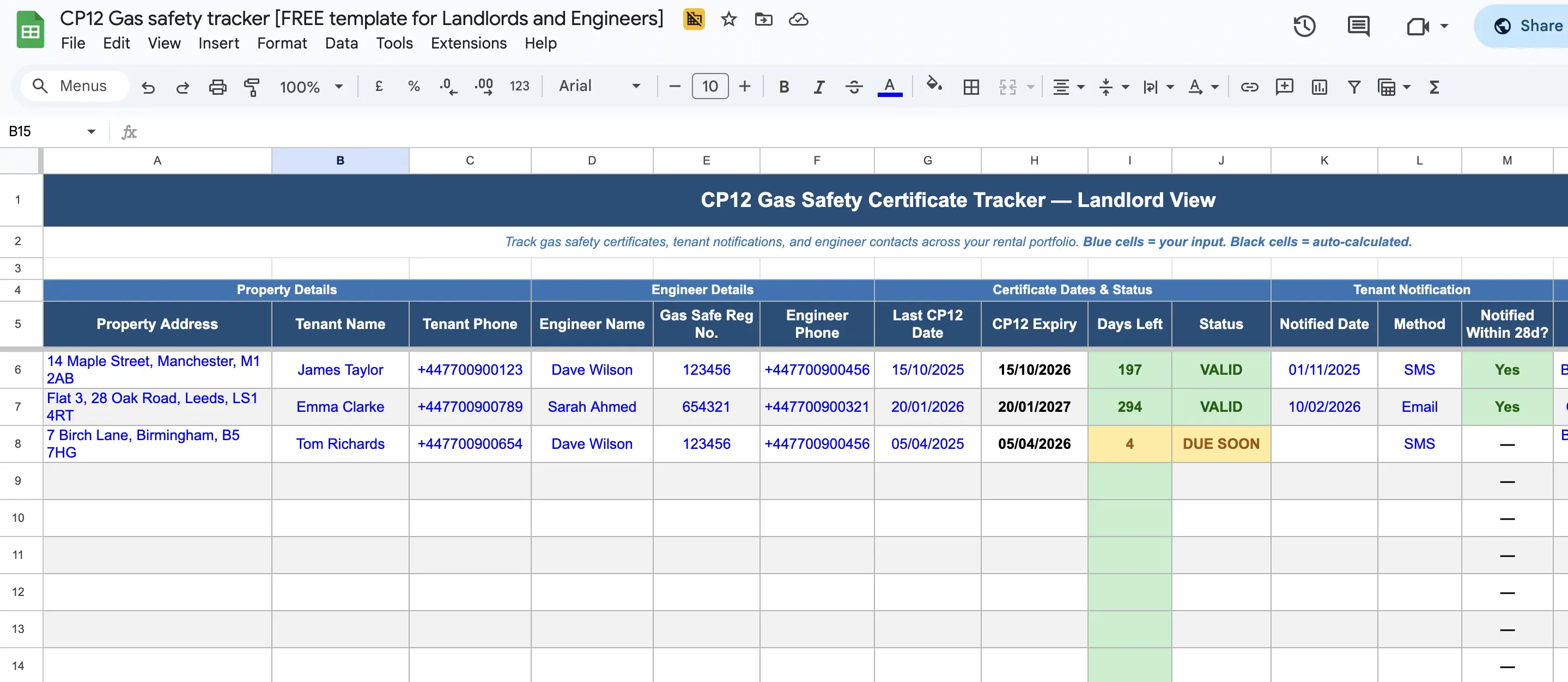
For landlords managing a handful of properties, a tracking spreadsheet is the next step up. We've put together a free CP12 Gas Safety Tracker template that you can copy and use immediately. It calculates expiry dates, flags the two-month renewal window automatically, tracks tenant notification dates, and colour-codes each property's status (Valid, Book Now, Due Soon, Expired). Fill in your property details and you'll have a clear view of what's due and when.
👉 Get the CP12 Gas safety tracker free template for Landlords and Engineers 👈
The template comes in two views: a Landlord View for tracking your own portfolio (with tenant phone numbers for access coordination), and an Engineer View for heating engineers tracking their landlord clients' CP12 dates (with landlord phone numbers and quoted prices). Both include automatic status calculation and the two-month renewal window.
If you want to take it a step further, you can connect the Google Sheet to Remindlo via Zapier so that when a certificate status changes to "DUE SOON," an SMS reminder goes out automatically - either to you (as the landlord) or to your landlord client (if you're the engineer). No manual checking required.
For landlords or letting agents managing more than a handful of properties, even an automated spreadsheet has limits. You still need to maintain the data, and Zapier has its own costs. A dedicated tool for sending reminders in HVAC industry, like Remindlo handles the entire cycle: set up recurring SMS reminders tied to each property's CP12 expiry date, and the system sends the right message at the right time - ten weeks before expiry, eight weeks, and so on. You book the engineer, enter the new expiry date, and the cycle continues automatically.
For heating engineers, the same system works in reverse. You can remind your landlord clients when their gas safety check is due, which means they book with you (not a competitor who happened to leaflet the area that week), and you build a predictable stream of annual recurring revenue. For more on this approach, see our guide about HVAC Customer Retention Strategies.
The cost of a reminder system is a fraction of the cost of a single civil penalty. More importantly, it removes the cognitive load of tracking dates across multiple properties, which is the real reason certificates expire.
Frequently asked questions
How often do I need a gas safety certificate as a landlord?
Every 12 months. The certificate must be renewed before it expires. You can use the two-month flexibility window to book the check up to two months early without losing your expiry date.
Is a gas safety check the same as a boiler service?
No. A gas safety check is a safety inspection that results in a CP12. A boiler service is a maintenance procedure that includes cleaning, adjusting, and replacing worn components. Both are recommended, but only the gas safety check is a legal requirement for landlords. Many engineers offer combined packages. For more on boiler servicing, see our guide to how often a boiler should be serviced.
What if my tenant refuses access for the gas safety check?
Document every attempt to arrange access in writing. Keep records of messages, letters, and any responses. If the tenant repeatedly refuses, you should seek legal advice. Courts and the HSE recognise that a landlord who can demonstrate persistent, documented attempts to arrange access has made reasonable efforts to comply. But "the tenant wouldn't let me in" without documentation will not protect you.
Do I need a gas safety certificate for a property between tenancies?
No - the legal requirement applies when the property is tenanted. However, you must have a valid certificate before a new tenant moves in. Many landlords maintain continuous certification regardless, to avoid any gap.
Can my tenant arrange their own gas safety check?
No. The legal obligation rests with the landlord, not the tenant. Even if the tenant happens to be a Gas Safe registered engineer, you (or your agent acting on your behalf) must arrange the check.
What about Airbnb and short-term lets?
Short-term lets are subject to the same gas safety requirements as long-term tenancies. If you rent out a property with gas appliances, you need a CP12, regardless of whether the tenancy is for a night or a year.
Does the gas safety certificate cover carbon monoxide alarms?
The gas safety check itself doesn't require CO alarms, but separate legislation does. Since October 2022, all rental properties in England must have a carbon monoxide alarm in any room with a fixed combustion appliance (except gas cookers). Scotland has similar requirements. The engineer carrying out your gas safety check may note the absence of CO alarms, but it's a separate legal requirement under the Smoke and Carbon Monoxide Alarm (Amendment) Regulations 2022.
Is there a grace period for a gas safety certificate?
No. The moment your CP12 expires you are in breach of the Gas Safety (Installation and Use) Regulations 1998. There is no tolerance period, no 14-day window, and no allowance for a check that is booked but not yet carried out. What landlords usually mean when they search for a grace period is the two-month flexibility rule, which works the other way round: you can have the check done up to two months before the current certificate expires and keep your original renewal date. That gives you a 60-day booking window ahead of the deadline, not any leeway after it.