How Gardeners and Landscapers Can Use Spring to Build a Year-Round Client Base
 by Peter Bednarek, Founder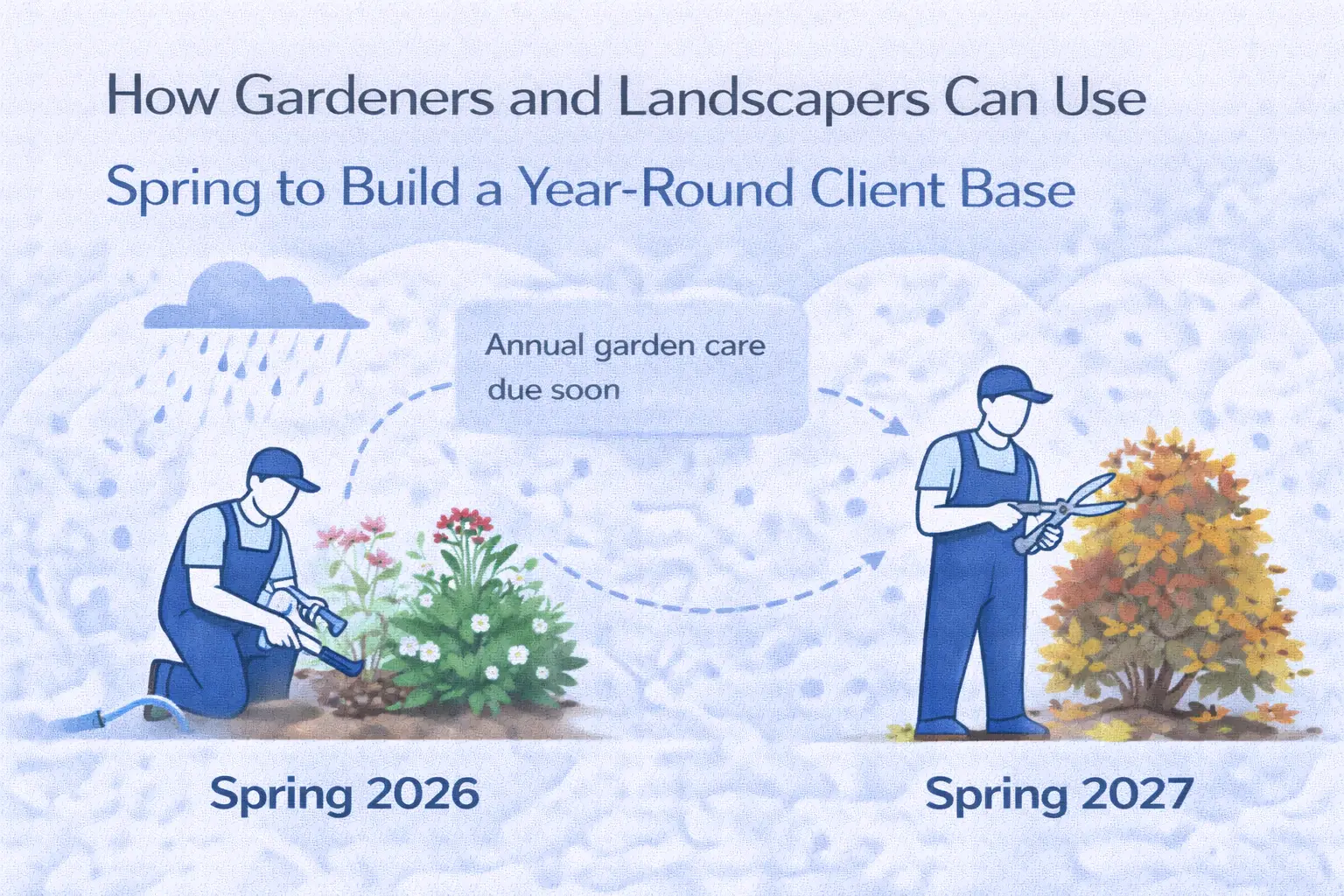
Spring is when the phone starts ringing. After months of cold, wet weather, homeowners look out at their neglected gardens and reach for the number of a local gardener. For small gardening and landscaping businesses across the UK, March through May is peak season - the weeks when you book more jobs than any other time of year.
Contents
- Why gardening is the perfect business for seasonal reminders
- The hidden cost of not following up
- How to capture client details during spring season
- Setting up seasonal reminder campaigns
- SMS templates that work for gardeners
- From one-off jobs to year-round contracts
- Practical tips for gardeners getting started
- Getting started: a quick action plan
But here is what most gardeners miss: every spring client is not just a one-off job. They are a potential recurring customer for the next three, four, or even five seasons. The homeowner who needs a spring tidy-up in March will likely need lawn mowing through summer, a leaf clearance and autumn preparation in October, and then another spring clean-up the following year. If you capture their details now, you can reach out automatically before each season - filling your diary without chasing new leads.
The problem is that most small gardening businesses don't have a system for this. The job gets done, the customer pays, and both parties move on. By the time autumn rolls around, the customer has forgotten your name. By next spring, they Google "gardener near me" and end up with someone else.
This article shows you how to turn this year's spring clients into long-term recurring customers using simple, automated SMS reminders for gardeners and landscapers. The whole concept is to make the best use out of your hard work in customers' gardens and convert that info into future jobs.
Why gardening is the perfect business for seasonal reminders
Gardening is one of the most naturally cyclical services in the UK. Unlike a one-off tradesperson job like fitting a kitchen, gardens need attention throughout the year. The work follows a clear seasonal rhythm:
Spring (March - May): Garden clean-up, lawn care restart, border tidying, planting, pruning spring-flowering shrubs, patio cleaning, first mowing of the year.
Summer (June - August): Regular lawn mowing, hedge trimming, watering, weeding, deadheading, and pond maintenance.
Autumn (September - November): Leaf clearance, lawn aeration and overseeding, cutting back perennials, planting spring bulbs, preparing beds for winter.
Winter (December - February): Tree pruning, hard landscaping projects, fence repairs, garden planning for the following year.
Each of these seasons represents a natural touchpoint where a well-timed text message can bring a customer back. And unlike MOT testing or boiler servicing, where there is one annual cycle, gardening offers three or four opportunities per year to re-engage a customer.
The UK landscaping services industry was valued at £6.8 billion in 2023 and continues to grow. With approximately 87% of UK households having access to a private garden, the addressable market is enormous. But most small gardening businesses compete on word of mouth and local reputation alone, with no system for proactively reaching out to past customers when the next season arrives.
The hidden cost of not following up
Let's say you complete 80 spring jobs this year, charging an average of £120 per job for a garden tidy-up. That is £9,600 in spring revenue alone. Now, how many of those 80 customers will call you again in autumn without being prompted? Based on typical retention rates for service businesses without follow-up systems, the answer is somewhere between 15% and 30%.
That means 55 to 70 of those spring customers simply drift away. Not because they were unhappy with your work, but because life got in the way and they forgot who did their garden last time.
If even 20 of those lost customers had come back for an autumn service at £100 each, that is £2,000 in recovered revenue. Add summer lawn care contracts and you are looking at significantly more. The cost of sending 80 text messages? Roughly £19.
Calculate your potential profit
See how much you can earn by recovering lost customers
Your data
What that could be worth
5-year projection
Assumes every recovered customer then returns each year
No credit card required • Full access • 10 SMS per month
Both percentages here are assumptions you set, not measurements. What we have actually measured, and the published research on reminders: our sources.
The maths is hard to argue with. A simple reminder system pays for itself many times over.
How to capture client details during spring season
Spring is your biggest opportunity to build a database of clients you can contact throughout the year. Here is how to do it without adding complexity to your day:
Ask for a mobile number as standard. When you quote a job or confirm a booking, ask for a mobile number. Most customers expect this - they want to know when you are arriving. Frame it naturally: "I will text you the morning of the job to confirm timing." You now have a number you can use for future seasonal reminders too.
Keep records simple. You do not need a CRM. A spreadsheet with four columns - name, phone number, date of last job, and type of work done - is more than enough. If you prefer, tools like Remindlo let you add clients one at a time from your phone, so you can do it between jobs. You can even take a picture of a paper calendar if you still use it and convert it into digital records within 30 seconds, so they are ready for SMS reminders.
Note what you did. Writing down "spring clean-up, lawn mowed, borders weeded, hedge trimmed" takes 30 seconds and makes your autumn reminder far more useful. Instead of a generic "time for autumn garden maintenance," you can send something specific and personal.
Mention it upfront. Let customers know you will send a seasonal reminder when their garden needs attention again. Most people appreciate this - it is one less thing for them to think about. It also sets the expectation and covers your GDPR basis for legitimate interest.
Setting up seasonal reminder campaigns
The most effective approach is to create separate campaigns for each season. This way, you can tailor your messages and timing to match what the garden actually needs.
Here is a practical example of how a small gardening business might structure its reminders:
Campaign 1: Spring Garden Service
Trigger: Customer's service date from the previous year
Reminder 1 (mid-February): "Spring is nearly here - shall we book your garden tidy-up before our diary fills up?"
Reminder 2 (early March): "Just a nudge - we have a few slots left this month for spring garden clean-ups."
Campaign 2: Summer Lawn Care
Trigger: 8 weeks after spring service
Reminder: "Your lawn will be growing fast now. We offer regular mowing visits through summer - call us to find out more."
Campaign 3: Autumn Garden Preparation
Trigger: Mid-September
Reminder: "Hi {name}, autumn is the best time to prepare your garden for winter. Leaf clearance, lawn feed, and cutting back - shall we book you in?"
Campaign 4: Spring Re-engagement (following year)
Trigger: 11 months after first spring service
Reminder: "Hi {name}, we tidied your garden last spring and it is nearly that time again. Booking early means you get your preferred date."
The key is the recurrent visit feature. Once you mark a job as complete, the system automatically schedules the next round of reminders. You set it up once, and it runs year after year, bringing clients back without you lifting a finger.
This is exactly what tools like Remindlo are designed for. You create your campaigns, add your clients with their last service date, and the system takes care of the rest. No spreadsheets to maintain, no diary notes to check, no "I must remember to text Mrs Jones about her autumn clean-up."
SMS templates that work for gardeners
Here are ready-to-use message templates for each season:
Spring (February/March):
Hi {name}, spring is on the way and gardens are waking up. We did your spring tidy-up last year - shall we get you booked in again before our diary fills up? Reply or call [number]. - [Business Name]
Summer (May/June):
Hi {name}, the grass is growing fast now! We offer regular lawn mowing visits through summer. Want us to keep your garden looking sharp? Reply for details. - [Business Name]
Autumn (September/October):
Hi {name}, autumn is here and your garden could use some attention before winter. Leaf clearance, lawn care, and cutting back - we have slots available this month. - [Business Name]
Year-round follow-up (after completing a job):
Thanks {name}, great to work on your garden today. We will be in touch before the next season so your garden stays in top shape all year. - [Business Name]
Need more ideas? Remindlo's free SMS template generator creates messages tailored to your industry and business name.
From one-off jobs to year-round contracts
Seasonal reminders do more than just bring customers back for individual jobs. They create a natural pathway to regular maintenance contracts - the holy grail for small gardening businesses.
Here is how it works in practice: A customer books you for a spring tidy-up. You do a great job and add them to your reminder system. In June, they get a text about summer lawn care and book a few mowing sessions. In September, they book an autumn clean-up. By the second spring, they say "Can you just come every month? Here is my key."
That progression from one-off customer to regular contract client happens naturally when you stay in touch. The reminder does the work of keeping your name at the top of their mind.
For a small gardening business, even 10-15 regular monthly clients at £80-120 per visit creates a stable base income of £800-1,800 per month before you take on any one-off work. That stability is transformative for a seasonal business.
Practical tips for gardeners getting started
Start this spring. Do not wait until your systems are perfect. Even if you just collect phone numbers this spring and send your first batch of autumn reminders manually, that is better than doing nothing.
Focus on the best clients. Not every customer is worth chasing. Prioritise the ones with larger gardens, higher job values, or those who mentioned they need regular help. These are the people most likely to become recurring clients.
Use quiet time wisely. Winter is when you should be setting up your reminder campaigns and importing your client list. When spring hits, you want to be focused on doing the work, not on admin. If you use Google Calendar to manage your schedule, look for tools that connect directly so you do not double-handle data.
Keep messages short and personal. Mention the specific work you did, use their first name, and make it easy to respond. A text that says "Hi Sarah, we did your hedge trimming and border work last October - spring is here, shall we get you booked in?" outperforms a generic marketing message every time.
Track what works. After your first full year of sending reminders, review which messages got the best response rates. Was it the February early-bird message or the March "last few slots" message? Use what you learn to improve next year's campaigns.
Getting started: a quick action plan
This spring: Collect a name and mobile number for every client. Note the work you did and the date.
By June: Import your spring clients into a reminder tool built for recurring services. Set up a "Summer Lawn Care" campaign.
By September: Send your first round of autumn reminders. Track how many clients rebook.
By January: Set up your "Spring Re-engagement" campaign for February. Your 2027 spring diary should start filling up before the season even starts.
Review and refine. Each year, your client list grows, your messaging improves, and your seasonal revenue becomes more predictable.
Gardens need year-round care, and homeowners need someone they trust to provide it. With a simple reminder system, you can be the gardener who never lets them forget - filling your calendar season after season, without spending a penny on advertising.
Want to turn your spring clients into year-round customers? Create a free Remindlo account and set up your first seasonal gardening campaign in minutes. No credit card required.
Related reading:
More seasonal trade guides - why roofers should book autumn inspections and bicycle service shops, plus tyre shops in the autumn changeover
SMS Reminders for Mobile Service Businesses: The Complete UK Guide
SMS reminders for gardeners and landscapers - how the seasonal campaigns in this article are set up