Every No-Show in Your Clinic Costs You Two Patients, Not One: A 2026 Guide for UK Osteopaths, Physios and Acupuncturists
 by Peter Bednarek, Founder
Solo osteopaths, physiotherapists, and acupuncturists are losing more than a slot when a patient does not turn up. They are also losing the person on the waiting list who never got that slot - and who quietly drifts to another clinic.
Contents
An allied health practitioner recently posted on social media something that captures the exact frustration thousands of small clinics feel every week:
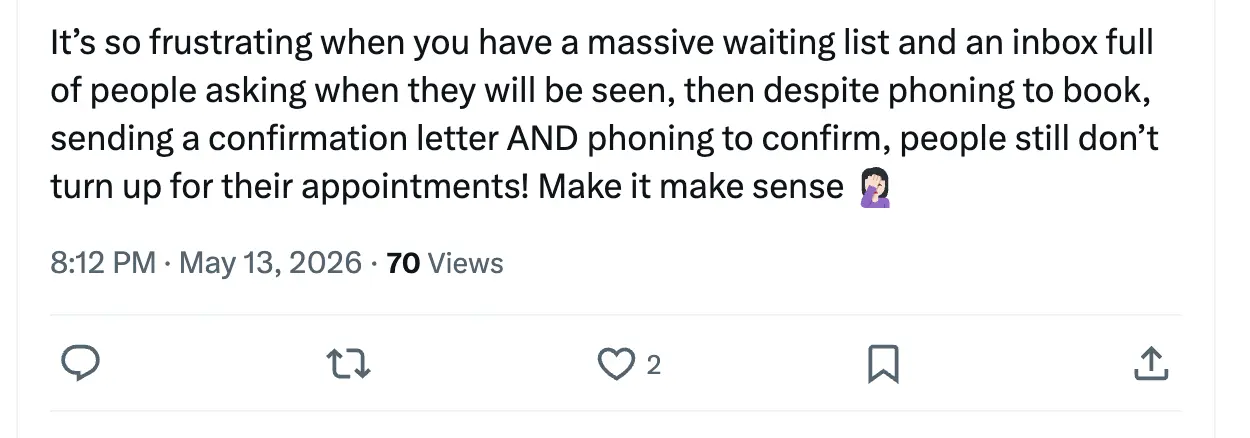
She is not exaggerating. She is describing the reality of running a single-handed practice in 2026 - where the patient who does not show up is only half of the problem.
The hidden cost most clinics never put on paper
When a solo practitioner adds up the cost of a no-show, the usual maths looks like this:
One hour of clinical time lost
Around £50 to £80 in revenue gone, depending on the discipline and region
Maybe a treatment room standing empty and a kettle going cold
That is the visible loss. The invisible loss is bigger.
If your inbox has people asking when they can be seen - and most allied health practices in the UK have exactly that - then every empty slot is a slot that someone else would have taken. The person who did not show up costs you their fee. The person on the waiting list who never heard about the cancellation costs you their future loyalty, because in a few weeks they will book somewhere else.
A no-show is not one lost patient. It is two:
The booked patient who did not arrive
The waiting patient who never got the slot - and now has a relationship with a different clinic
For a solo osteopath running 25 to 30 appointments a week, even a 10% no-show rate compounds into a serious leak. Three no-shows a week is around £200 to £240 in direct revenue gone, plus three patients from the waiting list who quietly stop replying to your "we will be in touch when something opens up" emails.
Why solo clinics get hit hardest
A large physio chain has front desk staff, automated systems and overflow appointments. A solo osteopath, single-room physiotherapist or independent acupuncturist usually has none of that.
You are the diary, the receptionist, the practitioner, the cleaner and the marketing team. Every hour during the working day is either generating revenue or being absorbed by admin. When a patient does not arrive at 10:30, the hour does not get reabsorbed elsewhere - you sit, you reset the room, you check your messages, and then the next patient walks in.
The single-handed nature of the work also means there is no buffer:
No second therapist who can pick up the slot
No receptionist who can phone the waiting list while you treat someone else
No software-driven backfill system filling cancellations automatically
In a chain clinic, a no-show is an inconvenience. In a solo practice, a no-show is a hole punched directly into your weekly income.
Why phone calls, letters and confirmations are no longer enough
That post hits hardest because the practitioner did everything right by the old playbook:
A phone call to book the appointment
A confirmation letter
A second phone call to confirm
And patients still did not show up.
The reason is not that patients have become rude. It is that the channels she used are no longer where people actually pay attention in 2026.
Phone calls in 2026 land in voicemail more often than not. Most people screen unknown numbers. Confirmation letters arrive two or three days after they are sent, often when the patient is no longer thinking about the appointment at all. Even a confirmation call from the clinic the day before competes with a notification stack already full of WhatsApp messages, work emails and supermarket delivery updates.
SMS is the one channel that still earns attention almost by default. UK industry data consistently puts text message open rates at around 98%, with most messages read within three minutes. There is no spam folder, no signal-to-noise problem, no "I will read it later" inbox. A short, polite reminder lands on the lock screen and gets seen.
For a small allied health clinic, this is the difference between a forgotten appointment and a kept one.
What actually works for solo allied health clinics
There is no clever trick to this. The reminder strategy that works for osteopaths, physios and acupuncturists is the same one that works for any single-handed clinic, and it has three components:
1. One reminder, sent at the right time
Two reminders is fine. Three is starting to feel like nagging. The single most useful reminder is the one that lands roughly 24 hours before the appointment - long enough for the patient to rearrange if needed, short enough that they have not forgotten by the time they need to leave.
A second, optional reminder a couple of hours before can help with patients who have a history of running late or missing morning slots.
2. Short, neutral and personalised
A reminder that says:
Hi Sarah, just a reminder of your appointment with Smith Osteopathy tomorrow at 10:30. Last minute changes? Just call/text us at +44 7700 900000 🙏
works better than a long, formal message. Patients respond well to being addressed by name, to seeing the clinic name (so they know who is texting), and to a single, clear piece of information.
3. Automated, not manual
The reason solo clinics stop sending reminders is not that they do not believe in them. It is that doing it manually adds half an hour of admin to every day, and that half hour gets eaten by something more urgent every single time.
The reminders need to send themselves. That usually means a tool that reads from your existing calendar - rather than asking you to maintain a second list - and sends the message automatically the day before.
A real example from a solo osteopath
One of the practices that started using Remindlo recently is a solo osteopath in the UK. The setup took roughly ten minutes:
Sign up for the free forever account
Connect Google Calendar
Let the tool read the next few days of appointments 🤖
By the time the connection finished, the system had already queued reminders for every confirmed appointment over the coming days. The result with his diary being full - every appointment was getting a text the day before.
That is exactly the right amount of effort for a solo clinic: one decision, ten minutes of setup, and reminders that keep working without further attention.
It is also a quiet but useful proof that allied health clinics are sitting on a calendar that is already doing most of the work. Patient names are there. Times are there. Phone numbers are usually there. The only thing missing is the automated step that turns a calendar entry into a text message.
The waiting list problem solves itself
Once your no-show rate drops, something quietly satisfying happens: the waiting list starts to move.
The patients who did show up free up slots more predictably. The patients who would have no-showed now turn up. And the patients on the waiting list - the ones in that frustrated social media post, the ones filling clinic inboxes across the UK - start to actually get appointments, instead of drifting to a competitor.
You do not need to solve the waiting list directly. You just need to stop wasting slots that you already booked.
What to do next
If you run a solo osteopathy, physiotherapy or acupuncture practice and you are losing time to no-shows, the cheapest intervention you can make is to send a single SMS reminder 24 hours before each appointment.
You can do this manually if your week is quiet. If it is not, it is worth looking at a reminder tool that reads from Google Calendar so you do not have to enter appointments twice.
Remindlo was built for clinics in exactly this position. The free forever account gives you ten SMS to test it on your real diary, and the Google Calendar integration means you do not have to change anything about the way you already work.
Try Remindlo for free
Read more about reducing no-shows in service businesses
See how SMS reminders for physiotherapy and allied health clinics work in practice
If you run a talking-therapy practice, see appointment reminders for therapists
If you run early or late clinics, see what an early morning no-show actually costs
A no-show is not one lost patient. It is two. The good news is that fixing it is cheap, fast, and something you can do before your next clinic day. If you want to dig deeper into a customer lifecycle see our guide on The Three SMS Touchpoints Every Service Business Should Automate (Most Only Use One).