Your Past Customers Forgot About You. Here's How to Fix That
You had customers last year. They were happy with your work. They just haven't come back yet. Not because they found someone better - because nobody reminded them. Here's how to fill your quiet days without spending a penny on advertising.
Contents
You did good work last year. Customers were happy. They paid on time, said thanks, maybe even left a review. And then they disappeared.
Not to a competitor. Not because anything went wrong. They just forgot.
Their boiler service is three months overdue. Their dog's vaccination lapsed in January. Their car failed its MOT reminder letter from DVLA because they didn't realise the date had crept up. They meant to call you. They just didn't.
Meanwhile, you're looking at next Tuesday and wondering why it's half empty.
You're not the only one. Google searches for "empty calendar" in the UK have spiked to record levels in recent months. More business owners are staring at gaps in their diary than at any point in the last five years.
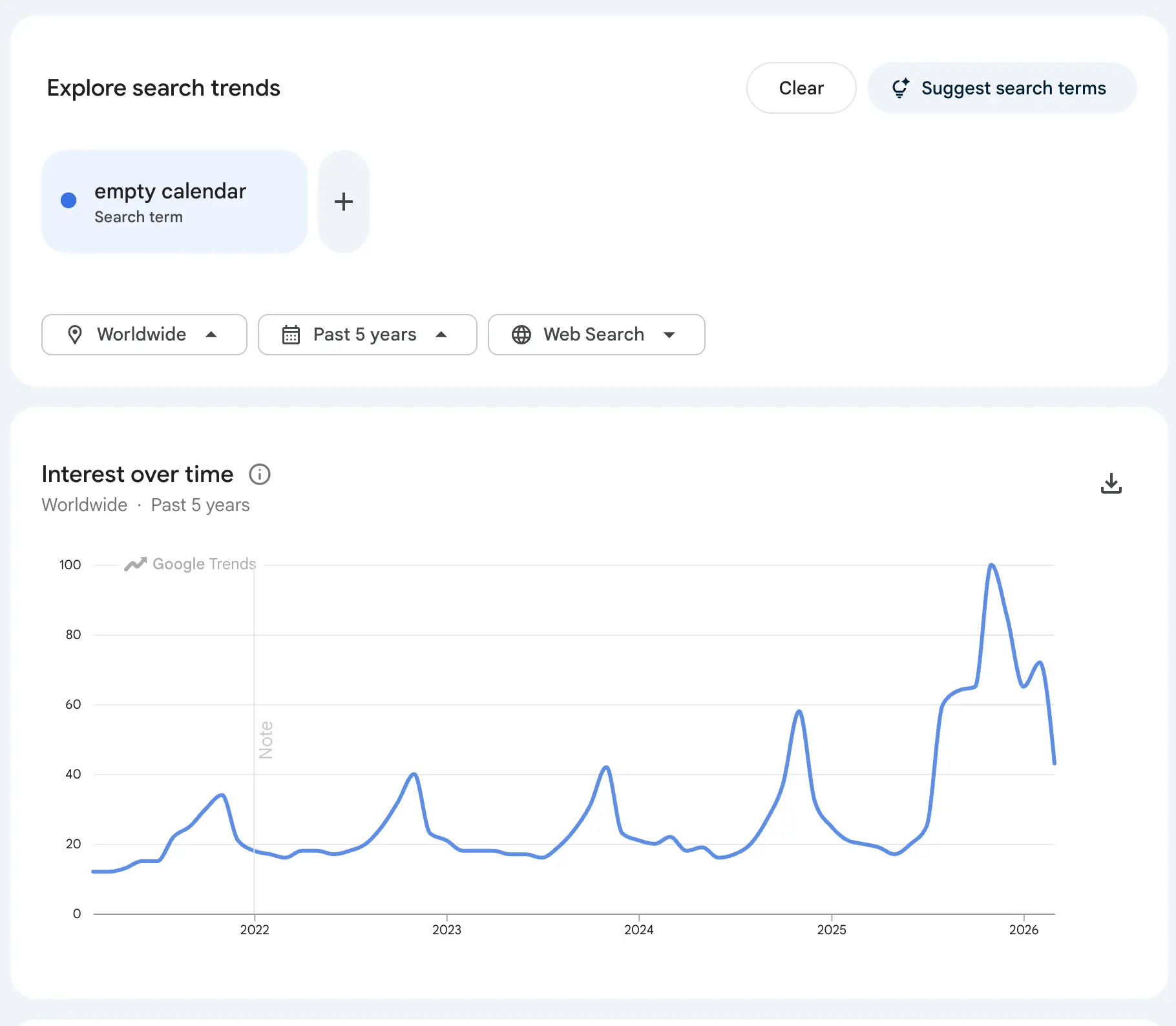
Google Trends: "empty calendar", Worldwide, Past 5 years
This isn't a marketing problem. You don't need a better website, more Google reviews, or a Facebook campaign. You need to text the people who already trust you and say: "Hi, your service is due. Want to book in?"
That's it. That is the whole strategy.
The maths behind your quiet days
Take a number. How many customers did you serve last year? If you run a small garage, it might be 200. A heating engineer, maybe 150. A vet practice, 400 or more.
Now ask yourself: how many of them have already come back this year?
If you don't know the exact answer, you're not unusual. Most small service businesses don't track this. Customers come in, you do the work, they leave, and you hope they come back when the time is right.
But here's what actually happens. Research from the trades consistently shows that 20 to 30 percent of customers who should return for a recurring service simply don't. They forget. They get busy. They see an advert from someone else at exactly the moment they remember they need a service.
Let's put money on that. If you served 200 customers last year and each job was worth an average of 80 pounds, losing 20 percent means 40 customers gone. That's 3,200 pounds in lost revenue. Not because they were unhappy. Because nobody reminded them.
And that 3,200 doesn't account for the years after. A customer who comes back annually for ten years is worth 800 pounds to your business. Lose 40 of those customers permanently and you've lost 32,000 pounds over the next decade. From one year of not sending a text message. Each calculation does not include additional services and products you naturally sell along those visits - fixing breaks in a car, replacing filters, or additional vaccinations. So, it's not only regular money, but also each extra pound you are not earning.
Why this matters more right now
You can feel it already. Costs are up everywhere. Fuel, parts, National Insurance, wages. Everything that goes into running a van-based business costs more than it did a year ago.
At the same time, customers are more careful with their money. They're not cutting essential services entirely, but they're stretching the gaps. The annual boiler service becomes every 15 months. The six-weekly dog groom becomes every ten weeks. They're still spending, just less often and with more thought about where.
And when they do book, they're less reliable about showing up. Worldwide searches for "no show" have climbed steadily over the past two years and hit an all-time high in early 2026. Customers are forgetting appointments, cancelling last minute, or simply not turning up. It's another symptom of the same problem: people are distracted, stretched, and your business isn't top of mind.
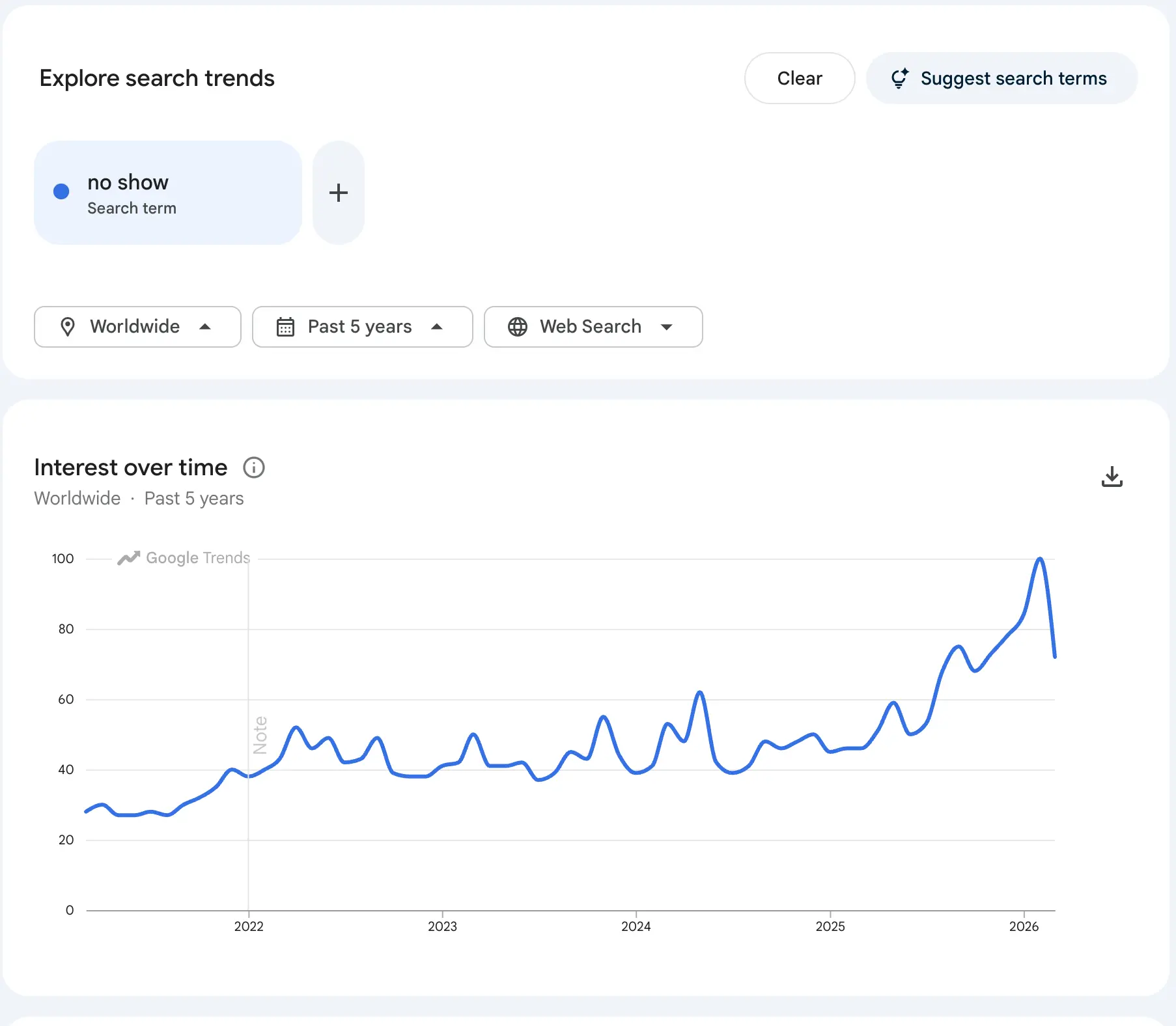
Google Trends: "no show", Worldwide, Past 5 years
This means two things for you.
First, every customer you lose hurts more than it used to, because replacing them is expensive. Running Google Ads in 2026 costs more per click than it did in 2024. Getting found on Google at all is harder now that AI answers are pushing organic results down the page. Your next new customer will cost you more time and money to win than the last one did.
Second, the customers you already have are worth more than ever. They already trust you. They already know where you are. They've already decided your price is fair. All they need is a nudge at the right time.
What a nudge actually looks like
You don't need to write a newsletter. You don't need an email sequence with a funnel and a lead magnet. You need a text message that arrives at the right moment.
Here's what that looks like in practice.
A customer brings their car in for an MOT in March 2026. You do the work, they pay, they leave. At that point, you save their name, phone number, and the date their next MOT is due: March 2027.
Eleven months later, in February 2027, they get a text: "Hi Sarah, your MOT is due next month. Want to book in? Call us on 01234 567890 or reply to this text. - Smith Garage."
That's it. No discount code. No marketing gimmick. Just a helpful reminder from a business they already know, arriving at exactly the moment they need it.
The numbers on this are striking. SMS messages have a 98 percent open rate. Almost everyone reads a text within three minutes. Compare that to email at roughly 20 percent, or a social media post that maybe 5 percent of your followers see. When you send a text, it gets read.
And because the timing is right, because the service is genuinely due, it doesn't feel like marketing. It feels like good service. Customers thank you for reminding them. They don't unsubscribe. They book in.
"I already do this with my diary"
Maybe you do. Some business owners keep a paper diary and flip back through it to see who's due. Some have a spreadsheet. Some have a good memory.
The problem with all of these is that they depend on you. They work when you have time, when you remember, and when things aren't busy. The moment you get slammed with a rush of jobs, the follow-up calls stop. And those are precisely the weeks when next month's quiet days are being created.
The other problem is scale. Calling 20 customers is doable. Calling 150 takes a full day. Sending 150 text messages takes about three seconds if you've set them up to go out automatically.
And there's a subtlety here that matters. The best time to remind a customer is before they realise they need to think about it. If their boiler service is due in October and you text them in mid-September, you're the first voice in their head. If you wait until November, they've already seen a leaflet from someone else, or their neighbour mentioned a different engineer. Timing is everything, and automatic reminders never forget the timing.
What you need to make this work
You need three things.
A list of your customers with their contact details and service dates. This doesn't need to be fancy. Name, mobile number, what service they had, and when it's next due. If you've been in business for more than a year, you have most of this already in invoices, job sheets, or your phone contacts. It just needs to be in one place. Then put it in a system - either manually, take a photo, or put it as a CSV.
A way to send text messages automatically when a service is due. Not bulk marketing texts. Not promotional blasts. Targeted, individual reminders that go out at the right time for each customer. "Your MOT is due next month." "Your boiler service was last done 11 months ago." "Bella's vaccination is due in three weeks."
A system that repeats this every year without you having to think about it. This is the bit that paper diaries and spreadsheets can't do. Once a customer's service is marked as recurring, the next reminder should schedule itself. You set it up once and it runs in the background while you're under a car or up a ladder.
This is what Remindlo does. You add your customers, set their service dates and reminder intervals, and the system handles the rest. You can see who's been reminded, who's booked back in, and who might need a follow-up call. It starts at 19 pounds a month, and there's a free plan if you want to test it with a handful of customers first.
But whether you use Remindlo or a spreadsheet and a pay-as-you-go SIM card, the principle is the same: stop waiting for customers to remember you and start reminding them yourself.
The garage that stopped losing customers
Here's a scenario that plays out across the UK every week.
A small MOT and service garage in a market town has about 250 regular customers. The owner, let's call him Dave, has been running the place for twelve years. Good reputation, steady work, but he's noticed the last two winters have been quieter than they should be.
Dave has never tracked who comes back and who doesn't. Customers just show up when their MOT is due, or they don't. He figured the ones who stopped coming must have moved house or changed cars.
Then he goes through his old invoices. Of the 250 customers he served two years ago, 70 haven't been back. That's 28 percent. At an average of 120 pounds per MOT and service, he's looking at 8,400 pounds in lost annual revenue.
He collects the phone numbers of those 70 customers and sends a simple text: "Hi, this is Dave at Market Street Garage. We noticed your MOT might be coming up. Give us a ring if you'd like to book in."
Twenty-two of the seventy reply. Eighteen book in within the month. That's 2,160 pounds recovered from one afternoon of sending texts.
Now imagine that happens automatically, every month, for every customer whose service date is approaching. Not 70 customers once. All 250, every year, at exactly the right time.
There's a reason more businesses are looking into this. Search interest in "service reminders" was flat for years and then exploded in late 2025. Business owners across the world are waking up to the same thing Dave figured out: the easiest way to fill your calendar is to remind the people who were already on it. What's also important is that the trend could also mean that your competitors will target your customers with that kind of service reminder. The longer you do not use it, the bigger the chance they will be the first to send out that text.
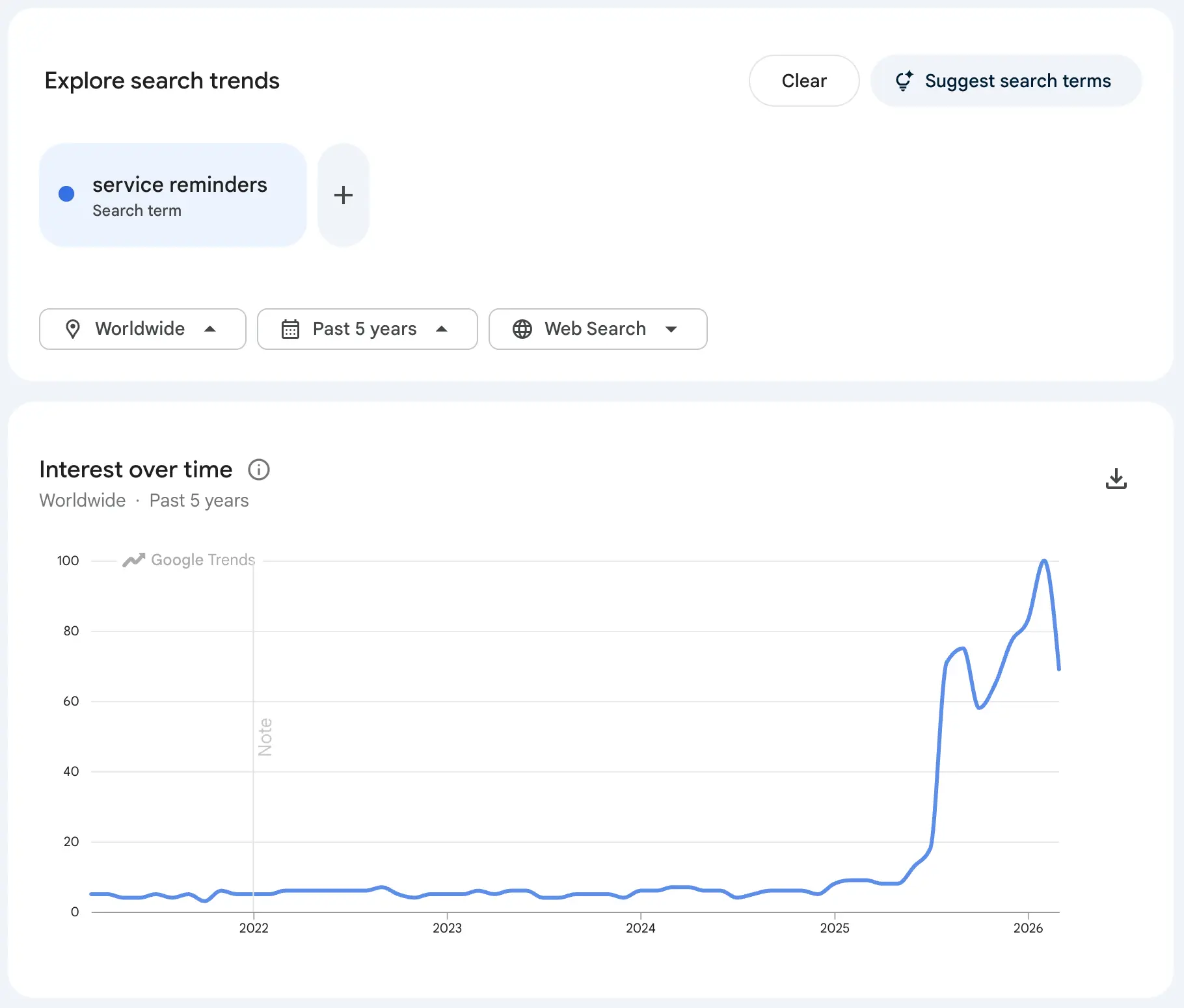
Google Trends: "service reminders", Worldwide, Past 5 years
What to do this week
You don't need to overhaul your business. You need to do one thing.
Pick up your invoices or job records from this time last year. Find ten customers who haven't been back. Text them. Something simple: "Hi [name], it's [your business]. Your [service] was last done about a year ago. If you'd like to book in, give us a call on [number]. Cheers, [your name]."
See what happens. If three or four of those ten reply, you've just proved the concept to yourself.
Then think about what it would look like if this happened for every customer, automatically, every time a service was due. That's the difference between hoping customers come back and making sure they do.
Your customers didn't leave. They just forgot. Remind them.
Frequently asked questions
Do I need consent to send reminders to past customers?
For service reminders about work the customer has already had done with you, UK rules generally allow you to rely on "legitimate interest" under UK GDPR. This means you can send a reminder that their boiler service or MOT is coming due without asking for separate marketing consent. The message must be directly relevant to a service they've already used with you. If you're sending promotional offers or marketing to people who haven't used your service, you need explicit opt-in consent. Read more about PECR and UK GDPR rules for small businesses on the ICO website.
How much does it cost to send SMS reminders?
Individual text messages typically cost between 3p and 20p depending on the platform and volume. For a small business sending 50 to 200 reminders a month, expect to spend between 15 and 50 pounds monthly. Most businesses find that recovering even one or two customers per month more than covers the cost.
Won't customers find text reminders annoying?
The opposite is usually true. When a reminder is timed correctly and relevant to a service the customer genuinely needs, people appreciate it. They see it as good service, not marketing. The key is timing: a message that says "your boiler service is due next month" arriving eleven months after the last service feels helpful. A generic "we miss you" message arriving randomly feels like spam.
What's the difference between appointment reminders and service reminders?
Appointment reminders confirm something already booked: "Don't forget your appointment tomorrow at 2pm." Service reminders are proactive: "Your annual service is coming due, would you like to book?" Most small service businesses need the second type. The first assumes the customer has already called and booked. The second is what gets them to pick up the phone in the first place.
I only have 50 customers. Is it worth setting up reminders?
Yes. In fact, smaller customer bases make each individual customer more valuable to your business. If you serve 50 customers a year and lose 10 because they forgot, that's 20 percent of your revenue at risk. A simple reminder system costs less than losing a single customer. In fact, it can be free. Still not convinced? Use the ROI calculator below.
Calculate your potential profit
See how much you can earn by recovering lost customers
Your data
What that could be worth
5-year projection
Assumes every recovered customer then returns each year
No credit card required • Full access • 10 SMS per month
Both percentages here are assumptions you set, not measurements. What we have actually measured, and the published research on reminders: our sources.
Related reading:
How Mobile Service Businesses Bring Customers Back Year After Year
Seasonal reminders for gardeners and landscapers - a worked example of winning back last year's customers