Why SMS Is the Right Reminder Channel for Businesses With Older Customers
 by Peter Bednarek, Founder
When your customers are older, the reminder channel matters more than the message. A perfectly written reminder inside an app most of them will never download is worth nothing. A plain text message, sent to a phone they already own and already know how to read, arrives every time. This is the case for SMS as the default channel for any business whose customer base skews older - and two real examples of it working.
Contents
- The friction tax nobody prices in
- Why SMS is the universal channel
- Example one: a hearing-care clinic, protecting the appointment
- Example two: a mobility retailer, capturing the service revenue
- The revenue hiding in the service cycle
- Accessibility is good business, not just good manners
- When SMS is the whole strategy
- Frequently asked questions
Most advice about customer reminders quietly assumes a customer who lives on their phone: downloads apps without a second thought, has a business saved as a WhatsApp contact, checks email hourly, and taps through a booking portal without help. For a large and commercially valuable set of businesses, that customer is not the typical one.
Audiology clinics, mobility and daily-living equipment retailers, chiropodists, opticians, dentists with a long-standing patient list, care-adjacent services - these businesses serve a customer base that is, on average, older. And for an older customer base, every layer of technology you put between your reminder and their attention is a layer that loses people. It's not that older customers can't use technology - many use it well - but it's an extra step like an app to install, an account to create, a password to remember, a data connection to have). It's a flow where a reminder silently fails to land.
SMS removes every one of those layers. That is the whole argument, and it is a stronger one than it first appears.
The friction tax nobody prices in
Every reminder channel except SMS asks something of the customer before the reminder can even reach them. It is easy to overlook because, for a younger or more digitally fluent audience, the asks are near-invisible. For an older audience, they are real barriers, and they compound.
Consider what each channel actually requires the customer to have already done:
Channel | What the customer must already have done |
|---|---|
WhatsApp / Telegram reminder | Own a smartphone, install the app, create an account, have a data or Wi-Fi connection, and save your business as a contact |
App-based reminder (your own or a booking platform's) | Own a smartphone, find and download the right app, create an account, remember the login, keep notifications switched on |
Email reminder | Have an email address they check, know their password, and not have your message filtered into spam or "Promotions" |
Booking-portal reminder | All of the above, plus navigate a web login |
SMS | Own any mobile phone that can receive a text. That is the entire list. |
For a customer in their seventies or eighties, the difference between "owns a phone that receives texts" and "has installed WhatsApp, created an account, and saved us as a contact" is the difference between a reminder that always arrives and one that mostly does not. The friction tax is paid by exactly the customers least able to pay it - and the business pays it too, in missed appointments and lost repeat visits it never even knows about.
Why SMS is the universal channel
SMS is the only messaging channel that is genuinely universal. It ships switched on with every mobile phone ever sold, from the cheapest feature phone to the newest smartphone. There is nothing to install, no account to create, no password to lose, and no data plan required - a text arrives over the cellular network whether or not the customer has ever touched mobile data or Wi-Fi.
For an older customer specifically, four things make it the right choice:
It is already familiar. Text messaging predates the smartphone. For someone who is 75 today, SMS has been part of ordinary life for over twenty years. It is not a new technology they have to learn - it is the one digital message format this generation is most comfortable with.
It costs the customer nothing. In the UK, receiving a text is free. There is no subscription, no data cost, no in-app purchase. The customer is never asked to spend money or make a decision to receive your reminder.
It costs the customer no effort. No downloading, no signing up, no remembering. The message simply appears on the home screen next to texts from their family.
It gets read. SMS open rates sit around 98 per cent, with most messages read within minutes of arrival. A text does not disappear into an unchecked inbox or a notification the customer has learned to ignore.
None of this is clever. That is precisely the point. The channel that wins with older customers is the one that asks nothing of them, and SMS is the only one that qualifies.
The two examples below are real Remindlo customers - anonymised, but their businesses and the way they use reminders are described exactly as they work. One uses SMS to protect appointments it has already booked. The other uses it to capture recurring service revenue that would otherwise quietly evaporate. Together, they show both ends of the value.
Example one: a hearing-care clinic, protecting the appointment
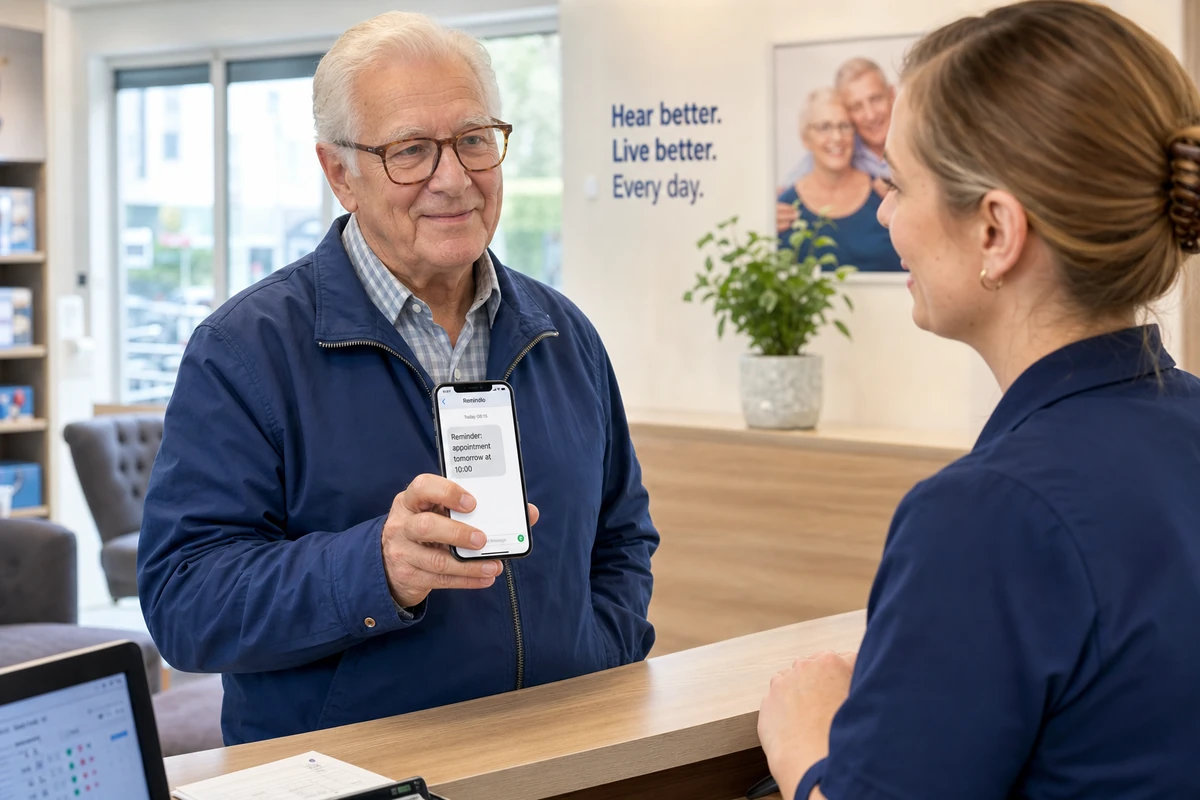
The first is an independent audiology and hearing-care practice - the kind of business that fits, adjusts, and services hearing aids and carries out hearing assessments. Its patients are, almost by definition, older, and many have some degree of hearing difficulty.
That last detail matters more than it looks. The traditional fallback for reminding a customer - a phone call - is the single worst channel for someone with hearing loss. A phone call is hard to hear, easy to miss, and impossible to re-read. An email assumes a checked inbox this patient may not have. A booking-app notification assumes a smartphone and an installed app.
A text message is the opposite of all of that. It is silent, visual, and permanent. The patient can read it at their own pace, re-read it, and show it to a family member. It sits on the phone until the appointment.
The clinic sends a simple pre-visit reminder the day before, along these lines:
Hi, your appointment is tomorrow at 2:30pm with Valley Hearing Care. To reach us, please call the practice on 01234 567890.
Short, clear, dated, with the practice's own number to call if anything needs changing. It does exactly one job - make sure a patient who booked an appointment actually remembers it - and it does that job through the one channel this patient base can reliably receive.
The commercial logic is the same as it is for any appointment-based business: a clinician's time is booked out in advance, and an unfilled slot is revenue that cannot be recovered. But the accessibility logic is what makes SMS non-negotiable here rather than merely convenient. For this clinic, there is no realistic alternative channel that reaches the whole patient list.
See how pre-visit reminders reduce no-shows →
Example two: a mobility retailer, capturing the service revenue
The second is a retailer of mobility and daily-living equipment - mobility scooters, powerchairs, wheelchairs, rise-and-recline chairs, and the aids that help less-mobile and older customers stay independent. Its headline product is the mobility scooter: a considerable one-off purchase.
But the one-off sale is not where the most interesting money is. Equipment like a mobility scooter needs an annual service - for safety, for battery health, for warranty, and to keep it running for the years the customer depends on it. That annual servicing is recurring revenue, and it comes at a higher margin than selling the scooter itself. For a business like this, servicing and aftercare can realistically account for something in the region of a third of service-side revenue, earned again and again from customers already won.
There is a catch, and it is the whole reason SMS earns its keep here. That servicing revenue only materialises if the customer comes back for the service. And this customer base - older, often less digitally connected, not the type to have a service reminder sitting in a calendar app - is exactly the group least likely to remember on their own, and least likely to be reached by an app-based nudge. A missed service is not just a lost booking; it is a lost high-margin, repeatable revenue stream, and a scooter that slowly falls out of safe use.
The retailer sends a reactivation reminder when each customer's annual service comes due:
Hi John, your mobility scooter annual service is due on 15/09/2026. To book, call us on 01234 567890 or pop into the shop at 5 High Street.
The message arrives at the exact moment the service is due, from a business the customer already trusts, with two easy ways to act: phone or walk in. No app to open, no portal to log into, no email to dig out. For a customer who bought a scooter two years ago and has not thought about servicing since, this text is the entire difference between a booked service and a scooter quietly going unserviced.
The system knows when to send it because it knows when the scooter was sold or last serviced. A retailer with hundreds of customers cannot track each service date by hand. Automated scheduling against each customer's last service date is what turns "we should really chase our servicing customers" into revenue that arrives on its own.
See how reactivation reminders bring customers back →
The revenue hiding in the service cycle
The two examples look different - one protects a booked appointment, the other resurrects a lapsed service - but they point at the same underlying truth. For a great many businesses serving older customers, the recurring, aftercare, or repeat visit is where the profit lives, and that visit depends entirely on the customer coming back.
The equipment sale, the initial fitting, the first assessment - these get all the attention because they are the visible transaction. But the annual service, the follow-up, the re-fit, the routine check are more frequent, often higher-margin, and far more predictable. They are also completely dependent on a reminder actually reaching the customer. A servicing programme that relies on the customer remembering by themselves is a servicing programme that leaks most of its potential revenue.
This is why the channel choice is not a minor technical detail. Choosing SMS over an app or email for an older customer base is not about being polite - it is about choosing the channel that actually captures the recurring revenue your business model is built on. Recurring and periodic reminders only work if they are received, and for this audience SMS is the channel that gets received.
Accessibility is good business, not just good manners
There is a genuine inclusion argument here, and it happens to line up perfectly with the commercial one. A meaningful share of older adults in the UK are digitally excluded to some degree - no smartphone, limited internet use, or simply no confidence with apps and accounts. Reminding these customers through an app is not neutral; it is a channel that structurally excludes a chunk of the very people the business serves.
Meeting customers on the channel they already use is both the fairer choice and the more profitable one. You do not ask an 80-year-old to download software to be reminded of the service that keeps their mobility scooter safe. You send them a text, the way their grandchildren have been texting them for years. The business that does this well is not being charitable - it is simply not throwing away the customers and the revenue that every app-first competitor is quietly losing.
When SMS is the whole strategy
For most businesses, SMS is one channel among several. For a business whose customers are predominantly older, it is closer to the whole strategy. The two examples in this article - a hearing-care clinic and a mobility retailer - could run their entire customer-communication programme on nothing but well-timed text messages and cover the two moments that matter most: making sure a booked appointment is kept, and making sure a due service is rebooked.
If you want the full picture of how those moments fit together across a customer's lifecycle, the companion piece on the three SMS touchpoints every service business should automate walks through the before, after, and reactivation messages as a system. But for a business with an older customer base, the starting point is simpler than any of that. It is a single decision about the channel: reach them where they already are, with a message that costs them nothing to receive and nothing to understand.
Start with 10 free SMS reminders - no credit card required →
Frequently asked questions
Do older customers actually read text messages?
Yes - more reliably than almost any other group. Text messaging has been part of everyday life since long before smartphones, so for today's older customers it is a familiar, low-anxiety format, not a new technology to learn. SMS is read at around a 98 per cent open rate across all age groups, and for older customers a text has real advantages over a phone call or email: it is silent, it can be read at their own pace, it can be re-read, and it can be shown to a family member. Many businesses serving older customers find SMS is the single most dependable way to reach their whole list.
What if a customer does not have a mobile phone at all?
A small minority will not, and for those customers you keep your existing channel - usually a phone call or a posted letter. The point of SMS is not that it reaches literally everyone, but that it reaches far more of an older customer base, far more reliably, than an app or email ever will. In practice the great majority of older customers do carry a mobile that receives texts, even if it is a basic handset rather than a smartphone - and SMS reaches basic handsets just as well as the newest phones.
Isn't a phone call more personal for older customers?
A call can be warmer, but it is also the least reliable channel and, for anyone with hearing difficulty, often the hardest. Calls get missed, go to voicemail, come at bad times, and leave nothing the customer can refer back to. A text is there on the screen until the appointment or service is dealt with. Many businesses use both: a text as the dependable reminder that always lands, and a phone call reserved for the conversations that genuinely need one. The two are complementary, not competing.
Do I need the customer's consent to text them reminders?
Under UK GDPR you need a lawful basis for the messages you send. For existing customers receiving reminders about a service they have already bought or booked - a due annual service, an upcoming appointment - the ICO's guidance recognises legitimate interests as a basis for these service-related messages. You should always include a simple opt-out (a "Reply STOP to opt out" line is standard) and honour opt-outs promptly. If you also hold explicit marketing consent, that gives you the broadest possible basis. When in doubt, keep the messages clearly tied to the customer's own service or appointment rather than general promotion.
How much does it cost the business to send SMS reminders?
Very little per message, and the return is high. A single reminder is a few pence. Set against the value of a kept appointment or a rebooked annual service - which for something like mobility-equipment servicing is a higher-margin, repeatable job - the cost of the text is trivial. Most businesses find that recovering even one or two otherwise-missed visits pays for a year of reminders many times over.
What about customers who use WhatsApp?
Some older customers do use WhatsApp, often to keep in touch with family, and there is nothing wrong with it as a channel. But it is not universal for this audience the way SMS is: it needs a smartphone, an account, a data connection, and your business saved as a contact. SMS reaches every customer with any mobile phone and needs none of that setup. If your customer base skews older, SMS is the channel that reaches all of them; WhatsApp reaches a subset. Start with the one that leaves nobody out.