The Three SMS Touchpoints Every Service Business Should Automate (Most Only Use One)
 by Peter Bednarek, Founder
Most service businesses touch their customers exactly once per cycle: when the appointment happens. The businesses growing fastest on word-of-mouth and repeat bookings do it three times. The gap between those two approaches is three short SMS messages - and a bit of automation.
Contents
- Why most businesses stop at the appointment
- Touchpoint 1: Before the appointment - protecting the revenue you already have
- Touchpoint 2: The day after - when your customer is most likely to leave a review
- Touchpoint 3: When it is time to come back - the message that decides whether they call you or Google your competitors
- The three touchpoints as a system
- How this works in practice
- Frequently asked questions
Think about the last time you had your car serviced, your boiler checked, or your teeth cleaned. Chances are you booked the appointment, turned up, and that was the end of the relationship until something prompted you to book again. Maybe that was a mailed card that arrived three months late. Maybe it was your own memory. Maybe it was, frankly, searching for "garage near me" because you had simply forgotten which one you used last year.
That search is where service businesses lose customers they already earned.
This article makes the case for three SMS touchpoints that together cover the whole customer lifecycle: before the visit, after the visit, and when it is time to come back. Each one is worth something on its own. Together, they close the gap between a one-off customer and a loyal one.
Why most businesses stop at the appointment
The instinct in most service businesses is to focus entirely on getting the appointment booked and delivered well. That is the right instinct - the service itself is everything. But the communication layer around it tends to go like this:
Customer calls or books online
Maybe a confirmation email goes out
Service happens
Customer leaves
Nothing happens until the customer either remembers or their car breaks down
In that model, the business is invisible for eleven months out of every twelve. During those eleven months, life moves on. The customer moves house. A competitor opens nearby. They get a leaflet through the door. They search on Google and get shown three other options with good reviews and a click-to-call button.
The service you delivered was probably fine. Possibly excellent. But "fine and invisible" loses to "visible and present" every time.
Three messages - one before, one the day after, and one when it is time to come back - change that picture without requiring a marketing budget, a social media strategy, or anything more sophisticated than a phone number and a piece of automation.
Touchpoint 1: Before the appointment - protecting the revenue you already have
The first message in the customer lifecycle is also the most straightforward: a reminder that the appointment is coming.
No-shows are the most expensive thing that happens in a service business. A slot that was booked but not filled costs you the revenue of that slot, the cost of holding it open, and in some cases materials or preparation work that went to waste (more on the topic of how much a missed appointment really costs). Across UK service businesses, no-show rates typically run between 8 and 15 per cent. For a business running 20 appointments a day, that is two to three slots a day lost to simple forgetfulness.
The largest single cause of no-shows is not protest or disorganisation. It is forgetting. Research consistently puts memory lapse at 60 to 70 per cent of missed appointments. That means the majority of your no-shows are people who fully intended to come, and simply did not have the appointment in mind when the day arrived.
An SMS reminder, sent at the right window before the appointment, fixes this with near-certainty. SMS open rates run above 95 per cent, with most messages read within three minutes of delivery. A text does not sit in an unread email folder. It arrives on the same screen people use for everything else.
The timing matters. Different service types warrant different windows:
Business type | Typical reminder window | Notes |
|---|---|---|
MOT / tyre service | 7, 3, and 1 day before | Customers may need to arrange transport |
Dental / healthcare | 14, 7, and 3 days before | Longer lead time for NHS and private practices |
Beauty salon | 7, 3, and 1 day before | Shorter cycle, shorter window |
Boiler / HVAC service | 21, 14, and 7 days before | Often involves an engineer visit window |
Veterinary clinic | 14, 7, and 3 days before | Vaccine due dates need advance notice |
What the message says is less important than the fact that it arrives. These examples, adapted from templates used across Remindlo customers in different industries, all work:
Hi Sarah, your MOT is due on 12/07/2026. Call us on 01234 567890 or visit us at City Motors, 42 High Street. Reply STOP to opt out.
Hi James, your dental check-up is due on 28/07/2026. Call us on 01632 960123 to confirm your appointment with Main Street Dental. Reply STOP to opt out.
Hi Mark, your annual boiler service with Reliable Heating is due on 20/10/2026. Call 0800 123 4567 to book your engineer slot. Reply STOP to opt out.
Short. Named. Dated. Actionable. The business phone number is right there. None of these messages need to win a copywriting award - they need to prevent the customer from having "was that next week?" as their last thought before forgetting entirely.
See how pre-visit reminders work →
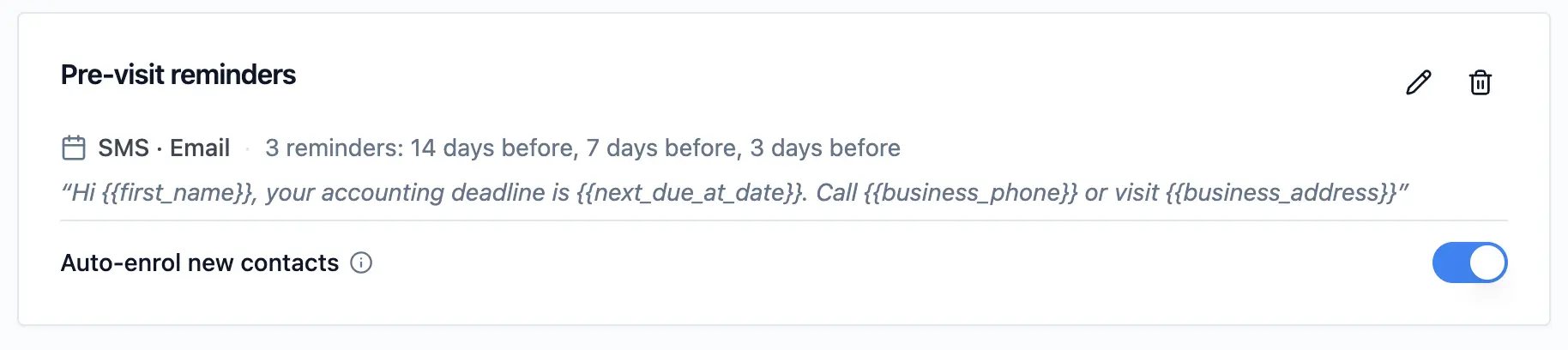
Here's a real example from Remindlo of how it works and looks:
Touchpoint 2: The day after - when your customer is most likely to leave a review
The second touchpoint in the customer lifecycle is almost universally overlooked, which is why it remains one of the highest-return messages you can send.
A customer who has just received good service is, in that window, more positively disposed toward your business than they will be at any other point until their next visit. Satisfaction peaks just after the service. That is the moment to ask for a review - not weeks later when the feeling has faded, not months later when they have almost forgotten the visit, but the morning after.
Hi Sarah, thank you for your MOT with City Motors yesterday. If you have a moment, a quick Google review would mean the world to our team - it takes less than a minute. [Google review link] Reply STOP to opt out.
Hi Emma, thank you for your visit at Bloom Hair & Beauty today. We'd really appreciate a Google review if you enjoyed it - it helps us enormously. Reply STOP to opt out.
Hi Tom, Buddy seems to have taken his vaccination in his stride! If you have 30 seconds, a Google review for City Vets would be hugely helpful. Reply STOP to opt out.
The case for prioritising Google reviews has never been stronger. In a search environment where AI Overviews are absorbing a growing share of informational queries, the clicks that still convert to bookings are heavily weighted toward local search - and local search is, in practice, a reputation contest. A practice, garage, or salon with 80 recent reviews averaging 4.8 sits higher in Maps results and gets more calls than an equivalent competitor with 20 reviews and a 4.3.
The challenge every business faces is that customers who are delighted often do not think to leave a review unless prompted. An SMS the morning after removes the friction: the link is in the message, the sentiment is still warm, and the ask is direct without being pushy. How far that lifts review volume is not something we can honestly put a percentage on, so we no longer try. What we can measure is whether the ask arrives at all, and that turns on one setting: a post-visit campaign with auto-enrol switched on reaches 69.8% of the customers who had a visit, against 0.6% when it is switched off. The full count is in why most customers are never asked for a review.
There is also a subtler effect worth mentioning. A thank-you message the day after communicates something about the relationship: you matter to us beyond the transaction. That is an increasingly rare signal for a small business to send. It is remembered.
See how post-visit messages and review requests work →
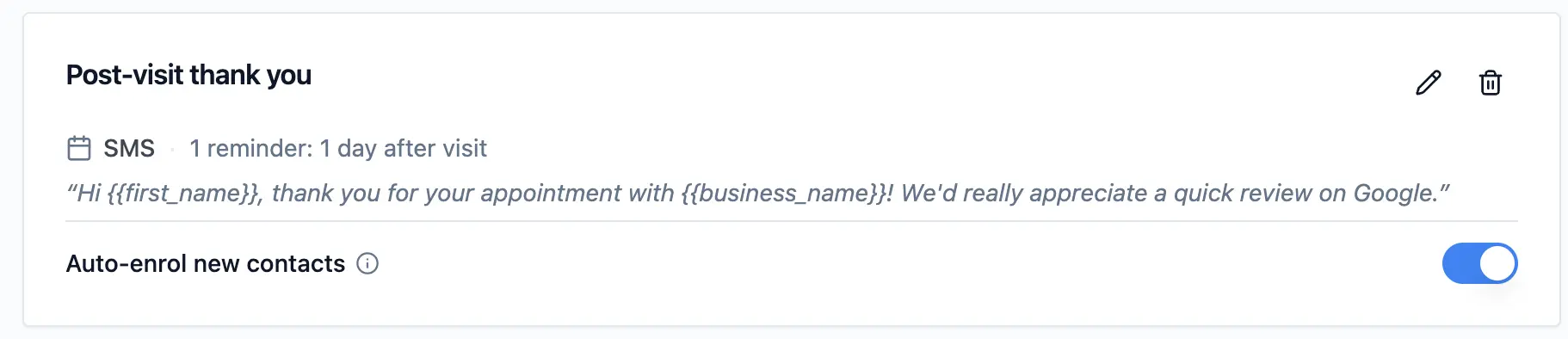
Here's a real example from Remindlo of how it works and looks:
Touchpoint 3: When it is time to come back - the message that decides whether they call you or Google your competitors
This is the touchpoint that generates the most return per message sent, and the one that almost no service business automates.
Every service business sells something that needs doing again. The question is not whether the customer will need the service again - they will. The question is whether they come back to you specifically, or whether they open Google and pick whoever appears first.
The problem is visibility. Between visits, a business has no presence in the customer's life. The customer's MOT is due in 12 months. During those 12 months, you are not in their head, you are not in their inbox, and you are not on their phone. When the month arrives and they go looking, they search. And "mot tests near me" or "boiler service near me" does not return a list sorted by their previous booking history - it returns a list sorted by review count, proximity, and a set of ranking factors the business cannot fully control.
A reactivation message changes this. It arrives at the exact moment the customer needs the service, from a number they recognise, with a name they associate with having already had a good experience. The decision is already half-made before they finish reading. And when your customers are older, that channel advantage is decisive - a text reaches them where an app or email quietly would not, which is why SMS is the right reminder channel for businesses with older customers.
Hi Mark, it's been a year since your last boiler service with Reliable Heating - time to book again before the autumn rush. Call 0800 123 4567. Reply STOP to opt out.
Hi Sarah, your car is likely due for its next service with City Motors. Give us a call on 01234 567890 or reply to this message. Reply STOP to opt out.
Hi Emma, it's been six weeks since your last visit at Bloom - ready to book in? Call 07700 900456 or pop in to the salon. Reply STOP to opt out.
Hi Tom, Buddy's annual vaccinations at City Vets are probably due soon. Give us a call on 01234 987654 to book in. Reply STOP to opt out.
The reactivation window varies considerably by industry:
Business type | Typical reactivation timing | What triggers the message |
|---|---|---|
MOT testing / tyre service | 11 months after last service | Annual legal obligation, predictable cycle |
Dental practice | 6 months after last check-up | Clinical guidelines, routine |
HVAC / boiler service | 12 months after last service | Annual service agreement, manufacturer warranty |
Beauty salon | 6 weeks after last visit | Short cycle, high frequency |
Veterinary clinic | 11 months after last vaccination | Annual booster cycle |
Gym membership | 1 month after membership lapse | Renewal or re-engagement |
Accountancy firm | 11 months after last tax return | Annual self-assessment cycle |
The detail that matters here is that the message knows when to arrive because the system knows when the last service happened. That is not something you can track by hand across a full customer list. A garage with 400 customers cannot manually remember to send Sarah a text in March and Mark one in October and Emma one in six weeks' time. Automated scheduling against each contact's last service date is what makes the third touchpoint possible at scale.
This message is also the one that most directly addresses the "mot tests near me" problem. A customer who receives a personalised message from a business they have already used is not starting from zero. They have a warm relationship, a remembered experience, and a direct line of contact already in their hand. They are not, at that moment, searching. They are replying.
See how reactivation campaigns work →
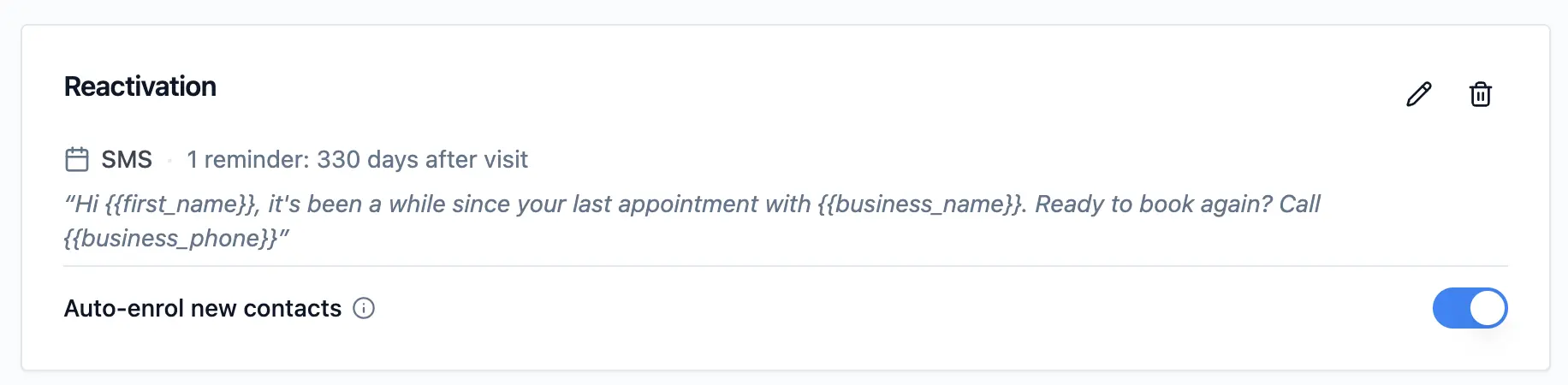
Here's a real example from Remindlo of how it works and looks:
The three touchpoints as a system
Individually, each of these messages has clear value. Together, they compound.
A business running only the pre-visit reminder captures some of the no-show recovery. A business running pre-visit reminders and post-visit thank-you messages captures the no-show improvement and builds a review base that improves its visibility to new customers. A business running all three retains a much higher share of its existing customer base while simultaneously growing the reputation that attracts new ones.
Here is what the three-touchpoint lifecycle looks like for a single customer at a dental practice:
Six weeks before their check-up: First reminder - "Your check-up is due 28/07/2026."
Three weeks before: Second reminder - same message, shorter.
One week before: Third reminder - confirmation and contact details.
Appointment happens.
The next morning: Thank-you message with Google review link.
Six months later: Reactivation - "Time to book your next check-up."
Steps 1-6 repeat.
That is six messages across twelve months of relationship. None of them requires a member of staff to do anything manually. Each one arrives at the moment it is most likely to be useful.
The cost of sending those six messages is, in SMS terms, approximately £1.08 per customer per year at standard rates. The value of retaining that customer through one rebooked check-up is multiples of that. The value of the Google review they left is compounding - it is there for every future customer who searches the practice's name.
How this works in practice
When a new service business joins Remindlo, three campaigns are now set up automatically based on the business type: a pre-visit reminder campaign, a post-visit thank-you campaign, and a reactivation campaign. The timing for each is calibrated to the industry by default - an MOT station gets an 11-month reactivation window, a beauty salon gets six weeks - but everything is configurable.
Each campaign links to the customer's record: their name, their last service date, their next due date, and the business's contact details. If you are wondering where that customer record comes from in the first place, it is usually already in your calendar - see how to turn your calendar into a customer list. The messages go out automatically at the right moments. The business sees the delivery status, the response rates, and the review count growing in the background.
This is a deliberately unexciting description of something that has a material effect on revenue and customer retention. The mechanism is not complicated. Three messages, three moments, all automated. The difficulty has never been understanding the model - it has been having the system to execute it reliably without adding work to someone's already full day.
That is the problem these three campaigns solve.
Start with 10 free SMS reminders - no credit card required →
Frequently asked questions
Do I need to send all three types of message, or can I just start with one?
You can absolutely start with whichever touchpoint makes the most sense for your business. For most service businesses, the pre-visit reminder has the fastest payback - it directly reduces no-shows and protects revenue you have already earned. The post-visit message is low effort and high return once you have the pre-visit flow working. Reactivation tends to have the highest absolute revenue impact but requires accurate records of when each customer last visited. Starting with one and adding the others is a perfectly sensible approach.
How do I know when to send the reactivation message?
The timing comes from the customer's service record. You need to know when each customer last visited and how long your service cycle typically is. For businesses where the cycle is standard - annual MOT, six-monthly dental check-up, 12-month boiler service - you set the interval once and the system handles the timing for every customer automatically. For businesses with more variable cycles, you can set the interval per customer.
What if a customer has already rebooked by the time the reactivation message arrives?
A well-configured reminder system checks the customer's record before sending. If a customer already has an upcoming appointment in the system, the reactivation message is suppressed - there is nothing to reactivate. If you are managing your customer records through Google Calendar sync or through the Remindlo contact database, this happens automatically.
Is it intrusive to send three messages around every appointment?
The research consistently says no - provided the messages are well-timed and personalised. Customers do not find a reminder intrusive if it is relevant and arrives at the right moment. What customers find intrusive is being messaged with irrelevant content at the wrong time. A reminder that arrives a week before a booked appointment is useful. A thank-you message the day after is warm. A reactivation message that arrives at the exact moment the service is due again is timely. All three pass the "would a customer appreciate this?" test without difficulty.
Do these messages need to be long?
No. The most effective reminder messages are short. They need to include the customer's name, the relevant date or context, the business name, and a way to respond or book. Most of the examples in this article fit comfortably within a single SMS segment - under 160 characters. Brevity is an asset, not a compromise.
What does GDPR require for sending SMS reminders in the UK?
Under UK GDPR, you need a lawful basis for processing and a lawful basis for direct marketing. For existing customers receiving reminders about services they have already purchased or used, the ICO's guidance recognises legitimate interests as a basis for service-related messages - that covers pre-visit reminders and reactivation for services with a clear cycle. Post-visit messages asking for a review are also covered under legitimate interests for existing customers. You should always include an opt-out mechanism (a simple "Reply STOP to opt out" in the message is standard), and you must honour opt-outs promptly. If you have explicit marketing consent from customers, that gives you the broadest possible basis for all three types of message.
Related reading:
Your Past Customers Forgot About You. Here's How to Fix That
What to put in each of those three messages: the call to action