Twelve Years, 113 Reviews, and a Traffic Cliff: Why the Only Channel You Truly Own Is Your Customer List
 by Peter Bednarek, Founder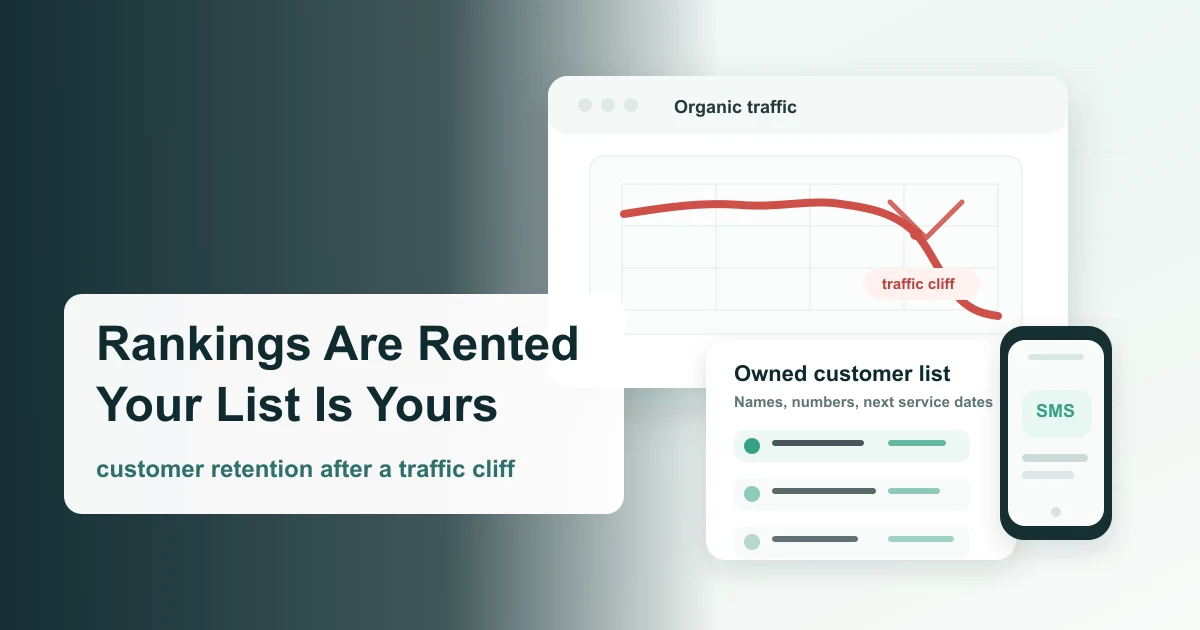
A home service business with a twelve-year-old domain and a 4.7 rating across 113 reviews was, by every reasonable measure, established. Then a 2025 core update arrived, organic traffic fell from 40 to 70 clicks a day to single digits, and nothing the owner has tried since has brought it back. They wrote, in the end, one word that should worry every local business owner: "Completely lost."
Contents
A post going around r/localseo last week is one of the most quietly alarming things you can read as a local service business owner, precisely because the person who wrote it did nothing obviously wrong.
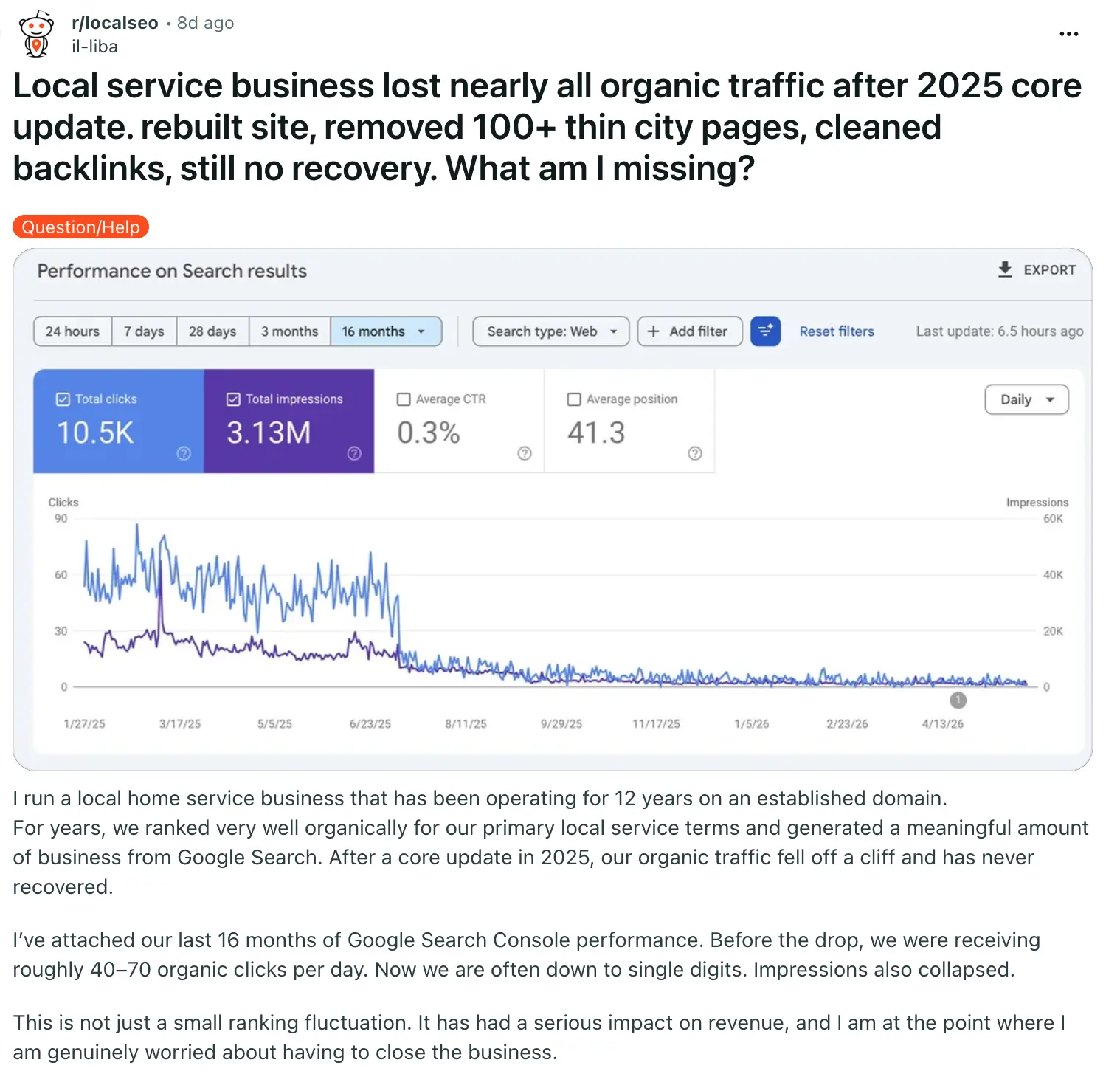
Here is their situation, in their own framing. A local home service business, twelve years on an established domain, ranking near the top for its primary local terms for years. A Google Business Profile with 113 reviews and a 4.7 rating, actively maintained. Real customers, real reputation, real history. Then, a core update in 2025, and organic traffic fell off a cliff: from a healthy 40 to 70 organic clicks a day down to single digits, with impressions collapsing alongside. Months later, it has never recovered. The owner is now genuinely worried about having to close the business.
That story is worth sitting with, because the lesson in it is not really about SEO. It is about the difference between a channel you rent and an asset you own.
They did everything the playbook says
The painful part is not that this business cut corners. It is the opposite. After the drop, the owner worked through the entire textbook recovery checklist:
Removed the thin, duplicated, low-value location content (the old site had 100+ city and service-area pages, some of which could fairly be called doorway pages).
Reworked the whole city and service-area strategy and wrote unique content for each remaining page.
Rebuilt the website from the ground up around usability, local relevance, and Google's people-first guidance.
Improved page structure, internal linking, technical setup, and the conversion experience.
Reviewed and cleaned up backlinks that looked spammy or unnatural.
Kept optimising the Google Business Profile and kept asking customers for reviews.
This is informed, diligent work. It is exactly what you are supposed to do. And the recovery still has not come.
Worse, when the owner looks at the local sites now ranking above them, the picture makes no sense: competitors with far fewer reviews, weaker-looking websites, thinner service content, and less established branding sitting in the spots this business used to hold. They are careful to say they know age and volume do not entitle anyone to rankings. They just cannot identify what is still holding the domain back.
That is the uncomfortable truth about organic search in 2026: there is no appeals process, no support line, and no guarantee that doing the right things gives you your rankings back. A core update can change the rules overnight, and a twelve-year-old business with a 4.7 rating can wake up to a chart with a cliff in it and no explanation.
This is not an argument against SEO. Good content and a clean site still matter. It is an argument against being dependent on a single channel you do not control, when that channel can be reset to zero by a decision you will never see coming and cannot contest.
Rented reach versus owned relationships
Every route to a customer falls into one of two buckets.
Rented reach is anything where a third party stands between you and the customer and can change the terms whenever it likes. Google organic rankings. AI Overviews that answer the query before anyone clicks. Paid ads where the cost-per-click creeps up every quarter. Social feeds where an algorithm decides who sees your post. You do not own any of it. You are renting access, and the landlord can raise the rent or evict you without notice.
Owned relationships are the customers whose details you already hold: the phone numbers, the names, the record of what they bought and when. Nobody can deprioritise that list in an algorithm update. Nobody can put an AI summary between you and a customer who already has your number saved. It is the one marketing asset on your books that a core update cannot touch.
This business lost its rented reach in a single month. What nobody in the thread can see is how much owned reach it still has to fall back on. And here is the thing: the evidence says it has a lot.
We made this same case in more detail in Why Your Customer List Is Your Most Valuable Business Asset Right Now. The Reddit thread is what that argument looks like when it actually happens to someone.
113 reviews is a clue, not just a vanity metric
Look again at that Google Business Profile: 113 reviews. Only a small fraction of happy customers ever leave a review - most estimates put it well under one in ten, and this owner explicitly says getting reviews has been hard. So 113 reviews do not mean 113 customers. It is the visible tip of a customer base that, after twelve years of trading, almost certainly runs into the thousands.
Every one of those people is a phone number this business has held at some point. Every one already knows the business exists, has used it, and rated the experience highly. They do not need to find the company on Google, because they already found it - years ago, and they were happy. That is an owned audience that no core update can take away.
And almost none of it is being used to bring people back. It is sitting in booking records, old invoices, a CRM, WhatsApp threads, the calendar, and the back of the owner's head. For most service businesses the customer list is really hiding in the calendar, which is also the easiest place to get it back out of. Twelve years of home service work is twelve years of customers who will eventually need the service again - and a home service business usually knows roughly when. A boiler serviced last winter is due this winter. A job done two years ago is wearing out. The timing is knowable.
A customer who already paid you once, and rated you 4.7, is the cheapest and warmest lead you will ever have. They just need a reason and a reminder at the right moment to reactivate:
Hi Sarah, it has been about a year since {{business_name}} last visited - happy to get you booked back in before winter. Reply or call 01234 567890. Reply STOP to opt out.
That message does not depend on a ranking, an ad budget, or an algorithm. It lands on a phone that already has the business saved, sent to someone who has already trusted them with their money and their home. SMS open rates sit around 98%, with most messages read within minutes. There is no core update for your text messages.
Why this keeps getting worse for local businesses specifically
Local service businesses are unusually exposed to the rented-reach problem, for three reasons.
The thin-page strategy was built on sand. For years the standard local SEO playbook was a landing page for every town you serve, "Plumber in [Town]" repeated 100 times. Core updates have systematically dismantled exactly this pattern, which is why this owner had 100+ pages to remove. A whole category of local marketing tactics stopped working, all at once.
AI Overviews are eating the clicks that remain. Even when you still rank, the answer increasingly appears at the top of the page with no click required. Collapsing clicks while impressions hold up for a while is the signature of this: people still see the business in results, they just no longer need to click. Impressions without clicks are not traffic. They are a reminder of traffic you used to get.
There is no recovery timeline you can plan around. A storefront that loses its lease can find a new unit. A business that loses its rankings is told to keep producing quality content and wait. That is not a plan a business with a payroll and a worried owner can run on.
None of this means search is dead. It means search has become unreliable enough that building your entire customer-acquisition model on top of it is a bet, not a strategy.
What to do this week
You cannot control the next core update. You can control whether you have an owned channel ready when it lands. And the work is far smaller than rebuilding a website from scratch:
Pull your customer list into one place. Export from your booking system, your accounting software, your phone, your old invoices. Even a rough spreadsheet of names and numbers is a real asset. For a twelve-year-old business, this list is probably your single most valuable and most neglected possession.
Sort it by when people are likely to need you again. Anyone overdue for the service is a booking waiting to be asked for. Mark your recurring customers so their next reminder goes out automatically.
Send one reminder, to one overdue segment, this week. Not a campaign. One message to people who are due. Watch how many reply.
You can do all of this with Remindlo on the free trial - 10 SMS, no card required. Connect your Google Calendar so every booking becomes a future reminder, or import your existing list from a spreadsheet. Mark your recurring customers once, and the reminders for their next visit send themselves.
The owner in that thread is still waiting on Google for an answer that may never come. The fix they actually needed was never in Search Console. It was in the customer list they have been building for twelve years and have not yet put to work.
Try Remindlo for free
Read the companion piece: Why Your Customer List Is Your Most Valuable Business Asset Right Now
See how SMS reminders work with Google Calendar for service businesses
Work out what your missed repeat bookings actually cost: no-show calculator
Rankings are rented. The customer list is yours. The next core update will land whether you are ready or not - the only question is whether you have a channel of your own to fall back on.