Why a Cancelled Cleaning Job Costs You the Whole Day (Not Just the Hour): SMS Reminders for Cleaning Businesses
 by Peter Bednarek, Founder
When a barber loses a slot, the next walk-in fills it. When a cleaner loses a slot, the van is already loaded, the route is already planned, and the four-hour window is gone for good.
Contents
- The cleaning no-show looks nothing like a hairdresser no-show
- What "the slot" actually contains
- Why you cannot rescue the slot
- The hidden second job that SMS reminder is doing
- What a good cleaning reminder looks like
- The timing question
- Recurring clients are where the second SMS use case lives
- What to do this week
A cleaning business that recently started using Remindlo had four jobs on its books for the week. The cheapest was $100. The most expensive was $500. Each one was a half-day or longer, with materials packed the night before and a driving route built around it.
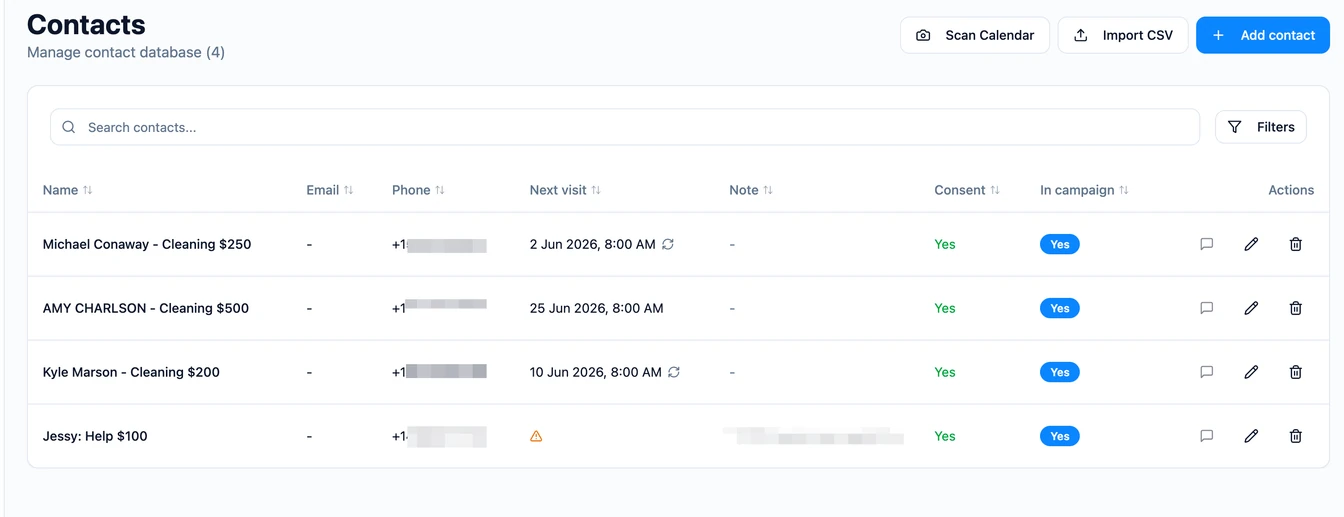
/ ^ Real data anonymized /
That is what a no-show actually costs a cleaning business in 2026. Not "an empty hour" - a half-day of revenue, a tank of fuel, a packed van of products, and a slot that no walk-in can ever rescue.
The cleaning no-show looks nothing like a hairdresser no-show
Most no-show advice online was written for storefront businesses - hair salons, beauticians, garages, dental practices. Those businesses share one thing: a fixed location with passing trade. When someone cancels at 9:30, there is at least a chance that another customer rings up, walks in, or rebooks into the gap by lunchtime.
Cleaning businesses do not have that lifeline. They are mobile, time-blocked, and built around long appointments. A typical week might look like this:
Tuesday 9:00 to 13:00 - Michael, regular bi-weekly clean, $250
Tuesday 14:00 to 17:00 - Amy, deep clean before viewing, $500
Wednesday 9:00 to 12:00 - Kyle, weekly clean, $200
Wednesday 13:00 to 15:00 - Jessy, help with elderly relative's apartment, $100
If Kayla messages on Tuesday evening to say she has to go into the office on Wednesday and forgot to mention it, the morning slot does not get filled by a walk-in. There is no walk-in. There is just an empty three hours, a vanload of products that were prepped specifically for her job, and a fixed cost - the van, the insurance, the staff hours - already burning through the day.
Industry surveys consistently put short-notice cancellation rates around 8 to 12% across mobile service trades. For a cleaner doing 20 jobs a week at an average of $200 per visit, that is roughly $20,000 to $30,000 a year in revenue, which simply does not happen.
What "the slot" actually contains
The hourly figure - $25 to $45 an hour for residential cleaning, more for deep or move-out work - is only the visible layer. Underneath are a stack of costs that do not stop when the client cancels:
Travel and routing. A cleaner's day is built around minimizing drive time between addresses. A canceled middle slot does not free up time elsewhere - it leaves a gap that cannot be backfilled with anything else, because the next job is already booked and twenty minutes across town.
Materials and product cost. Move-out and deep cleans are prepped to job. Limescale remover, oven cleaner, carpet spotter, refill cloths - the kit gets pulled the night before. If the client cancels on the morning of the job, the products are out, partly used, or sitting open in the van.
Mental load of scheduling. Cleaners run a private diary. Every recurring client has a rhythm - weekly, bi-weekly, monthly - and the diary has been arranged around it for weeks. A cancellation does not just take an afternoon; it forces a rebook that ripples through the next two or three weeks.
Insurance, van lease, payroll. These are flat costs that keep ticking through the gap. A canceled job does not reduce them.
When you add those layers up, the real loss on a $200 clean is rarely $200. It is closer to $230 to $280, depending on how far across town the job was, how much product was earmarked for it, and how tight the day's route was.
Calculate your potential profit
See how much you can earn by recovering lost customers
Your data
What that could be worth
5-year projection
Assumes every recovered customer then returns each year
No credit card required • Full access • 10 SMS per month
Both percentages here are assumptions you set, not measurements. What we have actually measured, and the published research on reminders: our sources.
Why you cannot rescue the slot
A garage with a missed appointment can sometimes pull a walk-in from the forecourt. A salon can move the next afternoon client forward. A clinic can offer the slot to someone on the waiting list.
Cleaners cannot do any of that, and the reason is purely geographic. By the time you find out the 9am clean is canceled, you are already half an hour away from the next available client's address. Even if a regular phoned at 9:05 and asked if you could "pop over today", the maths does not work:
30 to 45 minutes to drive there
15 minutes to reconfigure the van for a different type of job
3 hours minimum block to make the visit worth doing
Drive time back across town to the afternoon slot
You would need a customer who lives between two other jobs, wants the exact service you have product for, and can have you in their home within ninety minutes. That customer does not exist.
The slot is gone. The only realistic strategy is to make sure the slot never gets canceled in the first place.
The hidden second job that SMS reminder is doing
A good reminder for a cleaning business does two things at once. The first is obvious: it makes the customer remember the appointment so they do not cancel it. The second is quieter but in many ways more useful - it sets expectations on the awkward bits before the cleaner walks through the door.
Look at this real reminder that went out from a cleaning business this week:
Hi Kyle, your appointment for Laura to come clean is coming up 05/27/2026 8:00 AM. Reminder: payment is due at time of cleaning.
That single line - Reminder: payment is due at time of cleaning - quietly does five things:
Reminds the client of the date and time
Names the cleaner (so the client knows who is on the door)
Confirms there is no need to wait at home, wondering
Pre-empts the "I have not been to the bank" conversation
Removes the option for the client to say "Can I pay you next week?"
Most awkwardness in residential cleaning is not about the cleaning. It is about money. The cleaner spends three hours on the floor, packs up, and the client says they will send it tonight. Tonight becomes Friday. Friday becomes the next visit. By the third unpaid clean, the working relationship has shifted from professional to "could you just do me a favour".
A reminder that includes payment terms collapses that whole dynamic into one sentence sent the day before. The client is not surprised. The cleaner is not chasing. The conversation has already happened.
What a good cleaning reminder looks like
Cleaning reminders do not need to be clever. They need to be short, specific, and sent at the right time. A workable template for most cleaning businesses looks like this:
Hi {{first_name}}, just a reminder your clean with {{business_name}} is booked for {{next_due_at_date}} at {{next_due_at_hour}}. Payment is due on the day. Reply STOP to opt out.
A few things are doing real work in that message:
The customer name ("Hi Sarah") makes it land like a personal message, not a bulk send.
The business name stops it being mistaken for a scam text - especially important when the customer is letting a stranger into their home.
The date and time give the customer the information they actually need to act.
A short payment line sets expectations without sounding like a demand.
The opt-out is required by SMS rules in most countries and is good practice everywhere.
For move-out and deep cleans, where access is often through a property manager or a lockbox, a second line earns its place:
Access via lockbox code from the property manager - please confirm the code is still active.
That kind of message has prevented entire wasted journeys - a cleaner driving across town, only to find the lockbox code was changed at handover and nobody told them.
The timing question
For most cleaning businesses, a single SMS sent the day before works best. Mornings - sent between 9am and 11am - get the highest read rate without disrupting the customer's evening. Industry data consistently puts SMS open rates around 98%, with most messages read within three minutes. There is no inbox to lose it in.
A second reminder two hours before is usually overkill for cleaning. Customers know roughly when you are coming, and the day-before message has already done its job. The exception is first-time clients and one-off deep cleans, where a short "On my way, ETA 9:15" text reduces the "I have not heard from them, did I get the day wrong?" anxiety on the customer's side.
Recurring clients are where the second SMS use case lives
Half of a cleaning business's revenue is recurring - the weekly, bi-weekly and monthly regulars. The other half is one-offs - moves, deep cleans, post-construction, post-party. The recurring half is where SMS quietly compounds into a retention tool.
Each regular client is a private appointment, a known frequency, and a phone number you already have. With a tool like Remindlo, you can mark each recurring client as a recurring contact, set the interval (bi-weekly, monthly, quarterly), and the reminder for the next visit gets sent automatically. There is no spreadsheet to maintain, no "did I text Kayla this week" memory load.
For one-off clients - the move-out cleans, the post-party clears - SMS plays a slightly different role: it nudges them back when the right moment comes round. A short message six months after a move-out clean ("Hi Sarah, hope your new place is settling in - happy to book a one-off if you ever need it") brings in surprisingly steady repeat work. It is exactly the kind of follow-up most cleaning businesses know they should be doing and never get round to.
The customer list a cleaner builds up over five years is the single most valuable asset the business owns, and most of it sits dormant in WhatsApp threads and Notes app entries. Even a thin SMS layer on top of that list - one reminder before each visit, one occasional check-in after a one-off - turns it into something the business actually earns from. There is more on this in Why Your Customer List Is Your Most Valuable Business Asset Right Now.
What to do this week
If you run a cleaning business and you lost even one slot to a last-minute cancellation last month, the maths is already on the side of sending reminders. A single $200 clean recovered pays for a year of SMS reminders for most small operators. Here is how SMS reminders for cleaning businesses work in practice, including the weekly and fortnightly cycles, the access notes and the payment line.
The quickest way to get started:
Sign up for the free trial - 10 SMS, no card required.
Either connect your Google Calendar so each job in the calendar becomes a reminder, or import your client list from a spreadsheet.
Write one short reminder template with the payment line included. Send it the day before on every job for two weeks.
Two weeks is usually enough to feel the difference. Fewer "sorry, I forgot you were coming" messages on the morning of a job. Fewer "I will pay you next week" conversations on the doorstep. A diary that holds the shape you planned it to hold.
A cleaning business runs on time, route, and trust. SMS reminders protect all three for the price of a coffee.
Try Remindlo for free 👈
Read more about reducing no-shows in service businesses
See how SMS reminders work with Google Calendar for mobile trades
Work out what your no-shows actually cost: no-show calculator
See why the earliest and latest slots of the day cost more than the fee
A canceled cleaning job is not an hour gone. It is a half-day, a packed van, and a slot no walk-in will ever fill. The fix takes ten minutes.
Related reading:
SMS Reminders for Mobile Service Businesses: The Complete UK Guide