One Toggle Decides Whether Your Customers Are Ever Asked for a Review
Contents
Quick answer
Check whether "Auto-enrol new contacts" is switched on for your post-visit campaign. With it on, 69.8% of customers reach the review request. With it off, 0.6%. Then deal with the customers who never appear in your calendar at all, because no text message will ever reach them: they need the ask printed somewhere they already look.
A review is the only marketing asset a small business builds by doing its job properly. It costs one question, asked at the right moment, and it keeps working for years: on your listing, in search results, and in the AI answers your next customer reads instead of a search page.
Almost nobody asks. We can be unusually precise about that, because we can see it happening.
The measurement
Remindlo seeds every new account with a post-visit campaign. It fires the day after the appointment and it asks for a review. It has been shipping that way since June 2026.
On 22 September 2026 we counted how many customers it actually reaches. Across 114 businesses we took into the sample, 2,692 people had a completed visit in the previous twelve months. Fifty-seven of them have ever received a review request.
The obvious explanations are all wrong, and we checked each one:
It is not the anchor. Of the 954 customers at businesses whose post-visit campaign is actually running, 910 have a recorded last visit date for the campaign to count from.
It is not consent. 715 of those 954 have both a mobile number and permission to be messaged.
It is not old accounts. Not one of these businesses signed up before the lifecycle campaigns existed.
It is not the message. The campaign is running. The template is written. It simply does not go out.
What it is, is one switch.
69.8% against 0.6%
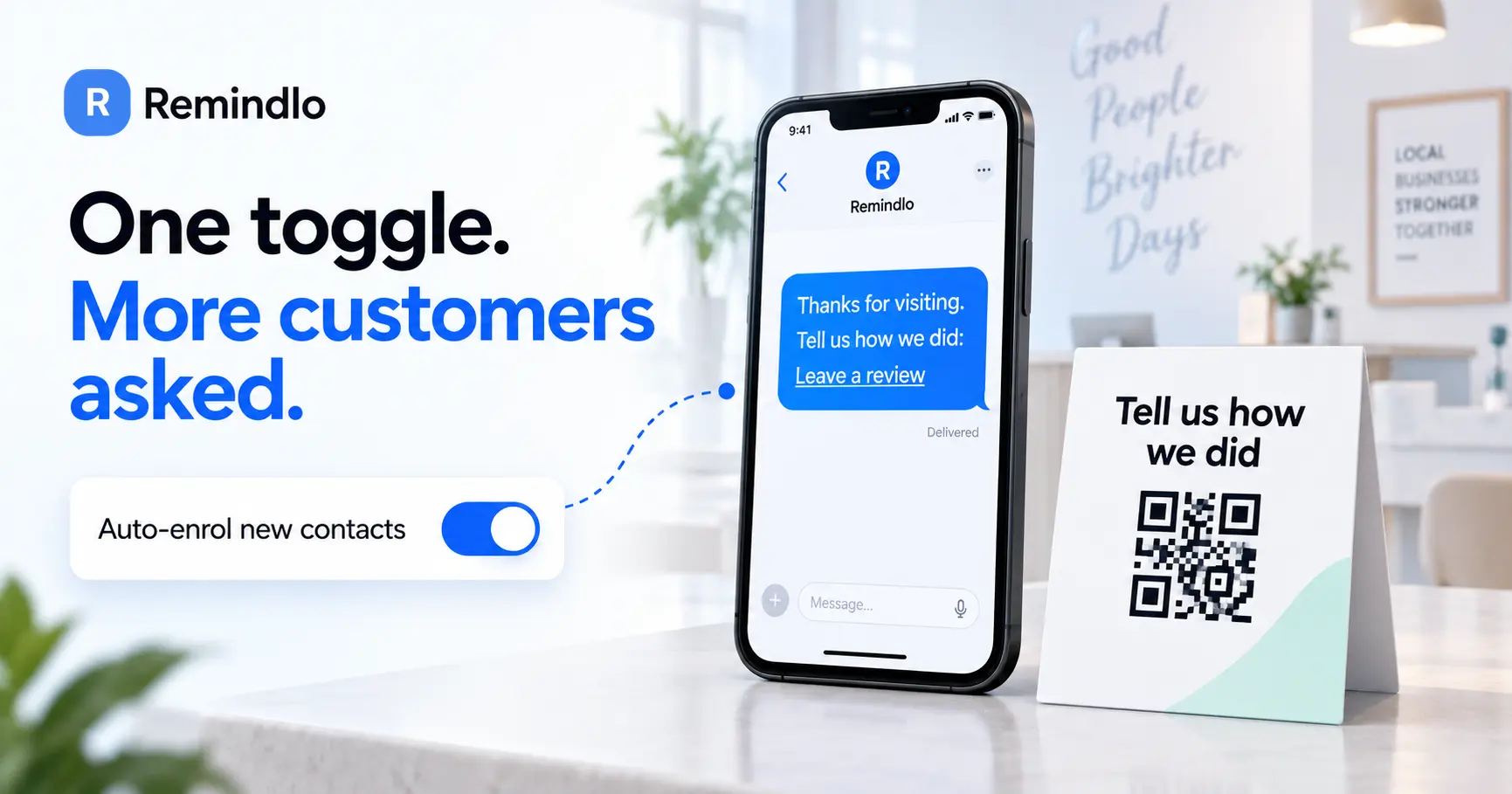
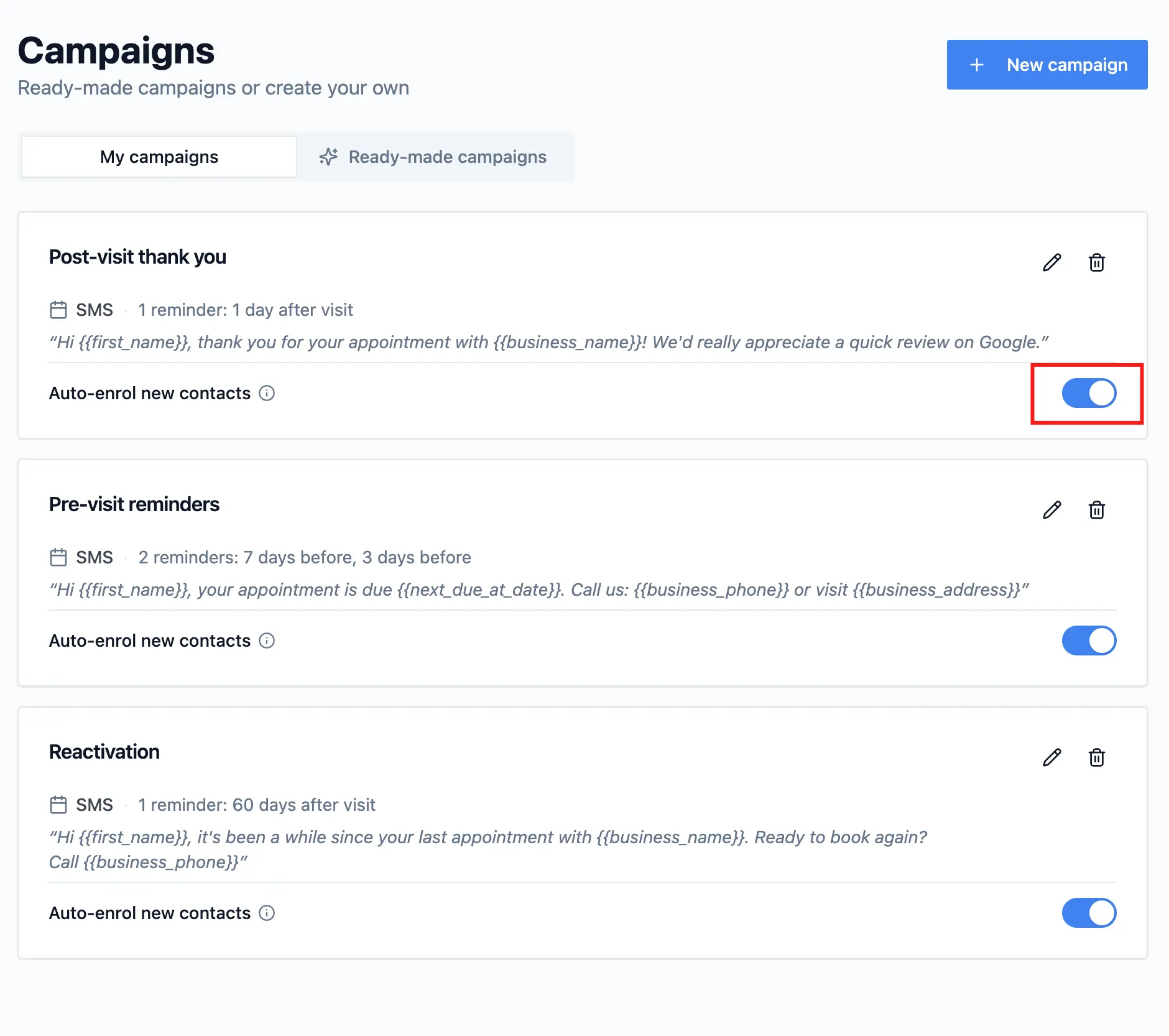
Every campaign card in Remindlo carries a toggle called Auto-enrol new contacts. When it is on, a customer who arrives from your calendar joins that campaign automatically. When it is off, nothing enrols them and the campaign sits there, running, addressed to nobody.
Splitting those same 954 customers by that single toggle:
Auto-enrol | Businesses | Customers who had a visit | Reached the review request |
|---|---|---|---|
On | 23 | 245 | 171 (69.8%) |
Off | 27 | 709 | 4 (0.6%) |
The mechanism works exactly as designed. Switched on, it reaches seven customers in ten. Switched off, it reaches nobody.
The part worth sitting with is the middle column. The businesses with the switch off hold three quarters of the customers. Thirty-seven of our 116 running post-visit campaigns have it turned off, and those are, on average, the busier accounts. A minority of businesses, a large majority of the people who walked through a door and had a good experience.
Almost all of them were switched off during setup, in the step that asks which kinds of message you want to send, and then never revisited. That is not a criticism of anybody. A toggle you meet on your first day, before you have sent a single message, is a toggle you cannot yet make an informed decision about. Ours defaults to on and a third of people turn it off, which tells you more about the setup step than about the customers.
If you do one thing after reading this, open your campaigns and look at the post-visit card. That is the whole intervention for three quarters of the people in this dataset.
What the message costs, and what it is worth
Here is the honest accounting, because "ask for reviews" advice usually skips it.
The service already happened. You already paid for the labour, the premises and the customer acquisition that brought them in. The thank-you message, for most businesses here, is already being sent. So the marginal cost of asking for a review is the extra length the review link adds to the text.
It is not nothing. Among the review requests actually sent through Remindlo between 29 June and 21 September 2026, the ones carrying a link ran to about 269 characters and 2.43 SMS segments, against 113 characters and 1.19 segments for the ones without.
Call it one extra segment, which on our smallest pack works out at about 18p.
We are not going to tell you what share of those messages turns into a review. We do not know; nobody has measured it credibly for a small UK service business, and the published trials on text reminders are about getting people to attend appointments they have already booked, which is a different question with a different answer. What we can say is the arithmetic: one review, sitting on your listing, read by strangers for the next three years, against 18p. You can decide whether that trade is worth making without anybody quoting a percentage at you.
That is the ambassador argument, and it is stronger than it sounds. A customer who has just had a good experience is the only advocate you will ever get for free. They are not a lead you bought. They are somebody who already paid you and left happy, and the only thing standing between that goodwill and a public, permanent, searchable endorsement is being asked.
The customers a text message will never reach
Now the part that no toggle fixes.
A text message goes to people you have a phone number for, which in practice means people who booked. For a dental practice or a garage doing pre-booked MOTs, that is nearly everybody. For plenty of other businesses it is not close.
Think about who passes through a barber's chair, a tyre bay on a walk-in Saturday, a farm shop till, a café, a florist the week before Mother's Day. They paid, they were happy, and they never became a record in anybody's calendar. No message can be sent to them, because there is no address to send it to. No amount of better copy helps.
We cannot tell you how big that group is, and we will not guess: our database only ever sees customers who became a contact, so the people who never did are invisible to us by construction. But for counter trade it is obviously most of them.
Those customers need the ask to be waiting where they already are, rather than arriving later. On the receipt. On the invoice. In the bag. On a card by the till.
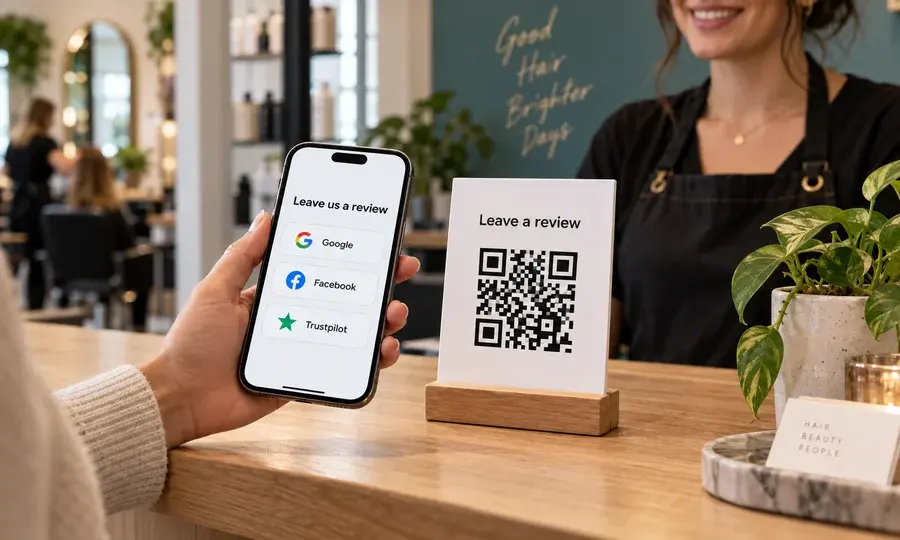
And this is not a grey area. Google spells it out in its own guidance on getting more reviews: "To leave reviews, you can ask customers to visit a Google link or scan a QR code." A link for the people you can message, a code for the people you cannot. Both explicitly permitted, by name.
One rule governs both, though, and it is the one most businesses break by accident: ask everybody, not just the ones you can tell are happy. Google prohibits incentives outright, and steering only your satisfied customers towards the review form is the thing platforms police hardest. Trustpilot writes its version of the rule down more explicitly than Google does, and the practical consequences are worked through in how to get more Trustpilot reviews. The short version: if you cannot choose who gets asked, the only variable left is where the ask sits, and it has to sit somewhere everybody passes.
Why so few links, and the short-link problem
Back to those two businesses out of fifteen.
Of the seventeen businesses that have sent a post-visit message, fifteen asked for a review in it. Two put a link in. The other thirteen sent a customer a message saying, in effect, we would appreciate a review, and then left them to find the listing themselves.
Part of that is ours: the template we seed asks for a review and deliberately ships without a link, because making somebody dig out their review URL during setup is a good way to lose them before they have sent anything. We have written about what that trade-off costs and it is the same story here.
But part of it is that the link is genuinely awkward, and worth solving once:
A full Google Maps URL can run past 100 characters, which on its own pushes a short message into a second segment.
The
g.pagelink from Ask for reviews in your Google Business Profile is the short form, and it is the right one to use. In practice it lands around 31 characters, not the 20 you might hope for.Google will not shorten it for you. The goo.gl shortener has been closed to new links since 2019 and its inactive links were switched off in August 2025, so there is no Google-branded way to make one shorter.
There is a version of this worth doing once if you are collecting reviews at all seriously: point both the text message and the printed code at the same short, trackable link you control. That is what a tool like Scanlo does (our sister brand). The address it hands you runs to roughly half the length of the g.page form, so it fits the first segment more often, and because the printed code encodes that short address rather than the destination, you can repoint it later. If you decide next year to collect on Trustpilot instead of Google, everything you already printed and handed to customers keeps working.
If you collect on more than one platform, do not print two codes side by side: a phone camera locks onto whichever is nearest and half your customers land somewhere you did not intend. One code that opens a page listing each platform lets the customer pick the one they already have an account on.
What you can measure, and what nobody can
Be realistic about this before you start comparing channels.
Nobody can tell you which ask produced which review. Not us, not Google, not any reputation tool that says otherwise. The platforms simply do not expose it. Any product claiming per-message review attribution is inferring it.
What you can actually count is one step earlier, and it is enough to make decisions with:
On the message side, how many went out, and how many people replied. Two-way SMS matters more here than it looks: a customer who was not happy answers you directly instead of in public, which is the outcome you wanted anyway.
On the printed side, how many people scanned, and from where, if each placement has its own code. The receipt, the counter card and the invoice as three separate codes give you three numbers at the end of the month instead of one.
On your listing, the review count itself, read monthly. Crude, but it is the number that actually matters, and most businesses have never once written it down and looked at it a month later.
One trap to avoid: a code in a busy doorway will out-scan a code on an invoice while producing worse results, because somebody who never bought anything is not a review opportunity. Compare placements that reach real customers against each other.
Why this compounds
A few years ago reviews did two jobs. They reassured whoever read your profile, and they fed the star rating next to your name in local results.
They have quietly picked up a third. When somebody asks an assistant whether your firm is any good, the assistant has no opinion. It goes looking for what other people wrote about you, and what it reaches for is overwhelmingly content you do not own: directories, forums, review platforms. There are a lot of confident percentages circulating about exactly how much, most of them published by companies selling visibility on the platforms being measured, so we are not going to quote one. The directional point survives without a number: you cannot optimise your way into those answers. You can only make sure there is something there to find on the day somebody asks.
Which is the same lesson as the home service business that lost its rankings overnight after twelve years and 113 reviews, read from the other end. The reviews live on somebody else's platform and can be reweighted by somebody else's algorithm. The customer list is yours. Build both, and understand which one you actually control.
A setup you can run this week
Check the toggle. Open Campaigns, find your post-visit card, and confirm Auto-enrol new contacts is on. For three quarters of the customers in our data, this is the entire fix.
Get your review link once. Google Business Profile, Ask for reviews, copy the
g.pageaddress. Open it on your own phone and make sure it lands on the write-a-review form rather than your listing.Put it in the post-visit template. Once. Never think about it again.
Print the same ask for the people you cannot text. Receipt footer, invoice, a card by the till. Somewhere every customer passes, not somewhere only the delighted ones linger.
Say nothing clever. "Tell us how we did", the link, your name. No stars in the artwork, no discount, no "if you were happy". The conditional version is both against the spirit of every platform's rules and worse at getting responses, because it invites the reader to audit their own mood before acting.
Write down your review count today, and look at it in a month.
Here is the shape of the message, with a number from the Ofcom drama range so nobody texts a stranger:
Hi Sarah, thanks for coming in to Hillside Motors today. If you have a minute, a review really helps us: [your link]
Anything not right? Call us on 01632 960123 and we will sort it.
Nobody is filtered, everybody gets both routes, and the unhappy customer is handed a human instead of a review box.
Frequently Asked Questions
Why are my customers not getting the review request?
The usual cause is auto-enrolment. Open Campaigns, find your post-visit campaign, and check whether Auto-enrol new contacts is switched on. With it off, the campaign runs but nothing joins it: in our own data, businesses with the toggle off reached 0.6% of their customers, against 69.8% for businesses with it on. If the toggle is already on, check that the contact has a mobile number and consent.
When should I ask a customer for a review?
The day after the visit, while the experience is still fresh and the result is visible. Remindlo's post-visit campaign defaults to one day after. Asking before the job is finished is premature, and asking weeks later means the customer has to reconstruct how they felt.
Should I put a link in the review request?
Yes. Without one you are asking the customer to open Google, remember your exact trading name, find the right listing among several similar ones and scroll to the review box. Use the short g.page address from Ask for reviews in your Google Business Profile, or a short trackable link from services like Scanlo that you can repoint later.
Is it against the rules to ask only my happy customers?
Asking is allowed and encouraged. Filtering is where businesses get into trouble. Google prohibits incentives in exchange for reviews outright, and platforms police selective solicitation, with Trustpilot writing the rule down explicitly. The compliant pattern is to offer everybody the same two routes in the same message: a review link, and a phone number if something was not right.
How do I ask customers who never book an appointment?
You cannot text somebody whose number you do not have, so the ask has to be waiting for them instead. Google's own guidance says customers can be asked to "visit a Google link or scan a QR code", so a printed code on the receipt, the invoice or a card by the till covers the counter trade that never reaches your calendar.
Can I tell which review came from which ask?
No, and nobody can. Review platforms do not expose the invitation that produced a review. What you can measure is one step earlier: messages sent and replies received on the SMS side, and scans per placement if each printed spot has its own code. Treat any tool claiming per-review attribution with suspicion.
Does asking for reviews cost anything?
A review link adds length to the message, which can push it into a second SMS segment. On our smallest pack that is roughly 18p. The service and the thank-you message have already been paid for, so that segment is the entire marginal cost of the ask.
The bottom line
The businesses with four hundred reviews are rarely four hundred times better than the ones with six. They built a habit of asking, and they put the ask somewhere it could not be forgotten.
In our data, "somewhere it could not be forgotten" turns out to mean two specific things. For customers who booked, it means a toggle being on, which is a ten-second job that three quarters of the affected customers are currently waiting on. For everybody else, it means the ask being printed on something they already hold, because no message can be sent to somebody who was never a record.
Do both, and the reviews arrive as a by-product of work you were already doing properly.
👉 Start free with Remindlo: automatic post-visit review requests, 10 SMS, no card 👈
Related reading: what to actually write in the message if your reminders give the customer nowhere to go, the three touchpoints worth automating for where the review ask sits in the wider lifecycle, and SMS review requests for how the campaign is set up.