The Most Valuable Customer List You Own Is Hiding in Your Calendar
 by Peter Bednarek, Founder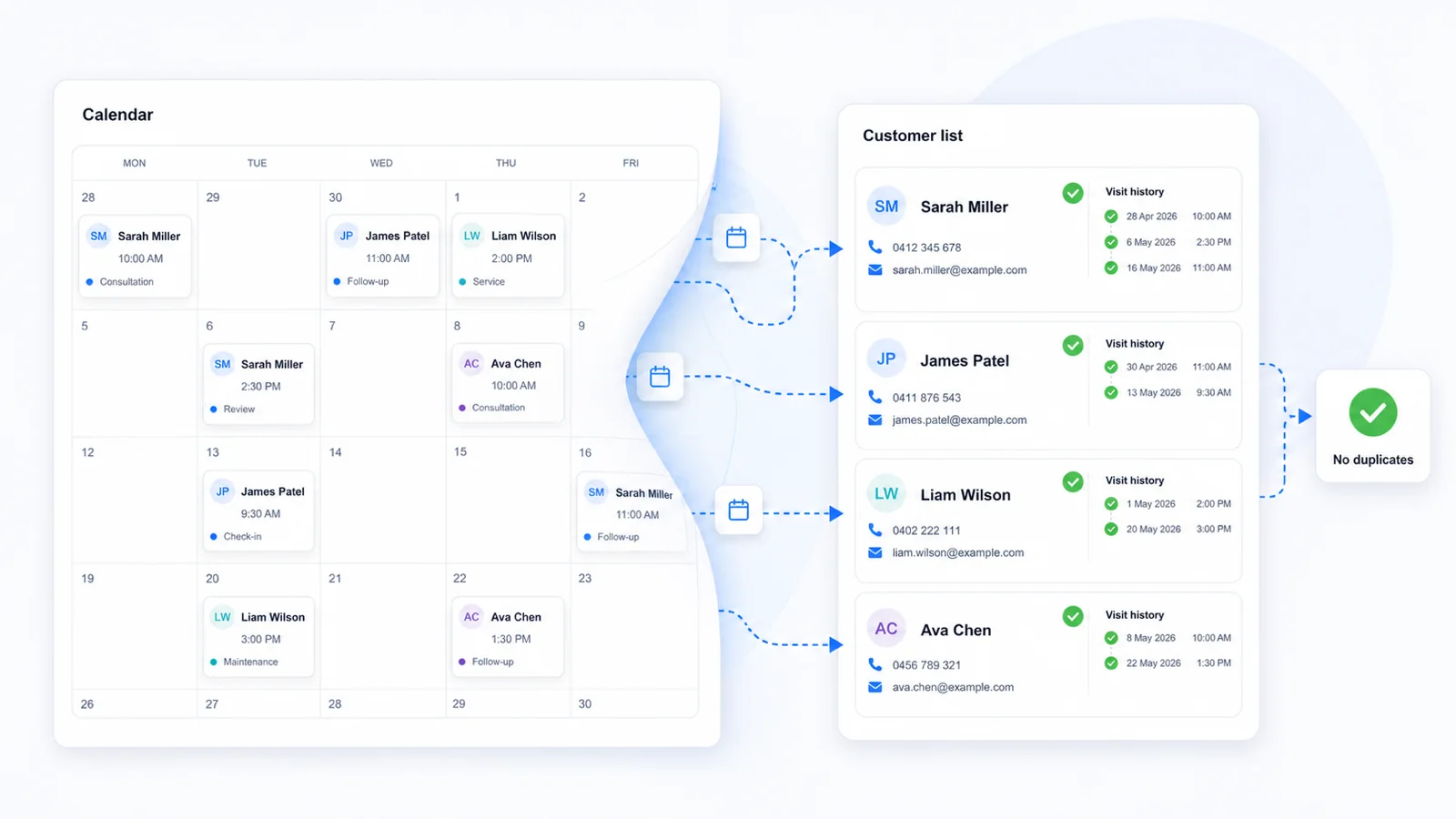
Contents
Quick answer
Most small service businesses already own a valuable customer list without realising it. It is not in a CRM - it is scattered across months of calendar appointments, one booking at a time. Connect that calendar to a tool that groups every visit under the right person, and you extract a working customer list you can actually market to.
Ask most owners of a small service business where their customer list is, and you will get a shrug. Maybe a spreadsheet someone started and abandoned. Maybe the booking software. Maybe "in my head, mostly."
But the honest answer is usually sitting right in front of them, open in another tab. It is the calendar. Every appointment booked over the last two or three years is a real person who chose this business, turned up, and paid. Their name is on the event. Often their phone number or email is too. That is not a diary. That is a customer list - it just does not look like one yet.
This is the quietly frustrating thing about running a service business in 2026. The asset everyone tells you to build - an owned list of customers you can reach directly - is one you have probably already built. You just built it by accident, one booking at a time, and it is trapped in a format you cannot do anything with.
The asset you own but cannot see
We have made the wider case before that your customer list is your most valuable business asset, and why it matters more every year: it is the one channel a competitor cannot outbid you for and an algorithm cannot switch off. When a Google core update wipes out a business's search traffic overnight - which happens to established, well-run businesses now - the customer list is the channel still standing.
The catch is that "own a customer list" sounds like a project. It sounds like you have to sit down, export things, clean data, and build a database before you get any of the benefit. So it stays on the someday pile.
Here is the reframe: for most service businesses, the list is already 90% built. It is just distributed across the exact place you spend your working day - the calendar - in a form that hides its value. Every event is a customer. You are not starting from zero. You are extracting something you already own.
Why the calendar is the richest source you have
A spreadsheet you build by hand is a snapshot that is out of date the moment you save it. A calendar is different. It is the one record in the business that updates itself, because you feed it every time you take a booking. That makes it the best possible source of a customer list, for three reasons.
It already has the identity. The name is on the event. For anything booked online or confirmed by text, the phone number or email is usually there too. That is the hard part of any customer list, already done.
It has the timing. A calendar does not just tell you who - it tells you when, and how often. Someone who appears every eight weeks is a different customer from someone who came once, eighteen months ago. That pattern is the whole basis of knowing who to talk to and when.
It records your best customers automatically. Repeat visits are the strongest loyalty signal a business has, and they are already logged. The person with six entries against their name over two years is worth more than any lead you could buy - and you already have their number.
No lead magnet, no ad spend, no data purchase produces a list this warm. These are people who have already trusted you with their money and, often, their home or their body. They are just not organised in a way you can act on.
The problem: a calendar is not a customer list
So why can you not just use the calendar as-is? Because a calendar is built to answer one question - "what is happening today?" - and a customer list has to answer a completely different one: "who are my customers, and who should I be talking to?"
Three things get in the way:
Everything is a one-off event. The same loyal customer who has been in five times shows up as five unconnected entries scattered across the year, not one customer with a history. The calendar has no idea they are the same person.
There is no way to see the whole base. You cannot look at a calendar and ask "who has not been in for six months?" or "who is due back next month?" The information is all there, but it is smeared across hundreds of days. The signal is buried in the thicket.
You cannot act on it. There is no way to message the forty people overdue for a visit, because they do not exist as a group anywhere. They exist as forty separate entries you would have to find and copy out by hand.
This is the gap. The value is real and it is already yours - but it is locked in the wrong shape. Extracting it by hand, scrolling back through two years of bookings and typing names into a spreadsheet, is exactly the kind of admin job that never gets done. So the asset just sits there.
Extracting the list without the data entry
The good news is that turning a calendar into a customer list is a job software should do for you, not something you should ever type out by hand.
This is exactly what Remindlo's calendar-to-customer-list feature does. You connect your calendar - Google Calendar in one click, or Outlook and iCloud through a public ICS link - and from then on every booking quietly becomes part of an organised customer list in the background. There is nothing to import and nothing to type.
The same holds when your bookings arrive through a booking platform rather than the calendar itself. A system like Square Appointments reminds the people who booked; the customers who have not booked anything are precisely the ones it cannot see.
Crucially, it solves the three problems above:
Repeat visitors become one customer, not five events. When the same person books again, they are matched by phone number or email and the new visit is filed under their existing record. One customer, one profile, however many times they come back.
Every customer keeps their history. Each record carries the visits they have had and the next one coming up - so a list of events becomes a lightweight CRM you can actually read.
You can finally see who is due back. Because the base now exists as customers rather than dates, you can spot who is overdue and who is returning at a glance.
That is the "extraction." You did the work of earning these customers years ago. Connecting the calendar just pulls that work into a shape you can use - without a data-entry project standing between you and it.
What a real list actually unlocks
Getting the list out of the calendar is not the goal. It is the thing that finally makes everything else possible. On its own, a booking record does nothing. A customer list is a launchpad - and this is where the return actually shows up.
Once your customers exist as a real, segmentable list, a handful of things that were previously impossible become a few clicks each:
Thank-you messages after the visit. A short, warm thank-you note the day after an appointment is the cheapest goodwill a business can generate - and it is only possible if you know who came in yesterday and can reach them.
Review requests at the perfect moment. The same touchpoint is the single best chance to earn a Google review, while the experience is fresh. Automated review requests turn your quietly satisfied customers into the public reputation that wins the next one.
Reactivation of customers who drifted. This is the big one. Every service business has customers who simply forgot to rebook and are now overdue. A single reactivation message - "it has been a while, shall we get you booked back in?" - lands on a phone that already has you saved, from a business the customer already liked. It is the warmest, cheapest booking you will ever win back.
Reminders that keep the cycle turning. For any recurring service, the next reminder can send itself, so a one-off customer quietly becomes a repeat one.
We break down how these fit together across the customer journey in the three SMS touchpoints every service business should automate. The point for now is simpler: none of them are possible without the list, and the list has been in your calendar the whole time.
Where does your business stand today?
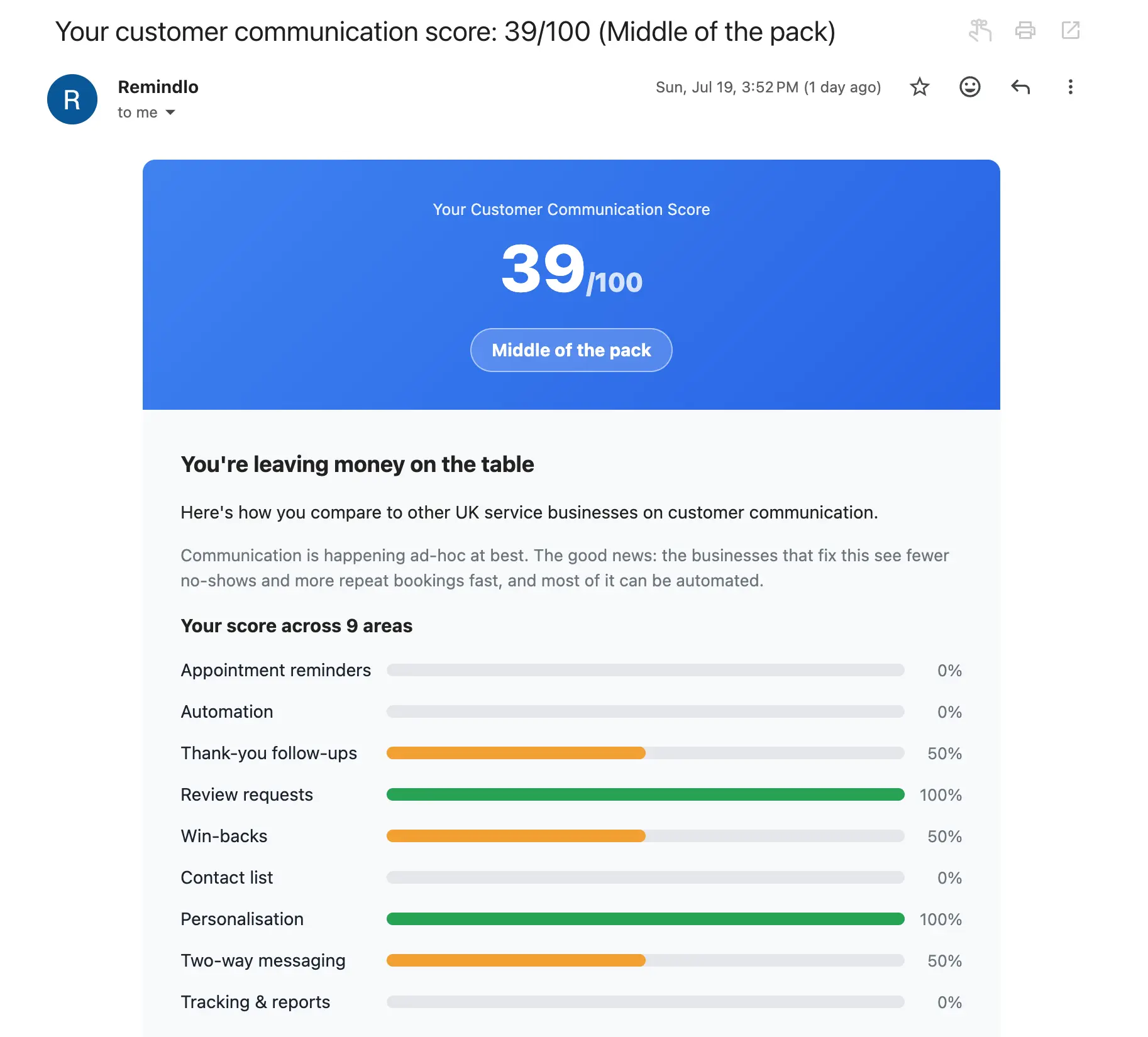
Most owners are further along than they think on some of this and further behind on the rest - a solid reminder here, no thank-you message there, a reactivation habit that has never quite started. If you want a quick, honest read on which of these you are already doing and which you are leaving on the table, our free customer communication scorecard scores your setup across the whole customer journey in a couple of minutes. It shows you the specific gaps worth closing first. There's also an email sent right after you fill out your data (see example below), so it's easy to revisit suggestions over time. No one big project to pursue on your already busy schedule, but rather a set of small steps for days or weeks ahead.
Frequently Asked Questions
Do I really already have a customer list?
Almost certainly, yes - just not in a usable form. If you have taken bookings through a calendar for a year or more, you hold the names, and usually the phone numbers or emails, of every customer who has been in. The information exists; it is simply scattered across individual events rather than organised as a list. Extracting it is the work, not gathering it.
How do I turn my calendar into a customer list?
Connect the calendar to a tool that reads your bookings and organises them into contacts for you. Remindlo does this with Google Calendar (one click) or any calendar that offers an ICS link, such as Outlook or iCloud. Each booking becomes a customer automatically, repeat visitors are merged into one record by phone or email, and every customer keeps their visit history - no manual import required.
Will I end up with a duplicate for every repeat booking?
No. Returning customers are recognised by their phone number or email, and each new visit is added to their existing record rather than creating a new one. A regular who has been in ten times appears as a single customer with ten visits, not ten separate entries.
What can I do with the list once I have it?
The list is what makes direct customer communication possible: thank-you messages after a visit, review requests while the experience is fresh, reactivation messages to customers who are overdue, and automatic reminders for recurring services. Each one drives repeat business from customers you have already earned, without spending on ads or search.
Is a customer list from my calendar better than relying on Google?
They do different jobs, but the list is the one you control. Search rankings and ads are rented - the terms can change or the traffic can vanish in a single algorithm update. The customers already in your calendar are an owned channel that no third party can take away, which is exactly why they are worth extracting and using.
The Bottom Line
You do not need to go and build a customer list. You need to realise you already built one - slowly, over every appointment you have ever taken - and it is sitting in your calendar in a shape that hides its worth. The work is not gathering those customers. It is pulling them out of the thicket of events and into a list you can actually act on: thank people, ask for reviews, win back the ones who drifted away.
That extraction is a job for software, and it takes about a minute to set up. Connect your calendar and let Remindlo build the list for you - then start free with 10 SMS and no card required. The most valuable list your business owns is already written. It just needs turning into one.